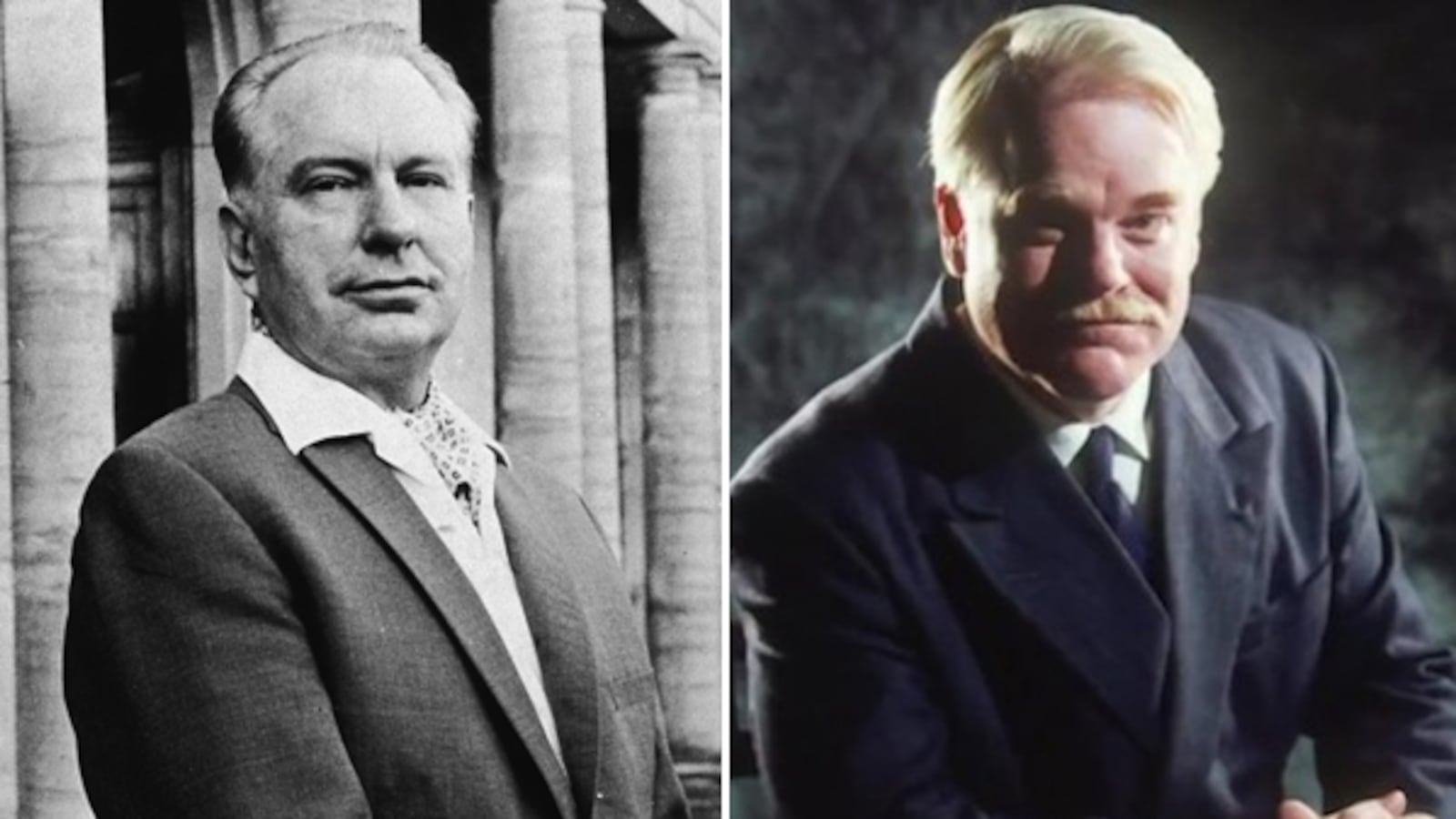
With all of the recent news regarding the Church of Scientology, it seems it was only a matter of time before someone made a movie about it. When it was first reported that Paul Thomas Anderson, director of Boogie Nights and There Will Be Blood, was filming a movie that took place during the 1950s and was about a curious figure who starts a faith-based organization that catches on in America, a lot of folks in Hollywood assumed this was about L. Ron Hubbard and the church he founded.
No one has officially stated that the movie is based on Hubbard or Scientology. But it has been reported that Anderson screened the movie for Tom Cruise, one of Scientology’s most fervent and devout followers. For a movie that is officially not about Scientology, having Cruise screen it, if he indeed did, sure would seem like a curious move.
People want to know: is the film about Scientology and Hubbard or not?
No one from Anderson’s camp will give a definitive answer. And as for Scientology, “No one in the church has seen the film, and we have no comment,” a spokesman told The Daily Beast recently.
I grew up in Scientology and worked at their international Sea Organization headquarters for 15 years. In 2005, I got out, in an escape that involved the local county authorities—I wrote about my experiences in my bestselling book, Blown For Good: Behind the Iron Curtain of Scientology.
Who better to investigate this whole Master debate than a former Scientologist? I received Scientology counseling from Tom Cruise himself. I’ve already had private investigators follow me and dig through my garbage—what else could they do?
I managed to get a recent (though not necessarily final) copy of the screenplay for The Master and I’ve spent the last few days going through it, looking for any comparisons between the character Lancaster Dodd (aka “The Master”) and L. Ron Hubbard. After reading the first 10 pages of the 121-page screenplay, I had made my decision.
I can tell you that even if Scientology comes out with a statement that this movie is NOT about L. Ron Hubbard or Scientology, this movie is the biggest fictional middle finger ever flown their way.

In my comparisons, everything I’ve noted as a comparison can be found in materials issued by the Church of Scientology or L. Ron Hubbard. You don’t have to be a nuclear physicist to figure this one out.
Of course, these comparisons are based on the screenplay. There are two trailers for The Master out right now and one of them is straight out of this screenplay and the other is not. So we will see what makes it into the film. Unless Anderson’s team rewrote the dialogue for the entire movie, most of these comparisons should be to what you will see in the film when it opens in October.
Whatever the hell this movie’s about, I can’t wait to see it. Maybe I can get onto the red carpet for the opening.
If Katie Holmes needs a date, I am pretty sure my wife might let me go this one time.
|
1. Captained a four-masted schooner in his early twenties. 2. Often referred to by his initials, L.R.H., instead of Lafayette or Ron Hubbard. 3. Owned and operated a former cattle trawler named the Apollo, where the Scientology group, the Sea Org, operates and manages Scientology operations. 4. Wrote the book Dianetics, which advocates addressing harmful past memories that affect people in their current life.
5. Claimed to have written the book The Dark Sword, Excalibur before Dianetics—after suffering crippling injuries during World War II. Excalibur was said to contain revolutionary and explosive information on the mind so powerful that Hubbard chose not to publish it. The manuscript is reportedly lost and never found. 6. Believed that prenatal experiences can cause one to behave irrationally and that erasing these can make one happier in their present lives. Wrote about these in his book Dianetics. 7. Often wrote and spoke about conspiracy theories that the American Medical Association, American Psychological Association, and Central Intelligence Agency were after him and attempting to infiltrate the Dianetics or Scientology organizations. 8. Operated a counseling center in Phoenix, where he delivered lectures, signed up members, and promoted his philosophies.
9. Developed a personality test—the Oxford Capacity Analysis, or “OCA.” It contains 200 questions. Some of the questions include:
a. Do you make thoughtless remarks or accusations which later you regret? 10. According to Hubbard, the solar system has been occupied repeatedly—and sometimes concurrently—by multiple invader forces. They were discussed in detail in a 1952 lecture, “The Role of Earth,” in which Hubbard described the conflict between the Fourth Invader Force (already occupying the solar system) and the Fifth Invader Force. 11. Hubbard often recorded his counseling sessions and lectures so that they could be played back for students during their Scientology training. 12. During the 1950s, small Scientology franchises opened up around the U.S. where students would purchase materials and lectures and study them there under supervision. 13. Through Dianetics and Scientology processing, an individual sometimes travels back in time through his memories. Sometimes a person is said to go back hundreds, thousands, or even millions of years. Hubbard referred to this as the Whole Track or Time Track. 14. Hubbard referred to Scientology as applied religious philosophy and the “religion of religions.”
15. In relation to attacks on Scientology, Hubbard wrote: “Don’t ever defend. Always attack.” 16. Hubbard was arrested on Aug. 31, 1948 and subsequently pleaded guilty to petty theft, for which he was ordered to pay a fine.
17. Hubbard refers to dissenters of Scientology as “squirrels.” 18. In 1954, Hubbard delivered a series of lectures in Phoenix and called it the “Unification Congress.” 19. Hubbard talked about how Scientology covers what has been happening for the last 75 trillion years.
20. On July 5, 1954, Hubbard delivered the lecture “The Role of Laughter in Processing” in Phoenix. 21. Hubbard purchased a large mansion in Sussex, England, and moved all management of Scientology to this location. 22. When members join the Sea Organization, they sign a billion-year contract. |
1. Sailed aboard a four-masted schooner in his early days.
2. Often referred to as MOC—“Master of Cause.”
3. Sails a former cattle trawler called the Aletheia, which he operates his spiritual group The Cause from. 4. Wrote a book called The Cause about addressing harmful past memories that affect one in their current life.
5. Writes the book The Dark Shadow, Split Saber before writing The Cause—after suffering serious injuries during World War II. Split Saber contains revolutionary and explosive information on the mind and is so powerful, out of the eight men who read it, four die and the other four disappear. Dodd never publishes it, but a single copy is said to be hidden in a secret location only Dodd is aware of. 6. Believes that prenatal experiences can cause one to behave irrationally and erasing these can make one happier. Writes about these in his book The Cause. 7. Dodd questions a man he finds stowed away on his ship and believes he was sent from the American Medical Association, American Psychological Association, or Central Intelligence Agency to gain information about him and his group. 8. Operates a counseling center in Phoenix, where he delivers lectures, signs up members, and promotes his philosophies. 9. Early on in the screenplay, Dodd convinces a stowaway on his ship to participate in some informal processing. Some of the questions include:
a. Do you make thoughtless remarks?
10. While Dodd continues to interrogate the stowaway, he asks him if he “is a member of the Ninth Battle Battalion or any other invader force, space stations or communication depots on this planet or anywhere else.”
11. Dodd records his counseling sessions as well as many of his lectures so that they could be played back for students during their training. 12. During the 1950s, small “Cause” franchises open up around the United States, where students would purchase materials and lectures and study them there under supervision.
13. Through “Cause” processing, sometimes an individual travels back in time through his memories. Sometime this can go hundreds, thousands or even millions of years ago. Dodd refers to this as the Time Hole. 14. Dodd refers to The Cause as a religious philosophy and the “religion of religions.” 15. In relation to attacks on himself and The Cause, Dodd instructs, “THE ONLY WAY TO DEFEND OURSELVES IS TO ATTACK. ATTACK. ATTACK.”
16. Dodd is arrested for wrongful withdraw of funds and operating a medical school without a license.
17. One of Dodd’s followers refers to dissenters of The Cause as “squirrels.” 18. Dodd delivers a series of lectures in Phoenix and calls it the “Unification Congress.” 19. During a lecture, Dodd explains, “This is a study of your last 83 trillion years.” 20. Dodd delivers a lecture and during this he states “…so let’s review “Laughter and Processing.” This lecture takes place in Phoenix.
21. Dodd purchases a large mansion in England and starts training students of The Cause at this location. 22. Dodd creates a new contract for members of The Cause, which entails them signing up for 3 billions years of service. |