When Mitt Romney attack-dog-of-choice John Sununu this week called Barack Obama corrupt, his campaign “stupid,” and explained that the president “has no idea how the American system functions,” it was further proof that Republicans excel at attention-getting theatrics.

If Obama wants to win, he doesn’t have to learn how to be an American (he already is one, damn it). What Obama does have to learn is how to be a queen.
I don’t pay that much attention to politics,” says San Francisco drag queen impresario VivvyAnne ForeverMORE! “But I know how to get people’s attention.”
“Democrats think the right idea will hold everyone’s attention,” says ForeverMORE! They’re wrong.
Especially when the audience isn’t entirely on board—say, straight tourists who stray into a gay bar, or swing voters—that’s when theatrics matter most. “They might not like the fact that a guy is wearing a dress and singing,” says ForeverMORE!, “but if I shoot glitter out of my head or stand on my hands, they love it.”
Sometime after President Obama took office, Republicans commandeered the political stage. And it’s not just a bunch of protesters wearing tricorner hats—pageantry has crept into Republican governance too. Recent examples include staged spectacles against Planned Parenthood and Eric Holder, culminating with the 33rd House vote to dismantle the Affordable Care Act. The fact that the Obama administration successfully passed health-care reform while it remains so hotly contested is a testament to the success of theater—by calling it “Obamacare,” the GOP even got the Democrats to read off their script.
By his own account, one of President Obama’s biggest mistakes during his first term was failing to “tell a story.” That’s an understatement. If the president is going to win reelection, he needs a grand, dramatic production.
He had one in 2008. Candidate Obama’s story played out like a made-for-television miniseries. The guy with the big ears and the funny name burst onto the political stage with a wide-eyed dream of hope and change. But also, around the country, millions of volunteers and donors felt like they were intimately part of the show—because the campaign let them be. Including artists.
According to Yosi Sergant, a cultural strategist who helped connect artists and the Obama campaign in 2008, “The Obama campaign didn’t make the famous will.i.am video or the Hope poster. We did that. The campaign just followed our cues.”
In a sense, the campaign’s cultural receptivity fit well with its narrative—the outsider candidate driven by free-flowing grassroots momentum. The willingness to experiment culturally in 2008 was also pragmatic; the insurgent campaign was bucking the Democratic establishment and needed all the help it could get. Ultimately, the cultural theatrics of the Obama campaign were so overwhelming, Republicans could only try and attack Obama for being too popular and attaining celebrity status, an attack that said as much about the jealousy of Republicans as the appeal of Obama.
“I’m not sure how to describe what changed between then and now,” said playwright and director Alex Timbers, “but something changed.”
What happened was Obama took office and demobilized his activist base—shunting it off into a Democratic Party apparatus that last plugged into pop culture when Fleetwood Mac was still big. The implicit message to the base, including cultural activists? “Thanks for getting us elected. We’ll take over the governing from here.”
“People felt there wasn’t a role for them to help continue the process of change they’d begun,” says Sergant.
Sure, it was a big deal that the Democrats had finally found a charismatic candidate. But in the long-run, it was perhaps a bigger deal that Democrats had momentarily learned to open themselves up to the activist wing of their party and embrace the messy, creative, democratic process of culture making. Today, many of the cultural activists heavily involved in 2008 aren’t even getting phone calls from the campaign.
“The meritocratic, elite wing of the Democratic Party doesn’t believe it needs public relations and propaganda,” says Stephen Duncombe, author of Dream: Re-Imagining Progressive Politics in an Age of Fantasy.
The right gets it, says liberal comedian Elon James White. He describes going to a conservative conference a while back. “You walk in and there’s banners and music and flags waving about conservative awesomeness,” says James. “Then you go to the progressive conference and there’s just some potted plants and facts.” Democrats tend to believe that the facts will set them free, and that spinning them is reductionist.
Or worse, deceptive. Republicans “pull the wool over people’s eyes,” says progressive comedian Lizz Winstead, author of Lizz Free or Die. But do Democrats just poo-poo political spectacle because of principle, or because—Obama 2008 aside—they’re so lousy at it?
Either way, says Winstead, the fact is Democrats just talk to themselves.
This hasn’t always been the case. “Progressives have historically been great theater folks, at least the activists have been,” says Duncombe. And, at times, so were Democrats. Knowing he needed to sell the New Deal to the American people, Franklin Roosevelt created the dramatic fireside chats. The chats were written by playwright Robert Sherwood.
But while the Republicans are virtually a 24/7, three-ring circus of demands for birth certificates and melodramatic phrases like “death tax” and “Obamacare,” the Democrats nowadays are just not known for their panache. In fact, they often push it away.
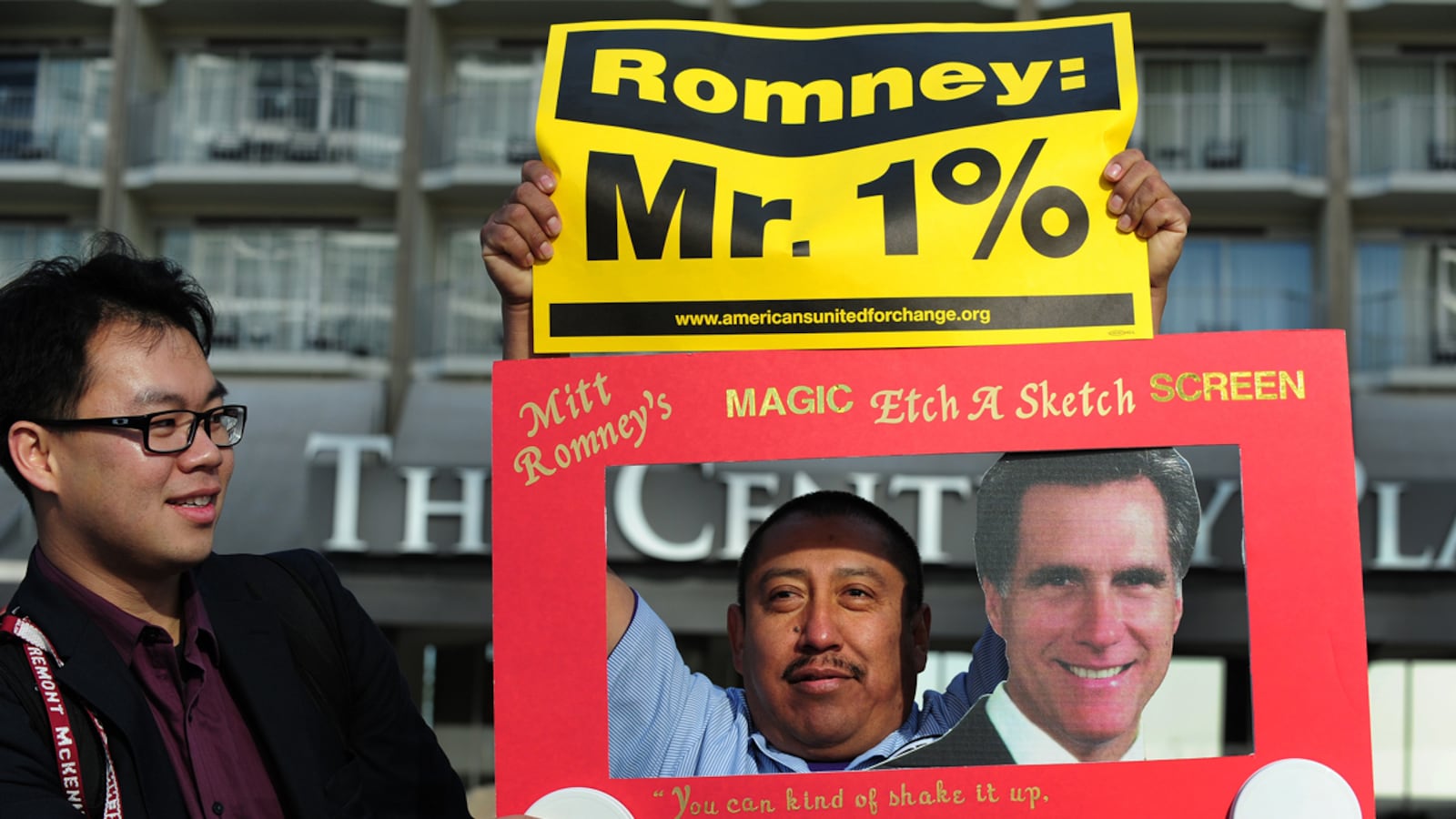
Weeks after the grassroots Iowa Citizens for Community Improvement barraged Mitt Romney with questions at the Iowa State Fair, infamously resulting in Romney saying that “corporations are people, my friend,” the Iowa state Democratic Party denounced the group for its “outlandish behavior.” While Republicans embrace their Tea Party base, Democrats have an odd habit of pushing creative energy away. Part of what got President Obama elected in the first place was that his campaign bucked that disastrous trend.
So what should the campaign do now?
“Open up to the freaks on the margins,” Duncombe, half tongue-in-cheek, advises the Democrats. “Give them a clear message to work with and let them run with it.” Make the campaign an open-source creative hub again—not just a top-down, insider machine.
Democrats are rightly worried that this time around, their base is disengaged. But what engaged that base in 2008 wasn’t just the candidate, it was also the culture around him.
Plus maybe that cultural activism will help re-cast the president in a more populist, everyman light. Broadway director and playwright Timbers says the campaign shouldn’t be about flashy LED screens, Greek columns, and slick presentations but something more authentic. And authentic is hard to script from Washington.
When VivvyAnne ForeverMORE! wants to get an audience’s attention, she’ll let her wig fall off. It creates that unexpected moment, both dramatic and deeply human. Maybe it’s time for Obama to do the same, to take off the artifice of Washington, reconnect on a human level, and let the creative grassroots community once again play a role in scripting the rest.