
After the grisly massacre in Colorado no one will attend weekend showings of The Dark Knight Rises with expectations of a rollicking, uplifting, feel-good night at the movies. But even before its association with horrifying images of real-life mass murder, this final installment in the current Batman series suffered from serious deficiencies in terms of its fun factor. It’s wrong to suggest that the movie provoked the killings in its midnight Aurora premiere, but those crimes do, in a sense, expose the nihilistic darkness at the heart of the film that’s become dominant in far too much of today’s pop culture.
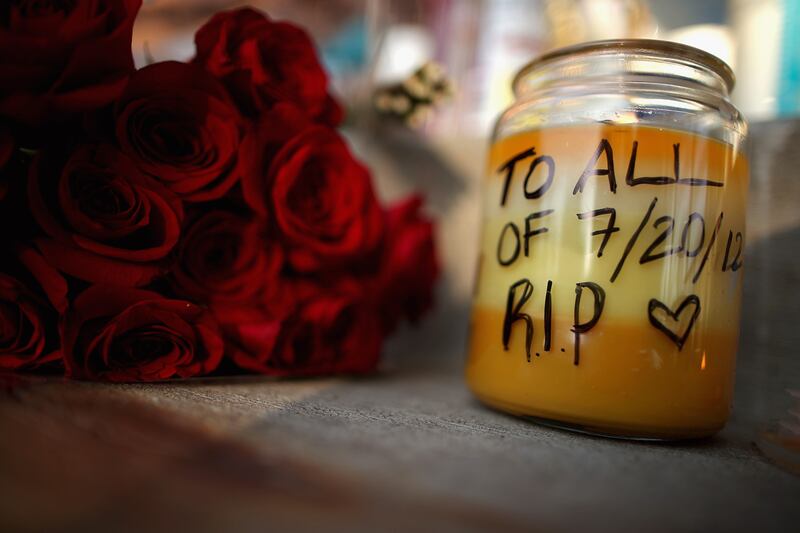
Whenever Americans find themselves transfixed by stories of senseless slaughter, there’s an irresistible impulse to seek causes and cures. We’re supposed to probe some chain of cruelty and complaint that impelled the alleged lone gunman (and it’s almost always a lone gunman) to undertake his deadly rampage. Custom also calls for earnest pronouncements by every preening pundit on social and governmental changes that might prevent such carnage in the future.
Concerning causes, we usually hear about the devastating impact of adolescent bullying, the influence of violent media imagery, the breakdown of the family, or, more generally, the toxic nature of our “sick society.” When it comes to cures, the most common recommendations involve tighter regulation of guns, or new restrictions on brutal entertainment, or more emphasis on character building in school, or more antibullying protections, or mental-health programs, or enhanced economic mobility, or smaller class size, or more spirituality in public life, or some idealized combination of all of the above.
Of course, none of these causes or cures seems to fit comfortably with what we know of the alleged shooter. Like the alleged killer's Colorado counterparts who perpetrated the Columbine massacre in 1999, the evidence suggests that the suspect was a bully rather than the bullied: with a reported height of 6 feet 3, he no doubt would have cut a hugely intimidating figure on the night of his alleged crime, dressed in black ninja garb with body armor and gas mask. Moreover, preliminary information hardly suggests the suspect is a troubled loser on the margins of society; instead, James Holmes compiled an impressive record of academic achievement (in the challenging field of neuroscience) with no reported record of prior arrests or serious psychiatric problems.
As for the recommended reforms that might prevent such nightmarish scenarios, the inevitable and simplistic case for gun control remains illogical at best, feeble at worst. For instance, Norway imposes fierce regulation on all private ownership of firearms, requiring detailed rules for use and even storage as well as a rigorous and restrictive licensing process. None of this prevented the monstrous Anders Behring Breivik from butchering 77 of his countrymen in a 2011 killing spree that lasted far longer and took a much heavier toll in human life than the movie massacre in Colorado.
All civilized societies enforce unequivocal laws against murder, let alone wanton slaughter, so it’s difficult to argue that a determined killer planning to break such clear-cut rules will somehow stop short when it comes to violating far more complicated and obscure strictures on firearms ownership. The stories from Aurora also concentrated on the tragic case of one 24 year-old victim, Jennifer Ghawi, who previously survived a bloody gun massacre at a shopping center in Toronto only to succumb to this latest outrage in the Rocky Mountains. Advocates for gun control (filmmaker Michael Moore particularly prominent among them) regularly lift up Canada as an enlightened example of tough, common-sense firearms regulation, which may in fact reduce, but hardly eliminates, gun violence.
Meanwhile, the incidence of homicidal violence in the United States has dramatically declined over the last 30 years, even as gun ownership has soared in every segment of society. According the Bureau of Justice Statistics, the overall murder rate peaked in 1980 at 10.7 per 100,000 people and then fell by more than half to 4.8 in 2010—a much more substantial drop in the murder rate than in tightly gun-controlled Canada, by the way.
But America’s ongoing reduction in violent crime also undermines a favorite talking point of many conservatives, who try to blame media violence for brutality on the streets. Anyone who believes that the reduction in the murder rate in the United States since 1980 is either the result or the cause of a corresponding reduction of violent imagery in movies, music, or TV has paid no attention to long-term trends in popular culture. Movies that once qualified as R- or even X-rated now easily slide into the catchall PG-13 parental-guidance designation for any child above the age of 12—as did the deeply disturbing and gratuitously sadistic The Dark Knight Rises.
Director Christopher Nolan seemed deeply determined to channel his inner Mel Gibson and to create a comic-book classic that might be subtitled “The Passion of the Batman.” The Caped Crusader suffers broken bones, bloody beatings, and exquisite tortures, all for the sins of citizens who mostly reject and despise him in a two-hour-and-45-minute ordeal. The deafening soundtrack, featuring a relentless and brutalist film score by the redoubtable Hans Zimmer, may count as the most earsplitting and headache-inducing sonic assault in major-motion-picture history. As my fellow film critic Joe Morgenstern sagely observed in The Wall Street Journal, the film “makes you feel thoroughly miserable about life. It’s spectacular, to be sure, but also remarkable for its all-encompassing gloom. No movie has ever administered more punishment, to its hero or its audience, in the name of mainstream entertainment.”
But worried social critics should avoid the instinct to interpret the popular embrace of such a cinematic assault as some powerful evidence of our sick society, just as the senseless killings in Colorado hardly offer proof of national disease or decline. On Aug. 1, 1966, an engineering student and former Marine named Charles Whitman murdered 16 strangers and wounded 32 others in an inexplicable rampage at the University of Texas, but we tend to look back on that era of the Great Society with nostalgia and affection as a time of hopeful innocence.
My first conscious exposure to the “sick society” mantra came two years later, after the Robert Kennedy assassination (which I personally witnessed), which, combined with the prior killings of JFK and MLK, led many prominent observers to suggest a deep disease afflicting the nation’s soul. Even at the time, that made little sense to me: as a buff on presidential assassinations, I knew that President McKinley in 1901 and President Garfield in 1881 had been shot by demented loners who bore a strong family resemblance to Lee Harvey Oswald, James Earl Ray, and Sirhan Sirhan, but few historians view that confident earlier era of economic growth and rising world power as a time of deep social illness.
A proper perspective doesn’t minimize the horror of the Colorado crimes, but should dismiss the obnoxious demands for coming up with causes and cures. There’s no cause for the killer’s unspeakable acts and no conclusive cure for senseless violence in society. Insanity and evil represent eternal and inevitable elements of the human condition. The killing doesn’t carry a politically correct point, or a particularly timely lesson, or some deeper meaning. It is, in the worst possible sense, meaningless and all the more horrible for that. The senselessness of the suffering should help us to avoid our vague, mostly groundless sense of collective guilt, but it won’t make that suffering—either on screen or in the streets—any more endurable.