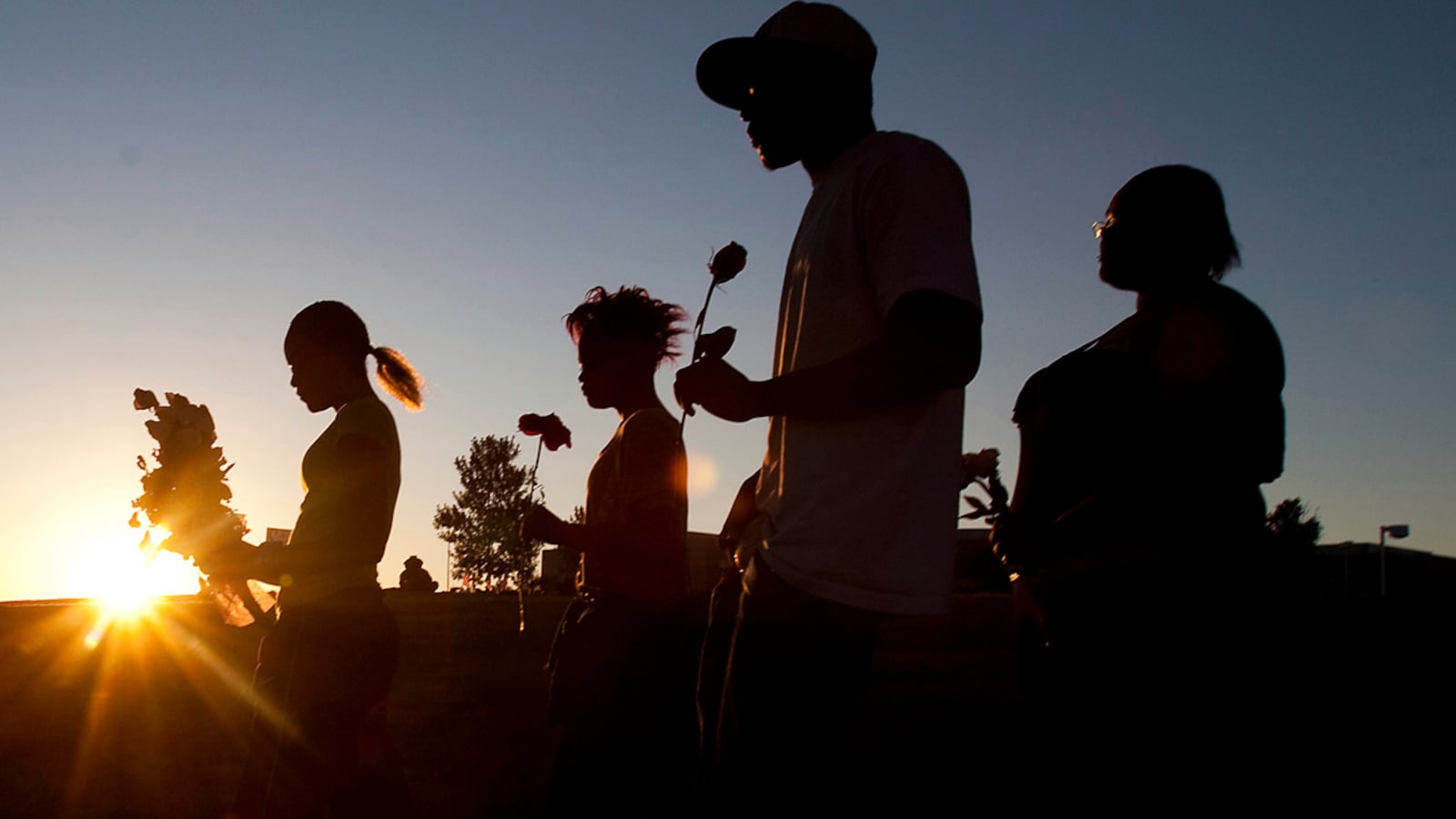
Friday’s movie-theater shooting in Aurora, Colo., which left at least 12 people dead, has ignited the same conversation as those that have followed other gun-related tragedies: what can be done to prevent this from happening again? And the debates that have ensued, on issues ranging from gun control to midnight-movie screenings, will only ramp up as more time passes.

It’s probably a good thing that these discussions are taking place. Yet psychologists and other researchers who study human decision making see some potential pitfalls in making new laws—or taking any major action—in the immediate aftermath of a tragedy.
Ellen Peters, a psychologist at Ohio State University, explained that when we’re thrust into moments of great emotional arousal, many of the tools we would otherwise use to make informed, rational decisions become less effective. For example, experiments by psychology researchers Christopher K. Hsee and Yuval Rottenstreich have shown that the more emotional an environment, the less likely we are to take probability into account. A more recent paper by Peters and some of her colleagues (PDF) showed that a similar effect takes hold when it comes to time: we overemphasize the feelings we’re experiencing in the immediate moment and don’t take into account what could happen a year or two from now.
These effects matter because, as Peters explained, it’s more difficult to make good decisions when we’re only relying on emotion, when we don’t have the potentially tempering effects of more cool-headed reasoning to back up our next move. However horrific the Batman shooting was, surely the frequency with which such incidents occur should color our judgment over what to do about them.
So while emotions greatly help us take decisive action when it’s necessary (you run from a bear not because of a careful, rigorous calculation that the bear does indeed intend to eat you but because you are terrified beyond words), “there’s always that dark…side to them,” said Peters.
Danny Oppenheimer, a psychology professor at UCLA and the author of Democracy Despite Itself: Why a System That Shouldn’t Work at All Works So Well, explained that the uncertainty that a tragedy like the Aurora shootings brings with it can go a long way toward explaining our desire to take immediate action.
“If we look at the psychological research on stress, the two things that can stress people out and cause all sorts of negative health effects…are lack of control and lack of predictability,” he said. “When there’s an event like this, it hits home because we can’t predict it’s happening. It feels very scary.”
So there’s a natural urge to try to regain control and to want to take action immediately. Psychologically, if the world tosses us from our usual nests of relative control and predictability, we feel an overwhelming urge to find a way to climb back into them.
The best tactic, said Oppenheimer, is to allow the event to sink in, to let things return to relative normalcy before making any major decisions. “If this had happened six months ago, how would we have taken it into account?” he said. “Right now it’s fresh, the wound is raw, and it’s very easy to want to go with your gut and make a knee-jerk reaction to it. And the real way we should be processing the information is in a calmer, more rational way.”
If we don’t, we risk coming up short with whatever policies we implement, said Brian Zikmund-Fisher, a researcher at the University of Michigan in Ann Arbor who studies individual public-health decisions from the lens of psychology and behavioral economics. He said that after a tragedy, the horrific details are still so fresh in our minds that our solutions aren’t likely to be effective.
“We can imagine other people doing exactly the same thing,” he said, “so we…think,—‘Oh, movie theaters must not be safe enough. Or, ‘He used a handgun, so we should look at handguns.’”
But those details come to mind, he adds, because they’re recent, not necessarily because they reflect the biggest risk factors for another shooting. A prime example, according to Zikmund-Fisher: aviation security. “We always seem to be changing our screening regiments to [address] the last problem,” he said. That may make us feel safer, but that’s not really the goal. “Our goal,” he said, “is to prevent all different types of future terrorist attacks or assaults.”
None of this is to say that there is anything inherently bad about taking action. Crises can also push us toward good policy, explained Baruch Fischhoff, who studies decision making at Carnegie Mellon University. “Crises often focus attention on issues that are understood but neglected among all the other issues competing for attention,” he wrote in an email to The Daily Beast. “If politicians have integrity, they use the moment to serve the public interest—which would include taking advantage of scientific knowledge about the topic. If they lack integrity, then they use the confusion to pursue their parochial agendas. Let’s hope that we get the former response now.”
Oppenheimer agreed, saying our tendency to want to act right after a tragedy is not necessary bad. But, he added, “We have to be careful…to pay attention to more than just the emotional response we’re having.”