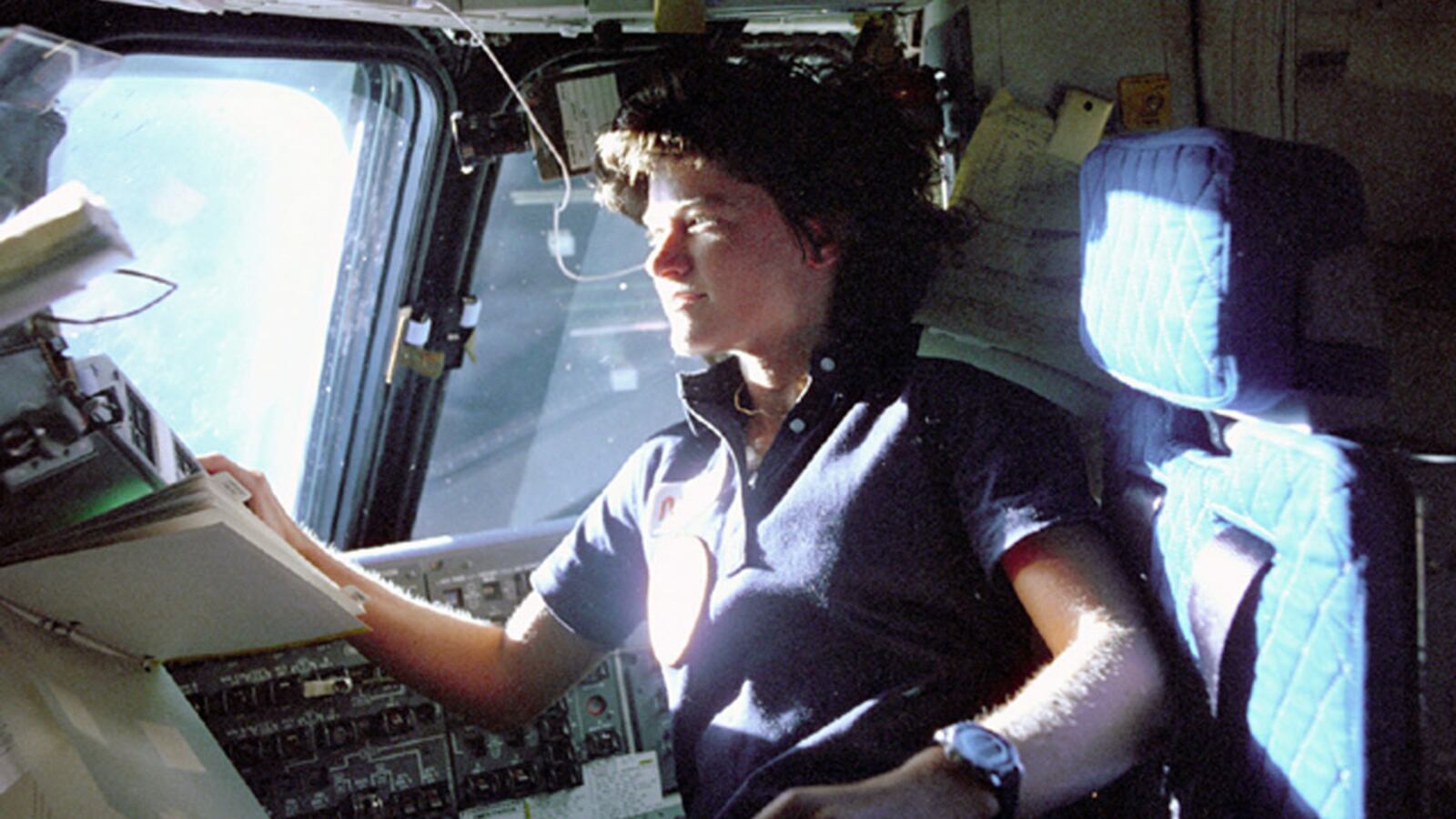
On June 19, 1983, just after 7:30 on a brilliant Florida morning, Sally Ride and four crewmates roared into space on a white-hot surge of rocket power. Officially, it was STS-7, the seventh trip for the nation’s two-year-old space-shuttle system. But for most folks watching that day, the mission of the shuttle Challenger represented something far more revolutionary: the first flight of an American woman into space.
Sally carried the dreams of her earthbound sisters with grace and good humor. As the shuttle shot skyward with a force far beyond that of any amusement-park ride, the trim, 32-year-old Californian immediately connected with Americans everywhere by radioing her counterpart back in Houston: “Have you ever been to Disneyland? This is definitely an E ticket”—in other words, the hottest ride of all.
I couldn’t help thinking that NASA had finally gotten it right.
As the anchor of ABC News' space coverage, I'd gotten to know Sally well. An astrophysicist with a poetic sensibility, she hooked me in our first interview with her direct manner and determination. “Why do you want to go into space?” I asked. “I don’t know,” she answered. “I’ve discovered that half the people would love to go into space and there’s no need to explain it to them. The other half can’t understand and I couldn’t explain it to them. If someone doesn’t know why, I can’t explain it.”
She also acknowledged unequivocally that the feminist movement had made her selection possible; that NASA, with its 20-year heritage of white male fighter pilots with The Right Stuff was finally doing the right thing. We became friends immediately, bonding over cold shrimp and funny stories at a variety of local dives. And the home she shared with her then-husband, astronaut Steve Hawley, was my beer-and-pizza hangout during other shuttle missions. We knew each other so well, that on the day before her big flight—in those early shuttle days, when astronauts were traditionally off-limits to the press and quarantined from human contamination—she telephoned me while I was working on that night's script from the ABC workspace.

“Hi there!” came a familiar, cheery voice. “In five minutes, why don’t you walk outside your trailer and look down towards the parking lot.”
I put down the phone and complied. There was Sally, about 50 yards away, wearing shorts and a T-shirt and waving to me from a car parked off the main drive. I wasn’t allowed to get closer—and she knew I wouldn’t try—but it was reassuring to see her in such good spirits. And I could report exclusively that night on the air that the woman most in demand at the Kennedy Space Center at that moment was doing just fine.
And pushing the envelope, as she always did, with a playful, anti-authoritarian attitude—up to a point. Sally Ride broke every rule she could, which made her great fun as a friend. But make no mistake: she also was a dedicated team player who could line up behind her commander and take orders like a trooper.
All of which made her a hero and a role model for us all—and for all ages.
Eager to share the excitement of her first launch, I’d invited my mother and sister to the Kennedy Space Center. When we finally hooked up after the day’s news had settled down, they were glowing.
“Fabulous,” said my sister excitedly, having seen such things only on television up to then.
My mother, about to turn 80, put it all in perspective: “I’ve seen the horse and buggy, I’ve seen the car and the train and the airplane,” she said. “And now this. Perfect.”
She also sent Sally some home-made brownies.
Sally’s own mother was equally elated, but slightly more frazzled. When reporters asked for her advice to future space travelers, Joyce Ride responded with understandable angst, “Think about your mother!” A few minutes later, she regained her composure and suggested this coda to the whirlwind day: “How about, God bless Gloria Steinem?”
The star of the show, the very private but cool astronaut, relished every single second. She had trained 24/7 to perfect her main task as a mission specialist: working the robot arm carried in the shuttle’s payload bay. All the while fielding interview after interview from a gushing American public. Her flight, she told me, was “more evidence that women can do anything.” “Do you,” I asked, “feel any special pressure as America’s first female astronaut?” “I do feel under some pressure,” she answered, “not to mess up.”
She did not. On orbit, she helped deploy two commercial satellites and tested the arm on another. She carried banners from her prep school (Westlake) and her college (Stanford). And a turkey sandwich on whole wheat. And yes, that was the female symbol on the official crew patch.
For a time, Sally was the most famous woman in the world, her face plastered on magazine covers, her every exploit recorded glowingly. Was Sally Ride shoeless? Get the picture. Was she talking? Get the sound bite. The London Sunday Mirror summed her up as “Super Sally.” Little girls in droves decided then and there to become astronauts. And when the shuttle landed, her parents pumped their fists into the air and held each other tight. “Hot dog!” Joyce Ride exclaimed, tossing her hat in the air. “Do Presbyterians light candles? I’ll go light a candle.”
In technological terms, NASA was pushing ahead toward the 21st century. But in human terms, it had finally entered the 20th. And it could not have picked a better pioneer.
Sally wore her celebrity well, graciously signing every piece of paper or cloth pushed in front of her, and saving her groans of annoyance for long after the crowds had left. She was especially generous with children, so eager to infect them with her love of space travel, she wrote several children’s books about the experience. She lectured, she explained, she cut ribbons, she went back to training. And after she’d flown again—by which time the concept of women in space was feeling quite natural, thank you—and was prepared to go yet again, the unthinkable happened.
In 1986 Challenger—the shuttle she’d flown into space—exploded on liftoff, killing the entire crew. Sally was quickly enlisted onto the investigative commission, the one that concluded NASA had been guilty of severe mismanagement and flawed decision-making. Not to mention faulty O-rings. In the midst of the disclosures, she agreed to an exclusive interview—not on the investigation itself, but on the impact of the revelations. Early one morning, she slipped into my motel at Cocoa Beach, near the Kennedy Space Center in Florida, sat down, took off her shoes, and said how “disturbed” she was about what they’d learned.
“Knowing what you know now,” I asked, “would you fly again?”
“I am not ready to fly again now,” she said. “I think there are very few astronauts who are ready to fly again now.”
For the respected agency that had put men on the moon and inspired a generation of Americans, it was a stunning setback. NASA and the shuttle would recover, but it would take years. Sally, however, had another important mission.
She retired from NASA and started her own company, a for-profit way to get youngsters—mostly girls—interested in science and math. She trekked across the country holding Sally Ride Science Fairs and talking about her adventures while little mouths gaped in awe. But it wasn’t about Sally—it was about them, about passing the torch and lighting the fires to make earth a better place. I don’t know how many children—especially female children—are signing up for physics classes today because Sally Ride said they should. And could. But I’m sure it’s substantial.
Sally used to have a running joke with me, and it had to do with the speeches she gave around the world—first for NASA, then for her own business. She’d tell the audience about her flights, and she’d show some slides—gorgeous, eye-popping pictures taken from, or on board, the shuttle. She’d show the one with her long curly hair floating in zero gravity; the one with the robot arm shaped like a number 7 for that seventh shuttle mission; the one showing the sun illuminating the earth as she clicked the camera from on high. They were magnificent, but, um, I’d seen them a few times already. And had no desire to sit through yet another showing. Still, every time we made a date to get together, she’d ask innocently, “Oh, have you seen my slides?”
I’m thinking that she’s got a whole new audience for those slides right now. And that it wouldn’t hurt the rest of us to watch them again. It was a great ride.