There are connections to be drawn between the tragic events at an Aurora, Colo., movie theater last week, and the movie those people had come to see, Christopher Nolan’s The Dark Knight Rises. But they’re not the obvious ones.
Yes, we can find parallels to last Friday’s news if we search the 73-year history of Batman: there have been a lot of Batman stories in that time, across TV, movies, and comic books, and some of them may seem to offer eerie coincidences. Batman stories often involve violence, and sometimes they involve movie theaters, too. But their main character explicitly despises firearms—precisely because his parents were murdered after a visit to the cinema—and has vowed never to kill. Any direct comparisons between this real-life tragedy and fiction are at best pointless, and at worst tasteless.
Instead, if you take a closer look, Nolan’s The Dark Knight Rises can offer a nuanced perspective on contemporary debates around gun control and the way media can influence individuals. Like his earlier Batman movies, it explores the gray area between opposing positions, and shows us how easily those seeming opposites can become blurred or even switch sides.
We’ve seen these themes before, in Nolan’s previous installments. Batman’s counterterror measures, in The Dark Knight, start to look a lot like Joker’s terrorism, and his use of fear as a weapon in Batman Begins is no different from Scarecrow’s modus operandi. Who is the real hero and the real enemy here? The Dark Knight Rises plays repeatedly on this motif of switching sides, with cops becoming an underground army, prisoners becoming hostage-takers, billionaire Bruce Wayne becoming a bum, waitress Selina Kyle rising through society ranks, and beat cop John Blake leaving the police force. The movie shows explosives ripping up a football field and revealing the city’s industrial underbelly; the distinction between recreation and work, surface and structure, Nolan reminds us, can be broken down in seconds. Even Bane, the film’s villain, boasts that despair is nothing without its opposite—a glimmer of hope.
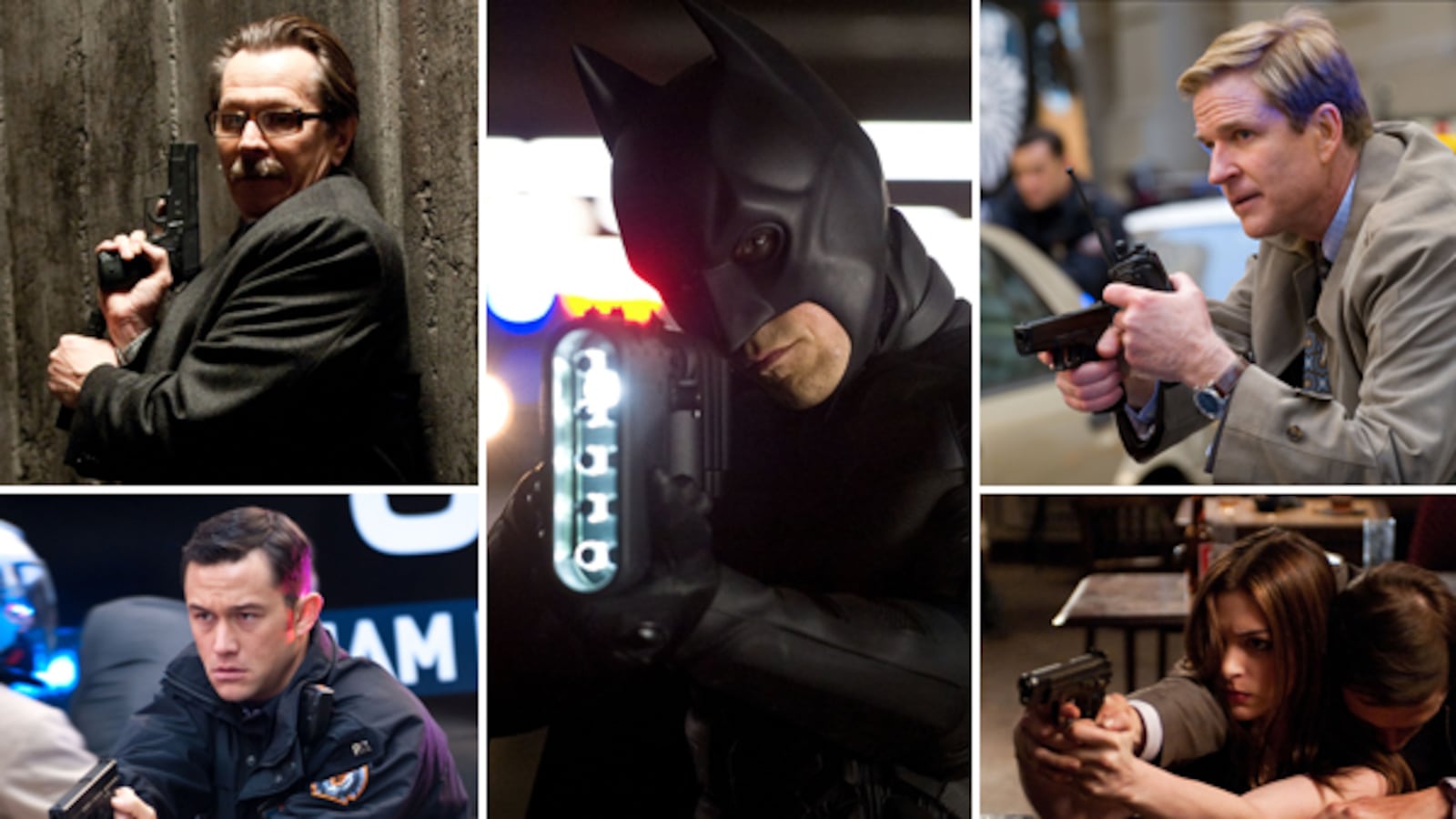
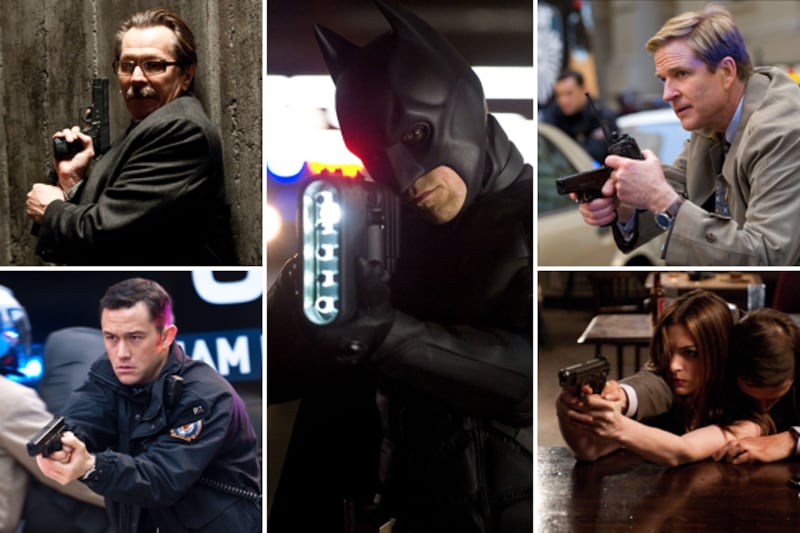
But one of the most relevant points for the debates happening around the shootings is the movie’s explicit statement that any tool can easily become a weapon in the wrong hands: a source of clean power can become a deadly bomb, and a firearm can take lives or save them. Bruce Wayne develops a military armory—to protect the city, not to destroy it—that inevitably falls into Bane’s possession, and is used against him.
While Batman himself is firmly anti-gun, and John Blake (Joseph Gordon-Levitt) tosses his service weapon aside after shooting two criminals, cynical Selina Kyle (Anne Hathaway) disobeys Batman’s “no guns” order at the movie’s conclusion and, in killing one man, offers millions of citizens a chance to live. Rather than pushing a single political message, The Dark Knight Rises offers a variety of positions, and shows us that people’s views can shift, and their values can alter, as circumstances change.
And if a clean fuel source can be misused as a bomb, if a firearm can end the world or save the day, and any tool can be transformed into a weapon, shouldn’t we also consider that a movie—particularly a complex, challenging story like Nolan’s—can carry more than one meaning?
We know that holy books, teaching the value of life and love, can be corrupted into justifications for hate and murder, and that preachers of peace can be cut down by an assassin’s bullet. Our popular novels and rock songs can contain “hidden messages” for someone determined to find them. And our comic books and movies, too, can uplift and enrich, or shape a disturbed imagination. The story of Batman, the orphan who pledged to save his city, can be twisted in the mind of an unhappy individual, or it can bring people together in celebration. We saw both, in the Aurora shootings: a fan gathering around a favorite story, which was abused and led to tragedy.
The Dark Knight Trilogy resonates because it captures some of our society’s underlying contradictions. Are we justified in fighting fire with fire? Is it ethical to step outside the law for the greater good, or to infringe civil liberties as a means to an end? Nolan offers no easy answers. But he reminds us, in his exploration of the blurred boundaries between opposites, both that any message—including a movie’s—can be read in different ways, and to ensure that our weapons don’t fall into the wrong hands.