
Personhood USA, the nonprofit group that seeks to outlaw abortion by defining human embryos as people with legal rights, said Monday that it has filed a petition with the U.S. Supreme Court to consider an appeal of an Oklahoma ruling against a ballot initiative in that state.
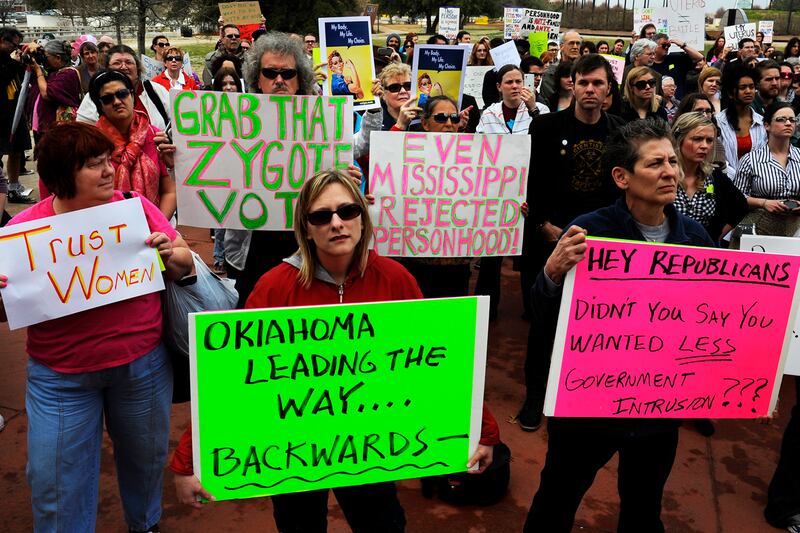
“It’s a milestone for us,” said Keith Mason, the president and founder of Personhood USA. “We’re fighting for First Amendment rights. Oklahoma is a very pro-life state, and people are being prevented from voting on personhood.”
This past April, the Oklahoma Supreme Court ruled that an initiative to get a personhood amendment on the state ballot was unconstitutional, as the proposed legislation would outlaw abortion, which the high court has recognized as a constitutional right. The Center for Reproductive Rights had filed the suit against the initiative, along with the American Civil Liberties Union and other groups.
Personhood activists say the Oklahoma ruling violated people’s right to petition for state legislation. Steve Crampton, general counsel for Liberty Counsel, which represents an offshoot of Personhood USA called Personhood Oklahoma, said in a teleconference call Monday morning, “It’s about the fundamental rights of the people of a state to decide for themselves what the law in their state should be.” The Oklahoma Supreme Court “shut down the entire debate,” he says, by blocking the ballot initiative at the signature-collecting stage.
The Center for Reproductive Rights issued its own statement Monday, with president Nancy Northup saying: “The proponents of this measure have made explicit the ultimate objective of the anti-reproductive rights movement: to strip all Americans of their constitutional right to make their own decisions about whether and when to have children. The scope of the fundamental rights and longstanding court precedents under attack by the opponents of reproductive rights is stunning. They’re coming after birth control. They would make access to abortion illegal in all circumstances. They would even threaten the ability of couples with fertility problems to seek medical assistance in starting a family.”
Mason has disputed claims that personhood would ban birth control, saying he does “not oppose contraceptives,” but rather methods that “kill a living human being.” In other words, he is opposed to methods that prevent an egg from implanting in the womb after fertilization, as he believes life begins at fertilization. The morning-after pill and the copper IUD can prohibit implantation, according to the FDA, although the scientific research behind this has been contested. As for IVF, Mason has said he doesn’t believe it should be banned, but “reformed” so that embryos aren’t discarded.
Personhood USA, launched four years ago in Colorado, has been fighting, state by state, to pass new legislation, working with local activists to push for bills and ballot initiatives stating that life begins at the moment egg meets sperm. The group got personhood on the state ballot in Colorado in 2008, getting 27 percent of the vote, and again in 2010, getting 30 percent of the vote. Last year, the group got on the ballot in Mississippi, getting 42 percent of the vote. The group is now collecting signatures for a fall ballot initiative in Colorado; ballot initiatives for the fall in Ohio and Montana didn’t collect enough signatures by deadline to proceed.
While personhood initiatives have been springing up since the 1970s, earlier efforts generally suffered from a lack of support and organization. Mason has reignited the personhood movement in recent years by organizing and galvanizing supporters. He says his group now has 80,000 nationwide volunteers who have helped collect more than a million signatures in ballot initiatives. “We won’t go down without a fight,” he says. “We will continue to fight, regardless of the outcome of this case."
The personhood movement faces some hurdles within the pro-life community itself. While some groups support defining embryos as legal people, others prefer a more incremental approach to ending abortion—chipping away with gradual restrictions. That approach has proved quite successful. Last year, states enacted a record 135 abortion restrictions, such as requiring women to view ultrasounds before abortion and banning abortion at the 20th week after conception, according to the Guttmacher Institute.
Mason's efforts have also rallied his opponents, such as Planned Parenthood and the ACLU. Those groups have been fighting the movement around the country, filing lawsuits against ballot initiatives and launching extensive campaigns. When the personhood initiative made it to the state ballot in Mississippi last year, a coalition of pro-choice groups raised $1.5 million to sway voters, knocking on 20,000 doors and making more than 400,000 phone calls, according to Planned Parenthood. It worked. Personhood, which had looked set to win in polling about a week ahead of the vote, lost.