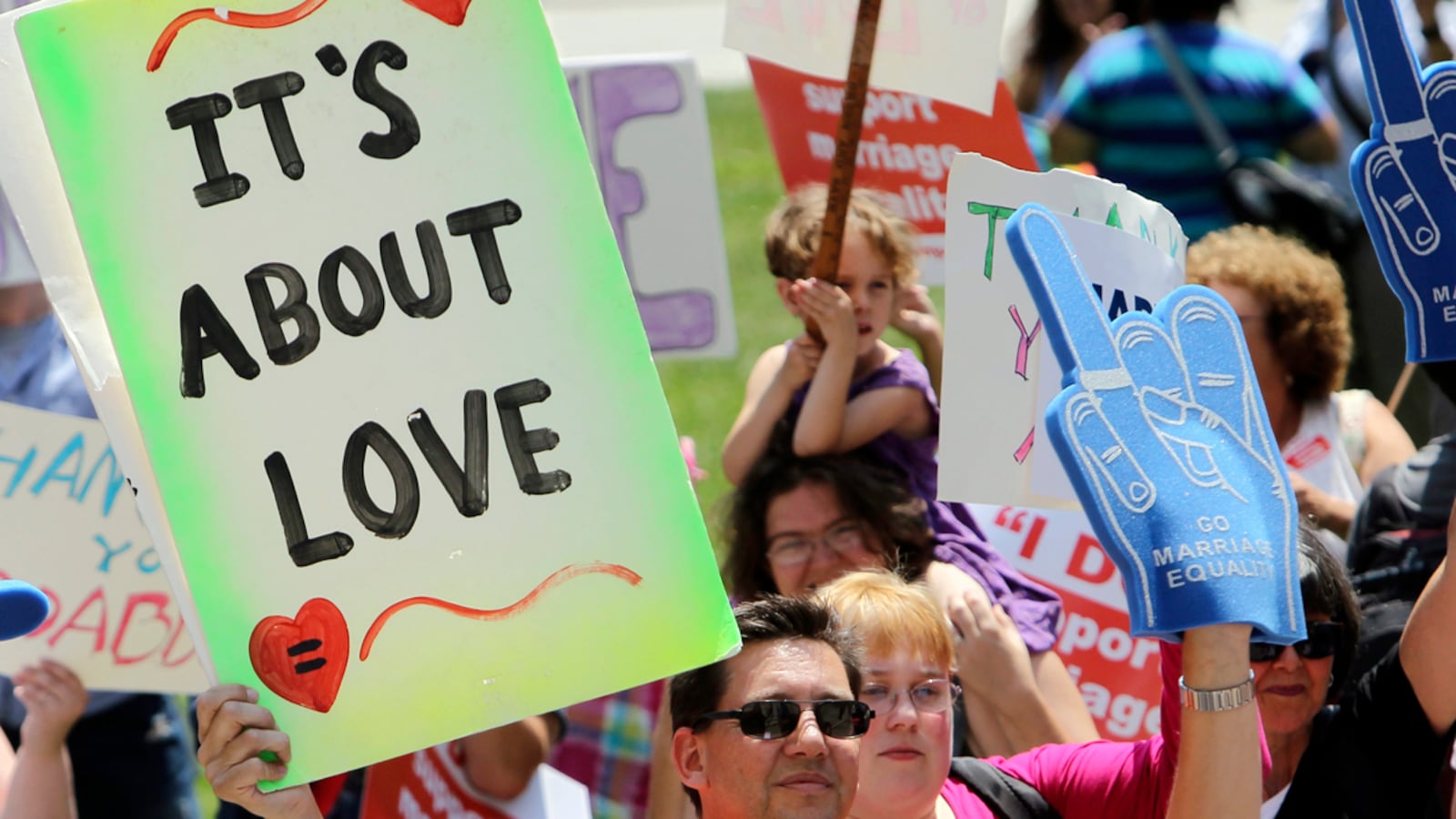
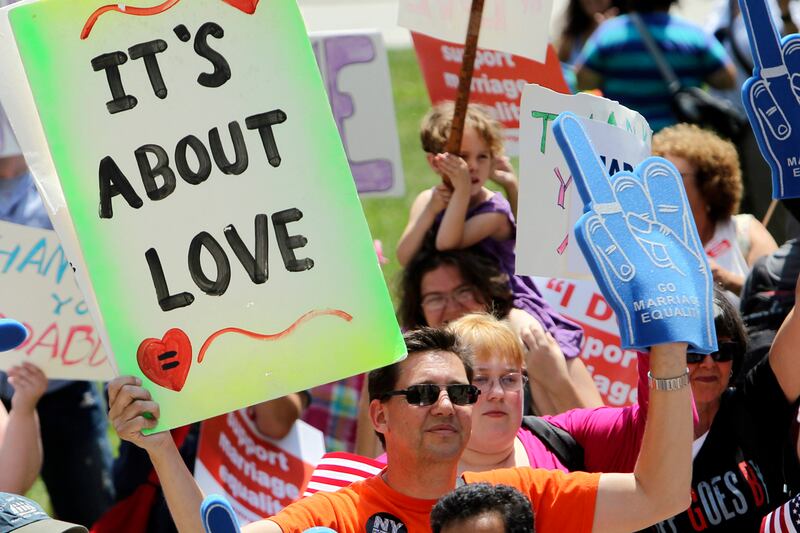
Sometimes history is made without fanfare or controversy. That’s what happened in Minneapolis on Sunday, when all 15 members of the Democratic platform drafting committee voiced their assent to the party’s first-ever plank endorsing same-sex marriage.
“It wasn’t even an issue,” says a source in the room who described the way it was presented to the group. “‘Here’s our suggested language vetted with friends and allies on the outside, and with Congressman Frank—next topic.’ I can’t even remember what came before or after. It was a no-brainer.”
Massachusetts Rep. Barney Frank, newly married to his partner, spoke in passionate support of the proposed language, and that was it. The die had been cast in the spring, when President Obama said his views had evolved, and he endorsed gay marriage. There was debate about the wisdom of the president’s announcement, and its timing, but there was also a sense of inevitability that the Democratic Party, along with a growing portion of the country, was on its way to embracing same-sex marriage. “Attitudes on this issue are changing faster than on any other issue in the history of public-opinion polling,” says Democratic pollster Mark Mellman.
Democrats seemed surprised that anyone would think they had committed news with this proposed plank. “A second-term platform at its best is an expression of the vision and aspirations of the president, and a recap of successes that came before,” says Andy Grossman, who is overseeing the process as national platform director. The drafters who convened in Minneapolis heard testimony from dozens of interest groups on the full range of issues that Democrats campaign on, from preserving Medicare and Social Security to social justice and labor issues, distilling what they heard into the words that will appear in the platform.
They make their recommendations to the full platform committee, which meets in Detroit on Aug. 10 and 11. No bombshells are expected—and from there, the platform goes to the convention delegates in Charlotte, N.C., for final approval at the convention the first week in September. Of course, the delegates could disagree and mount an effort behind alternative planks, but there hasn’t been a minority report since 1992, and it’s unlikely there will be one this time, not with Democrats focused on creating the smoothest convention possible for a president challenged enough by a bad economy.
(For trivia buffs, the dissenting reports in ’92 reflected concern about the deficit. One urged reduction in military spending to help curb the deficit, another proposed delaying the middle-class tax cuts that Bill Clinton had campaigned on, and a third urged a 5-percent increase in the gas tax.)
Minutes after the news broke that the Democrats would include same-sex marriage in their platform, the Republican Senatorial Campaign Committee sent out an e-mail to reporters with a May 12 story from The Wall Street Journal with the headline “Gay Marriage Recasts Senate Races.” Written after Obama’s announcement, the piece points out that a number of Democrats in tight Senate races are refusing to support same-sex marriage. They include Sen. Jon Tester of Montana and Sen. Claire McCaskill of Missouri, and former governor Tim Kaine in Virginia. Newly minted senatorial candidate Bob Kerrey, running in Nebraska after living in New York for a decade, is also on that list.
A Democratic strategist who declined to speak on the record says that in the two months since the Journal article, the candidates in question have had no difficulty asserting their independence on this issue. And with the economy such a dominant issue on the campaign trail, there isn’t an active debate about a social issue where the level of acceptance has increased so significantly. “It’s a net positive for Democrats as a whole because it generates a tremendous amount of enthusiasm in our base, and I don’t think we lose a single independent vote,” says the strategist.
With the Republicans poised to include support for traditional marriage in their party platform—a stance backed by Mitt Romney—the Democratic strategist takes it one step further. He says he believes there is “greater vulnerability for George Allen [running in Virginia] and Scott Brown [running in Massachusetts] to appear anti-equality. Ask Republicans if they are going to actively make this a campaign issue—I don’t think any of them will say yes.”
If so, that is the real history that’s been made. In just two election cycles, a once-powerful wedge issue has been taken off the playing field, or at least relegated to the sidelines.