
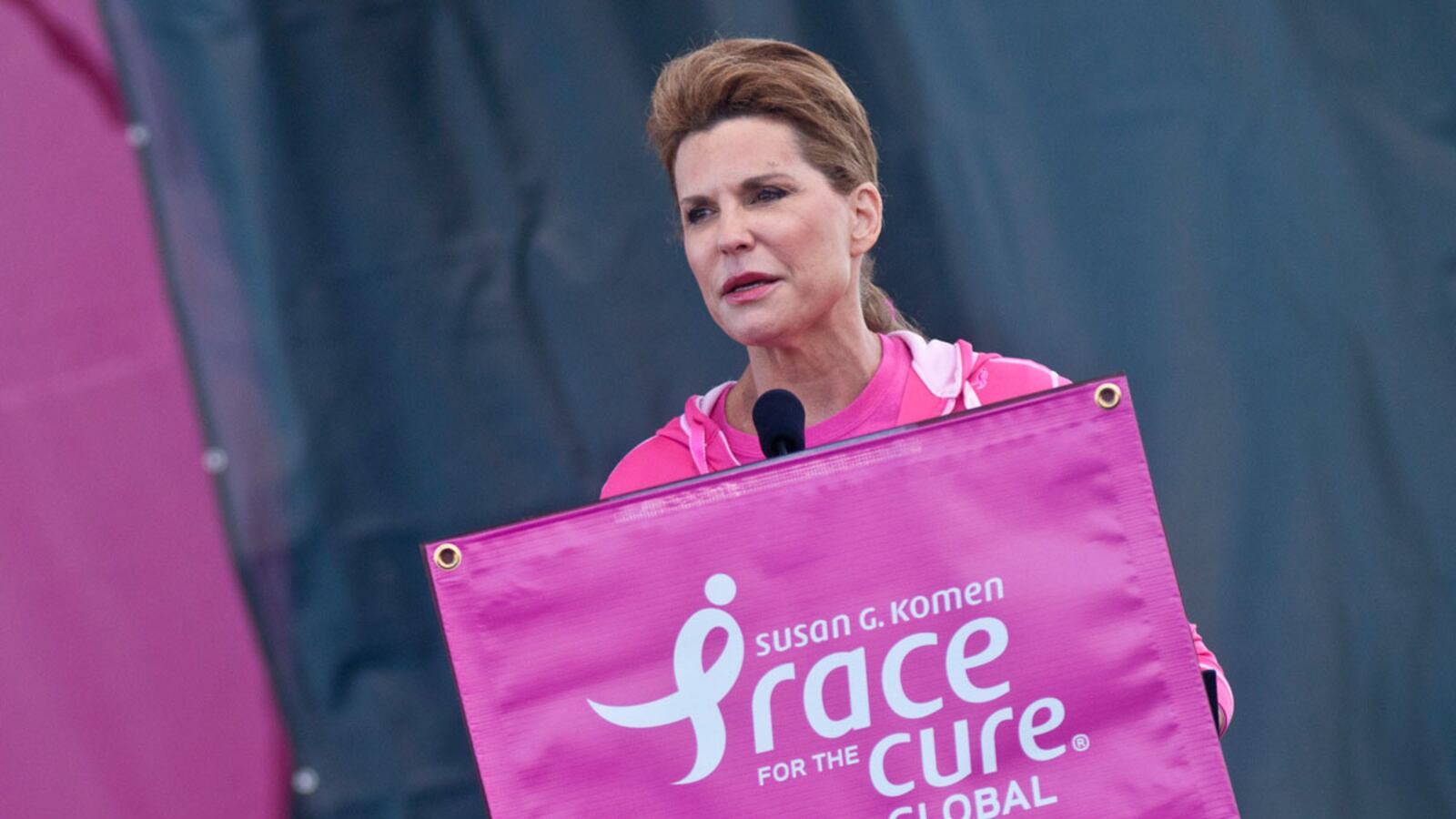
As the media chew on news that Nancy Brinker, the controversial founder of Susan G. Komen for the Cure, will step down as chief executive after a brutal year, a new study says progress in fighting breast cancer is unacceptably slow, public perception is skewed—and the media are partly to blame.

Breast cancer has dominated the headlines of late, thanks in large part to Brinker, a wealthy socialite and former U.S. ambassador to Hungary who has spent the past three decades building her cancer-fighting charity after her sister, Susan G. Komen, died of the disease in her 30s. Brinker has come under intense scrutiny in recent months for her spending and management style after her foundation cut funding to Planned Parenthood amid pressure from Catholic bishops, then restored the money after a backlash.
The debacle sent the powerful charity reeling—a string of executives left, key events got canceled, donors pulled out, and pink-ribbon races lost participants. Critics accused Brinker of losing touch with her important mission. The charity apologized and reminded people that it has raised some $1.9 billion to fight cancer. Last week, Brinker said she would step down as CEO and take a separate managerial role.
At the same time, according to a new report by the National Breast Cancer Coalition—a group that includes hundreds of cancer-fighting organizations—the breast-cancer industry as a whole is facing its own battle: frustratingly slow progress in finding a cure. In the past year, according to the annual report released Monday, breast-cancer incidence and mortality rates remained essentially unchanged from the prior year, and there were no major advances in treatment. In the U.S. in 2012, the report says, an estimated 290,000 women and 2,190 men will be diagnosed with breast cancer.
The mortality rate for breast cancer has declined over the years, but not sharply enough, the report says. In 1975 there were 31 deaths for every 100,000 women diagnosed in the U.S., according to the National Cancer Institute; in recent years that number has fallen to 23 deaths. In comparison, while it’s not apples to apples, the cervical-cancer death rate fell by nearly 70 percent between 1955 and 1992, according to the American Cancer Society. The drop was due mostly to the increased use of the Pap test.
“Billions of dollars have been invested in breast-cancer research, and many organizations and public-health officials continue to focus attention on early detection and awareness campaigns as the primary approach to addressing breast cancer,” the National Breast Cancer Coalition says in its report. “Given the attention and resources directed to breast cancer, the public understandably believes that we have made significant progress.” That’s not so, the report says: “We know little about how to prevent breast cancer or how to prevent deaths from the disease. While we have discovered new ways to treat breast cancer, they have not had a great effect on the important outcomes: preventing breast cancer and making certain no one dies of it.”
Fran Visco, the president of the National Breast Cancer Coalition, believes the solution lies in science—specifically, in studying how breast cancer develops and metastasizes. “We get sidetracked by efforts to focus on getting every woman a mammogram,” she recently told The Daily Beast. “We could screen every woman in the world, and we would not have stopped breast cancer. I am not saying to stop funding for screening; however, we cannot afford to make it a main focus.”
Experts differ on how best to spend money—on mammograms, research, or both. The Komen foundation, for instance, allots around 24 percent of its funds to research and 15 percent to screenings; 34 percent goes to education, 7 percent goes to treatment, and the rest goes to fundraising and administration. The Avon Foundation Breast Cancer Crusade generally splits its funding for screenings and science equally. The foundation allots around 38 percent of its money to grants for research and around 38 percent to grants for programs that include screenings; the rest goes to fundraising and management.
A primary focus of the National Breast Cancer Coalition, meanwhile, is to lobby for federal spending for research. The group has lobbied for $2.8 billion in federal funds for research in the past 20 years and has set a goal of ending breast cancer by 2020.
The National Breast Cancer Coalition says there are many "myths and misunderstandings" surrounding breast cancer and that the public has been misled into thinking scientists are close to finding a cure. That’s due in part to media coverage, which does not always “reflect the realities of the disease,” the group’s report says.
For instance, in an analysis of coverage during National Breast Cancer Awareness Month in October 2011, the report says, many stories focused on young women’s personal triumphs and effective treatments. “The majority of personal accounts were primary, early stage, breast-cancer diagnoses. Often times, a picture was painted of survivors who are disease-free and overcame the disease,” the report says. “Only about 1 in 9 articles portrayed women battling metastatic disease.”
The report says that “the keys to ending the disease—understanding primary prevention and how to prevent metastasis—do not receive significant coverage.” The report also notes, “During the past year, women’s health issues, including breast cancer, were embroiled in controversy. The nature and extent of the fallout, both on political support for women’s health issues, and on fundraising around breast cancer and other women’s issues, remains to be seen."