
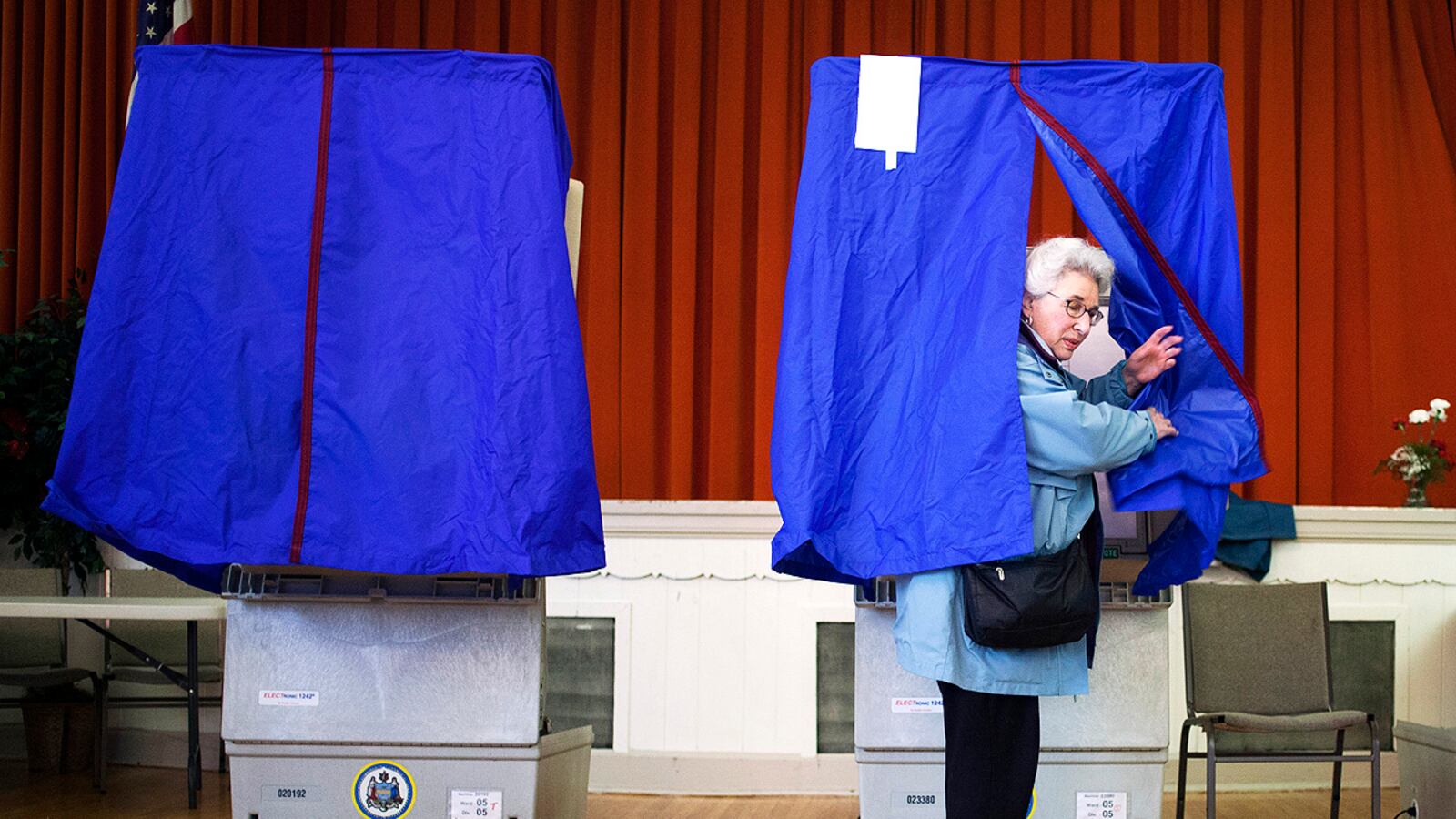
When George W. Bush’s narrowly won reelection in 2004, not a single American state had a law requiring voters to present photographic identification at the polls. Today about 10 states, with 134 electoral votes among them, have enacted such laws—all at the prompting of Republicans.
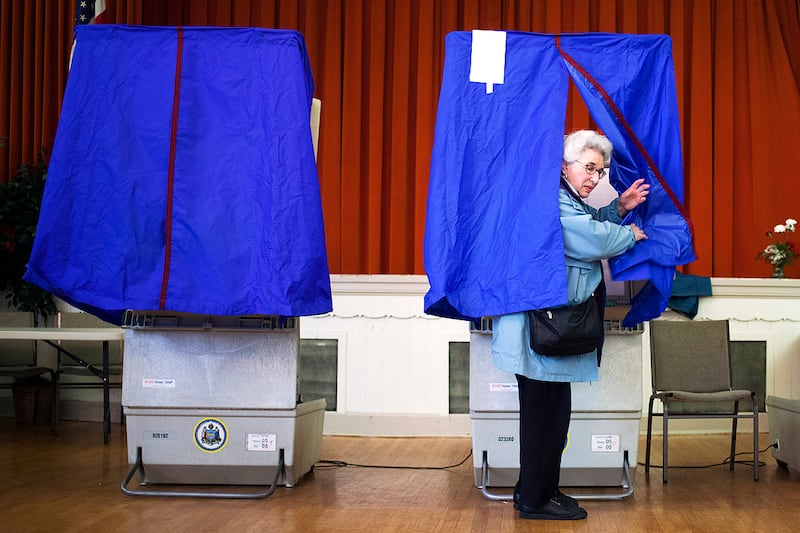
Republicans are not responding to a newly discovered crisis in voter impersonation at the polls, but to a partisan crisis brought on by their party’s declining base of white Protestant voters. If the GOP can’t grow its own voter base, it can at least hope to shrink the Democrats’ base.
Photo-identification laws are targeted heavily at Democratic minority voters, who are significantly less likely than whites to possess the required identifications. A reduction in the votes of racial minorities relative to the votes of reliably Republican white Protestants benefits the GOP. In an unguarded moment, Pennsylvania’s state House majority leader, Republican Mike Turzai, said that his state’s newly enacted photo-identification law “is gonna allow Governor Romney to win the state of Pennsylvania.” In a response to a lawsuit challenging the law, the state’s attorneys admitted that they were “not aware of any incidents of in-person voter fraud.” Impartial studies have reached similar conclusions about voter impersonation across the nation.
In contrast to voter fraud, the decline of the Republican’s base vote is real and pervasive. America is no longer a white Protestant nation. Until the late-20th century, white Protestants had composed the majority of Americans and the overwhelmingly majority of voters. That white Protestant majority has since disappeared. Fewer than 40 percent of all Americans today are white and Protestant, though the group, which tends to be older and more likely to vote, is usually overrepresented at the polls.
The percentage of white Protestants among voters will continue to slide as America becomes increasingly non-white. The big states of Texas and California are already majority non-white and all of America is likely to follow suit before mid-century according to US Census projections. Hispanics, the nation’s largest minority group, are increasingly gaining citizenship and voting. African American voter turnout now closely approximates that of whites.
The presidential tickets of both parties are added testament to the declining political power of white Protestants in the United States. The political elite have now caught up with trends among rank-and-file voters. For the first time since its founding in the 1850s, the Republican Party will nominate for president a candidate other than a white Protestant: the Mormon Mitt Romney. For the first time in the history of the American Republic neither major party ticket includes a white Protestant nominee.
The dependence of the Republican Party on white Protestant voters is deeply rooted in the party’s history. The modern Republican Party took shape in the 1920s out of a widespread concern that secular, pluralistic, and cosmopolitan forces threatened America’s national identity as a white Protestant nation. At the core of conservative politics both in the 1920s and today is the ideal of America as a unified nation that upholds traditional white Protestant values.
White Protestant voters overwhelmingly backed Republican candidates in the early 20th century, with the exception of the South, which was solidly opposed to the party of Lincoln until later in the 20th century. Racial and religious divisions in voting remain pervasive today, far overshadowing divisions of gender or class. And white Protestants are still overwhelmingly Republican. In 2004, according to exit polls, George W. Bush won two thirds of the white Protestant vote, but only about 11 percent of the African-American vote, 44 percent of the Hispanic vote, and 25 percent of the Jewish vote. In 2008, John McCain won 65 percent of the white Protestant vote, but only about 5 percent of the African-American vote, 31 percent of the Hispanic vote, and 21 percent of the Jewish vote. Republican support among evangelical, white Protestants has been especially impressive, with Bush winning 79 percent and McCain 73 percent.
But Republican majorities among white Protestants count for much less in recent years than in earlier times. To fill the gap left by white Protestants’ diminished share of the national vote, Republicans have sought an alliance with traditionally Democratic white (non-Hispanic) Catholics, which is reflected in the selection of Ryan as Romney’s running mate. Republicans have wooed Catholic voters by appealing to their church’s conservative positions on moral issues also championed by evangelical Protestants such as abortion, pornography, and gay rights. However, Catholic teachings clashed with Republican positions on other issues including social welfare, labor rights, and capital punishment.
The result was to turn white Catholic voters into the only major ethnic or religious swing vote in the United States. In 2004, Bush won the presidency because he prevailed among white Catholics by a margin of 13 points. In 2008, McCain’s white Catholic majority had shrunk to five points. Like Bush, Romney must win a hefty majority of white Catholics if he hopes to win this year.
Catholic vice-presidential candidates Ryan and Biden mirror the divided souls of American Catholics. Ryan, who would ban abortions, even in cases of rape and incest, closely follows the church line on moral issues, but has been rebuked by some Catholic bishops for budget proposals that harm the poor and the elderly. Biden follows the church line on social justice for the less fortunate, but has been criticized by some bishops for his pro-choice stance on abortion. Already Republican and Democratic partisans are debating whether Ryan or Biden is more faithful to Church teachings.
With Catholics divided and white Protestants as their only reliable voter bloc, the Republican Party is rowing against the tide of demographic change in the United States. Regardless of the outcome of this year’s election or the fate of voter-identification laws, if Republicans fail to expand their demographic base they will disappear as surely as the Whigs that they replaced in the 1850s.