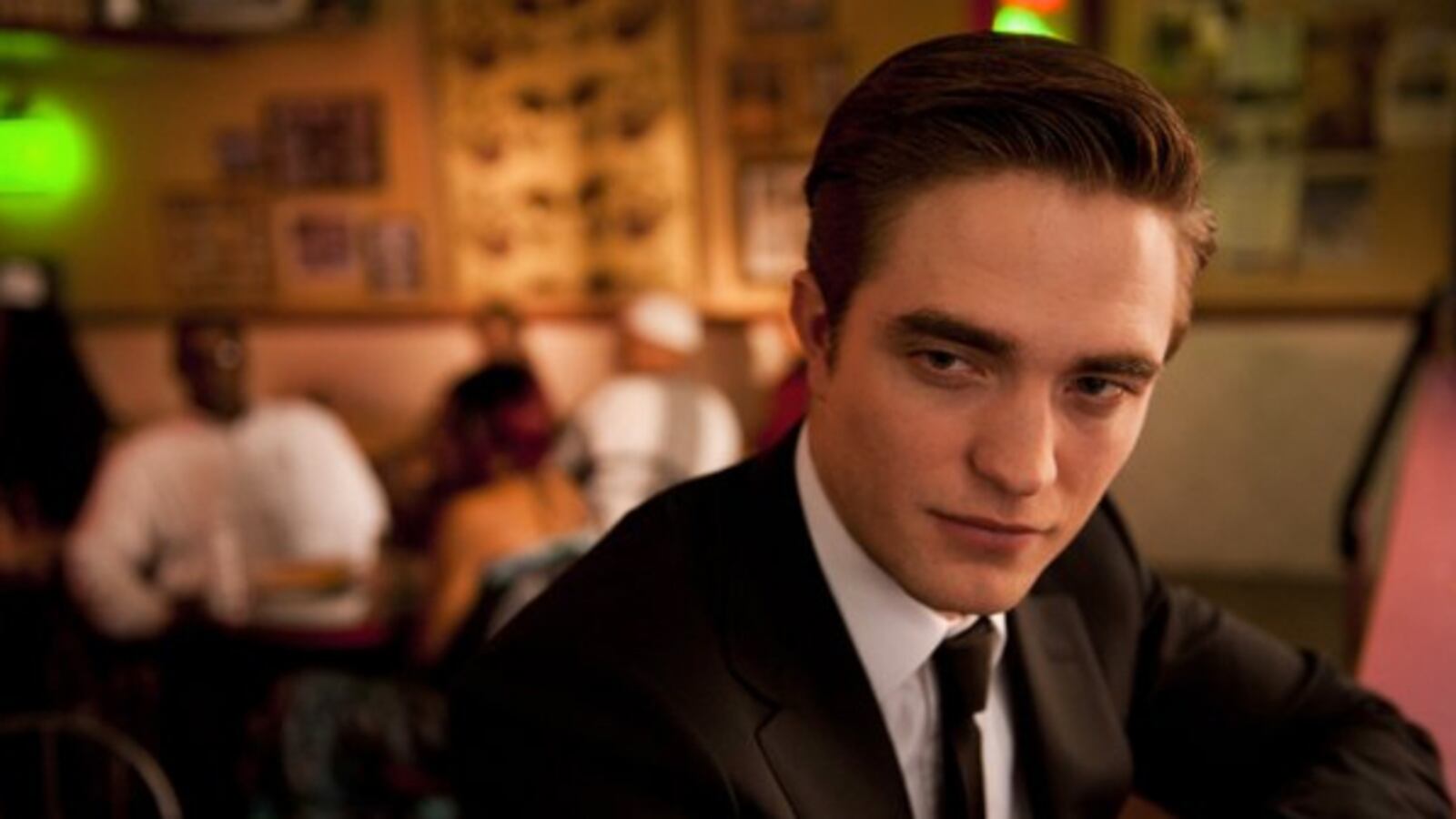
Robert Pattinson glides, reptilian, up and down a defaced stretch limo, its surfaces sparkling with Bloomberg-esque data terminals. Paul Giamatti huddles at an ATM as Occupy-style protestors quote Marx and fling dead rats. The president tours a rioting Manhattan, but everyone seems more concerned with capital flows in Beijing.
In Cosmopolis, the hyper-stylized adaptation of the Don DeLillo novel, director David Cronenberg refracts modern financial angst through a fun-house mirror. We follow the protagonist—Pattinson’s Eric Packer, a 28-year-old wunderkind hedge funder—through a day of self-destruction, abetted by a capital market gone mad. Along the way, the film distills some real-world Wall Street trends to tragicomic extremes: American declinism, anti-capitalist agitation, inscrutable financial engineering, hyper-alienation of Wall Street’s wealthiest. Some of the financial plot points are plausible; some, less so. (Beware, Twi-hards: spoilers ahead.)
First, there’s Packer’s big bet: one that would make hedge-fund pioneer George Soros proud. The multibillionaire prodigy stakes out a huge short position on the Chinese yuan. (In the book, published in 2003, it was the yen.) Even Packer’s 22-year-old, Converse-wearing quant and equally young technical guru (both plausible) tell him that the market is too chaotic to graph (less so). But Packer relishes the risk: “It can’t go any higher,” he says, tapping away at a glowing data-pad. The hedge-funder leverages his bearish bet even more: by mid-movie, he’s losing “hundreds of millions” an hour.

And it gets worse. The managing director of the IMF appears on North Korean television to tell the world that the yuan is, in fact, “inflated.” But before he can explain why, a knife-wielding assailant conducts some brutal ocular surgery on the screaming bureaucrat. The currency continues to climb, and Packer’s portfolio crashes.
The yuan gambit is the first clue that Cosmopolis deals with a parallel financial universe. In our own, China’s currency is thought to be deflated—“moderately undervalued,” in the words of the real IMF—due to Chinese capital controls, which are designed to boost exports. If the managing director of the IMF wanted to weigh in on an inflated currency, he’d go on CNBC, not North Korean state television. And if he was attacked while doing it, that would probably give the markets even more reason to flee the yuan, not less.
But these are quibbles. The broad Occupy strokes are there, and convincing. The Cosmopolis protestors go a step beyond their real-world forebears. “A specter is haunting the world,” they chant, echoing the first sentence of the Communist Manifesto: “The spectre of capitalism.” A scene in Times Square, where the malcontents spray-paint Packer’s limo and hack the advertising billboards to display Marx’s message also has real-world echoes, evoking last October’s protests in midtown, where Occupiers spread rumors that they had, in fact, broken into the billboards.
Then there’s Packer’s asymmetric prostate. Really. In Cosmopolis, Packer Capital uses complex fractal modeling, based on patterns in nature, to map data in the markets. The asymmetric prostate, which is graphically uncovered by Packer’s personal doctor during an in-limo examination, serves as a metaphor for the asymmetries that these models seem to miss. Sound farfetched? Well, Wall Street has been using mathematical modeling for years. Benoit Mandelbrot, the famed father of fractal geometry, applied many of his models—based on natural patterns, like galactic and coastline edges—to the financial markets. Banks and bankers have hired mathematicians and physicists like him to find order among the natural, evolutionary disorder of capital flows.
Another trope in the movie rings more true. As the rapacious engine of techno-capital puts Pattinson in a bullet-proofed limo and everyone else in decaying slums, it seems that the machines are in control: high-frequency trading robots. Paul Giamatti, as a former trader at Packer’s fund, loses his job at the hands of a “bot,” whose inscrutable, lightning-fast transactions boggle even his impressive mind. Giamatti had messed up trades on the “baht”—pun presumably intended—the Thai currency that precipitated the 1997 Asian financial crisis. Giamatti ends up with a towel on his head, waving a gun. A depersonalized Pattinson blows a hole in his hand, ostensibly to feel human again.
As the algorithms reach peak efficiency, human traders literally lose their minds. Plausible? Just ask Knight Capital, BATS Global Markets, or the investors taken for a high-frequency ride during the “Flash Crash” of 2010. As Packer’s “chief of theory” puts it, the techno-financial markets have commoditized time, and money has lost its extrinsic value: it is only accumulated for money’s own sake. You can take that all the way to Zuccotti Park.
Sure, Cosmopolis has Brechtian absurdity, Dostoevsky echoes, and tons of sex. But there are times when it reads like one of those documentaries CNBC runs at night: “Twilight of the Trader.” Though its $96,437 opening weekend wouldn’t raise one of Packer’s well-plucked eyebrows, any real financiers who buy a ticket may find a lot to recognize—and maybe fear.