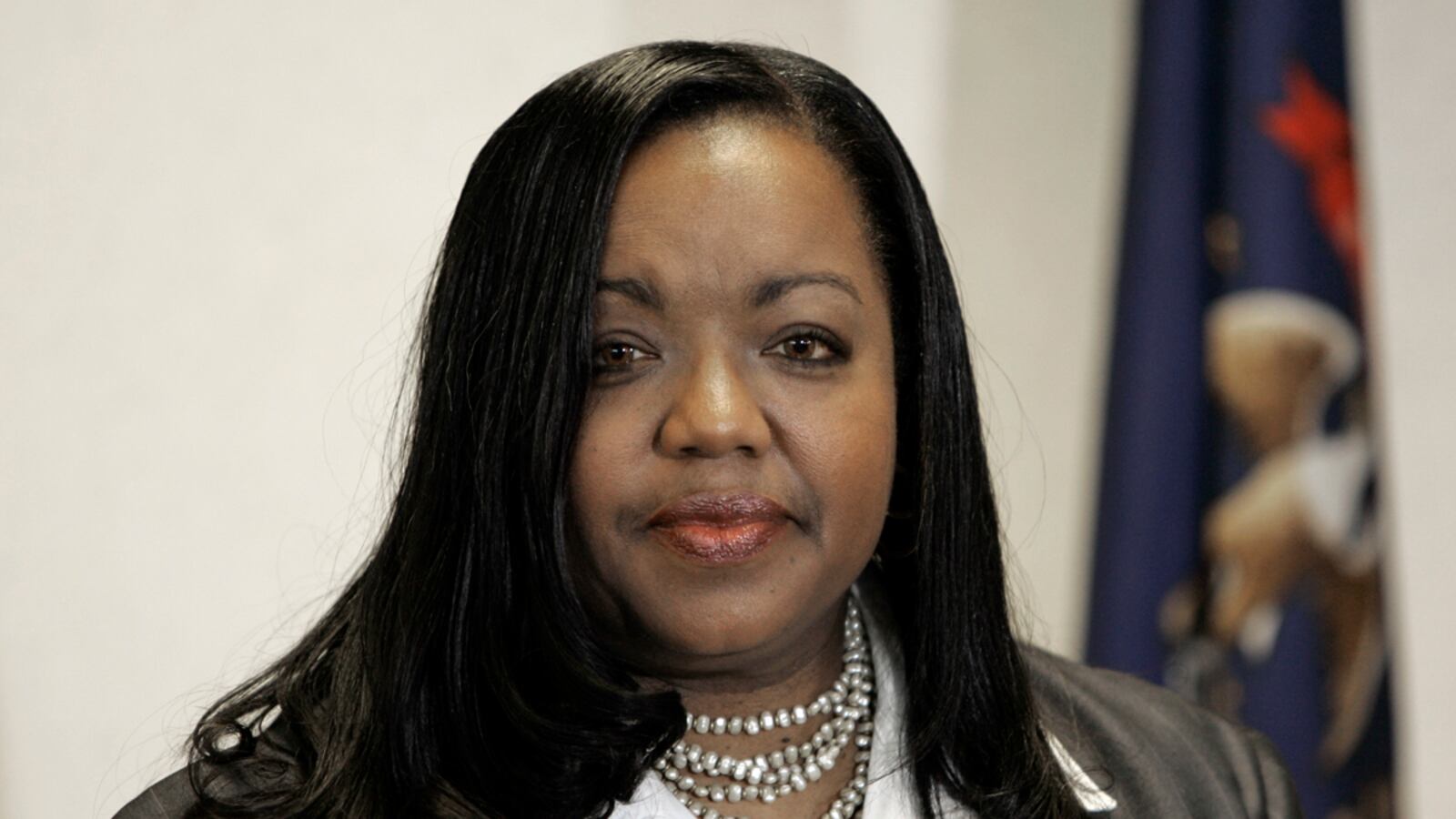
Twenty-one serial rapists have been identified in a massive investigation led by Detroit prosecutor Kym Worthy—and her manhunt has only just begun.
Worthy is leading a charge to investigate more than 11,000 police “rape kits”—which contain swabs of semen, saliva, and other evidence of rape—so the rapists can be brought to justice. The thousands of rape kits had piled up in a dusty police warehouse in Detroit for years, ignored, until one of Worthy’s colleagues stumbled upon them in 2009. Since then, an outraged Worthy has been fighting to get the kits logged, tested for DNA, and then entered into the national DNA database.

The logging of the kits alone has been a staggering project. “There were no police reports attached to the kits,” she says, explaining that her colleagues “literally had to dust them off” and “physically go through and open them to get the name of the victim, the date that it happened.” A federal grant for $1 million—the first of two such grants of its kind, with the other going to Houston—has helped her get all the kits logged, she says, but the grant won’t cover the DNA testing of all 11,303 kits. “Unfortunately money’s not falling from the sky,” she says.
Rape-kit pileups aren’t just a problem in Detroit. In recent years, cities across the country have reported mountains of kits—11,000 in San Antonio, 1,200 in Albuquerque, 4,000 in Houston—according to Sarah Tofte, who has studied the national debacle for the advocacy group Human Rights Watch. Experts estimate that hundreds of thousands of kits are languishing in police warehouses.
When Worthy learned of the Detroit pileup from the colleague who discovered it by chance, she says, she demanded immediate action from the police chief at the time. “No one really paid attention to what I was saying and yelling about till about four months in,” she says. People finally took notice, she says, when someone in the police department leaked the news to the press.
Twenty of the 21 serial rapists were identified from the first 153 rape kits officially tested for DNA and entered into the national database known as CODIS, or the Combined DNA Index System, this summer. In other words, these 20 men had been involved in at least one other rape case, according to the database. The twenty-first serial rapist was identified from earlier tests on a random sampling of kits, conducted in order to do a broader statistical analysis of the project.
In one especially horrific case, Worthy says, a convicted rapist named Shelly Andre Brooks had raped and murdered five women after raping a woman whose kit was just recently entered into the database through Worthy’s initiative. If that rape kit had been tested and entered into the database sooner, the man could have been caught sooner—and five women’s lives could have been saved. “That’s why it’s so horrible, this whole thing,” Worthy says.
In addition to the serial rapists, the DNA evidence in the batch of 153 kits has yielded another 38 DNA matches in the database, Worthy says. All of the cases now need to be investigated. “People think when you get a CODIS hit, we can just go out and arrest that person,” she says. “But a DNA hit is never the whole case. We have to go find the witnesses, do the old-fashioned kind of investigation. They’re cold cases—they’ve just been sitting there. We have to reinvestigate all these cases.” She adds, “I say ‘reinvestigate,’ but some were never investigated properly, frankly.”
Worthy says she has funds right now to cover tests for about 1,600 rape kits—a small chunk of the 11,303 kits in all. “It’s very troubling,” she says. “Every day cases are pouring in as well. We need to increase staff. We need more funds. I’m calling it a pandemic—you have this many people running around.”
Part of the reason for the national rape-kit clog is the price of testing the kits. Each kit can cost an average of $1,200 to $1,500 to test, as technicians need to extract and separate DNA from two people—the victim and the assailant—from a swab, says Tofte. However, slim resources aren’t always the issue; she says that often the kits are just a low priority for police. The arrest rate for rape, 24 percent, has barely budged in the past three decades, she says, noting that it’s not because many cases are unsolved but uninvestigated.
Still, some progress has been made. For instance, says Tofte, Los Angeles has nearly eliminated a backlog of 12,500 kits, while New York City managed to get through a backlog of 16,000 kits and then adopted a policy of testing every kit entered into evidence. In addition, several rape-kit reform bills have been introduced in Congress. Sen. John Cornyn (R-Texas), for one, is pushing for an act called SAFER, or Sexual Assault Forensic Evidence Registry, aimed at reducing the national backlog.
In Detroit, Worthy’s project has already yielded one rape conviction this past spring and an upcoming trial this fall, thanks to the early study of the random sampling of kits. A jury found Antonio Jackson guilty of first-degree criminal sexual conduct in May; he received a sentence of 10 to 30 years, according to Worthy’s office. Eric Taliaferro has a trial set for November.
Worthy says she hopes to create a blueprint through her project for cities nationwide.
A single mother of three, Worthy began her legal career in the Wayne County Prosecutor’s Office in 1984, later becoming the first African-American to serve as a special assignment prosecutor. In 1994 she was elected to the Wayne County Circuit Court, where she presided over hundreds of felony cases. In 2004 she became the Wayne County prosecutor, the first African-American and first woman to hold the post. She is perhaps best known for indicting Detroit mayor Kwame Kilpatrick, long accused of corruption, on charges of perjury and obstruction of justice in 2008. He served jail time after pleading guilty to reduced charges and now faces another trial.
Some 30 years ago, Worthy was a victim of rape when she was a law-school student at the University of Notre Dame in South Bend, Ind. Attacked from behind while out on a jog around her apartment complex one night, she didn’t report the rape. “Things were different then,” she told Newsweek and The Daily Beast earlier this year. “And I was young.”
Today she has a much different perspective, calling that decision many years ago “all justification and rationalization.” Ultimately, she says, the attack made her stronger—and more determined to seek justice for people who do report their rapes.