
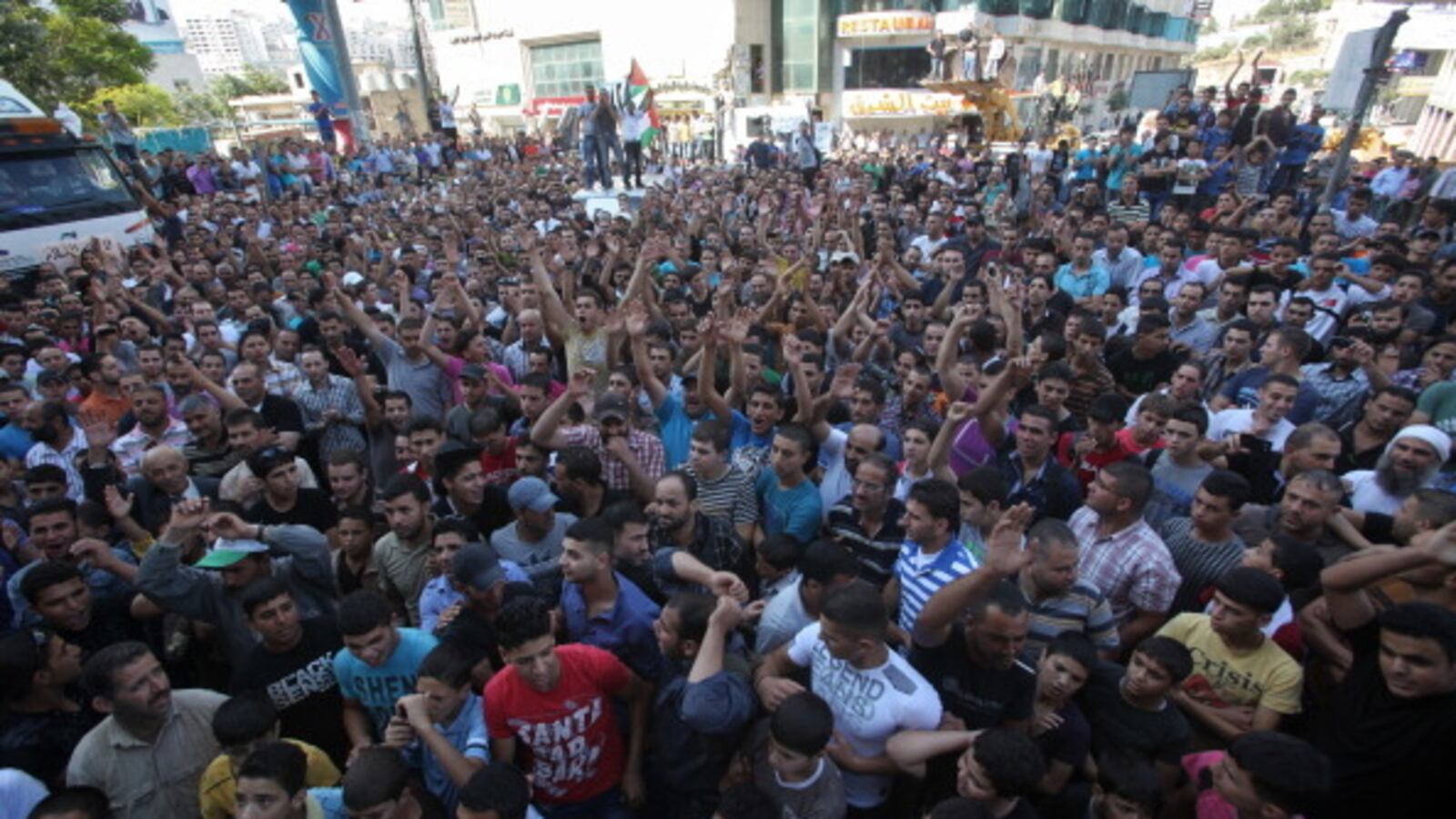
Amid growing concerns that the situation could turn into a violent conflict with Israel, Palestinians turned against their leaders this week with protests in the West Bank targeting the Palestinian Authority for mismanagement of the struggling economy.
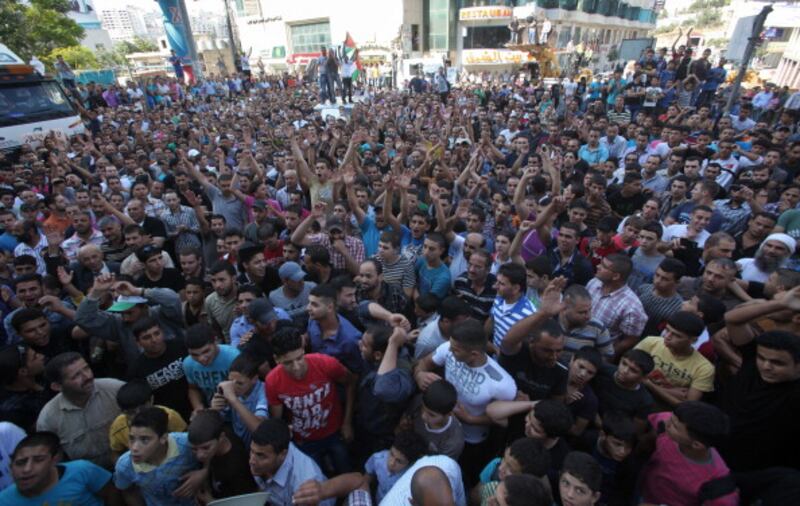
Hundreds of demonstrators, directing much of their ire at Prime Minister Salam Fayyad and his fiscal austerity program, burned effigies of the celebrated economist in Hebron and damaged government buildings in Ramallah. On Monday, reported the New York Times, taxi and truck drivers all over the West Bank participated in a mass strike against a recent rise in fuel prices, now above $2 a liter. The increases came as Israel, which has the third highest price in the world for gasoline, raised its own prices; the two economies are linked by the Oslo-era Paris Accords.
Even though Israeli Prime Minister Benjamin Netanyahu scheduled an early transfer of $63.3 million in taxes levied on Palestinians to help ease the financial burden, observers and officials in Israel worry that the protesters’ rage will morph into a third intifada against the occupation. According to the Times of Israel, demonstrators in Ramallah Tuesday chanted, "The people demand an end to Oslo," and carried signs reading, "No to the agreements of shame."
A mass uprising may be "probable," said George Washington University political science professor Nathan Brown, but the timeline is uncertain.
"The feeling has sort of set in that there’s going to be some kind of uprising in response, but whether it happens now or five years from now is anybody’s guess," he said Wednesday.
Israel has a long-term outlook, but naturally keeps a close eye on current developments.
"There have been warnings within the Israeli establishment, especially from the intelligence apparatus, about the volatility in the territories," said Natan Sachs, a fellow at the Saban Center for Middle East Policy at the Brookings Institute.
A third intifada, Sachs added, may also look "very different" from the previous two, multi-year uprisings in the late-1980s and early-2000s that often turned into violent clashes with Israelis and between Palestinian factions. The first intifada was known for stone-throwing and the second remembered for suicide bombings.
The 2.5 million Palestinians living in the West Bank face an unemployment rate of more than 20 percent, as well as a government saddled with $1.5 million in debt and a cash shortfall of $500 million, due to Israeli restrictions on economic activity and support from international donors decreases. In 2011, donors promised $1.1 billion, but the Palestinian government only received $750 million of it.
Fayyad, supported by President Mahmoud Abbas, introduced limited austerity measures on Tuesday in an effort to contain the demonstrations, vowing to lower fuel prices and slash top officials' salaries. It may not be enough to stave off an escalation—perhaps into violence—as Netanyahu continues to focus much of his attention on Iran and other regional issues. Microscopic attention to the Israeli-Palestinian conflict only increases with internet-enabled citizen journalism and actions like the Palestinians’ UN bid, but Israel’s leadership largely ignores Palestinian issues..
Last year’s Arab Spring largely non-violent demonstrations in Tunisia and Egypt periodically encouraged similar peaceful reactions in the West Bank, but with no success. West Bank protests this week seem similar to the first intifada’s "quiet revolution," but the rapid decay of the Palestinian economy could be the catalyst that turns this relative calm into a storm.