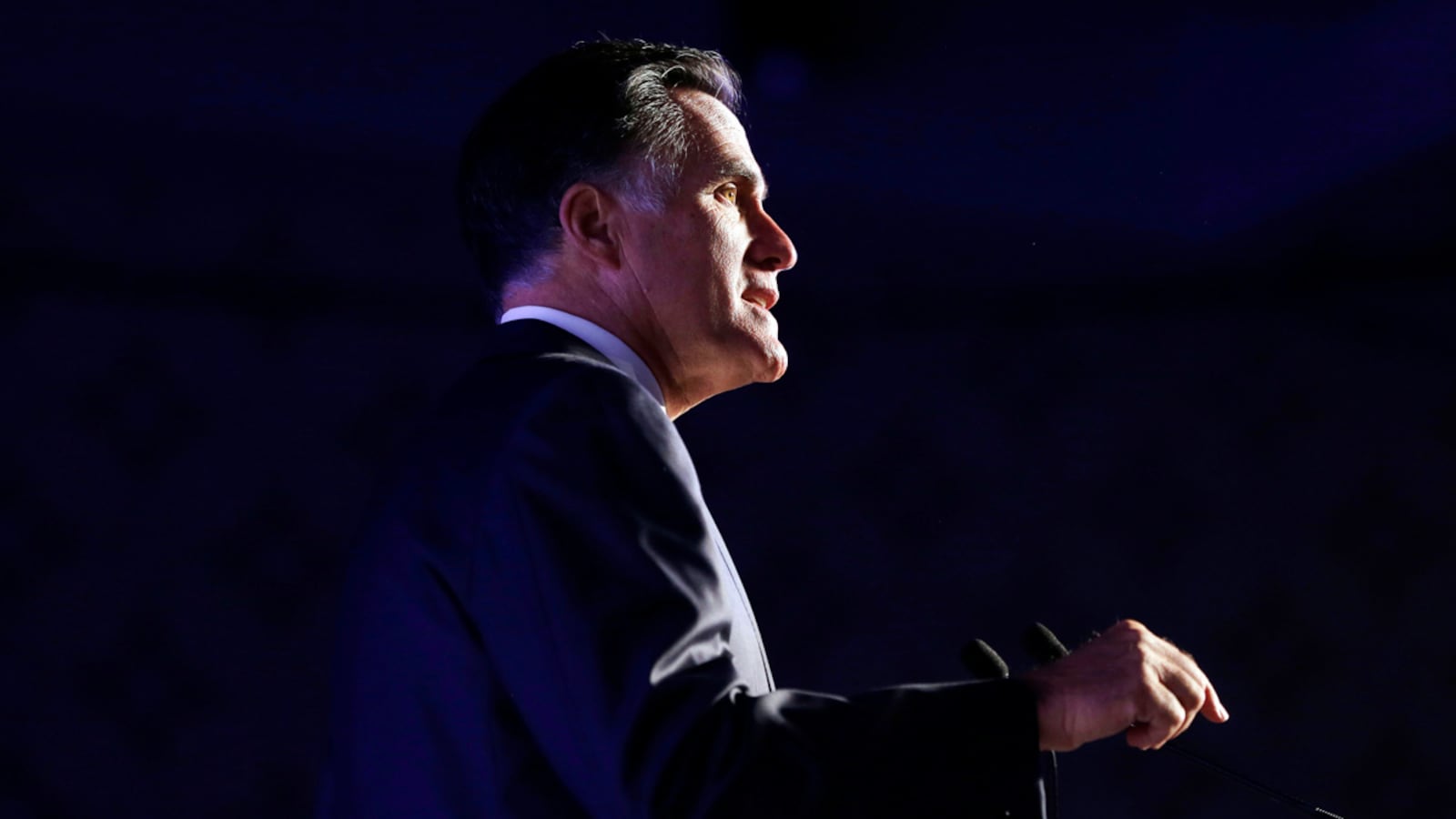
In late August, when a certain Republican presidential candidate said that “big business” was “doing fine” due to “offshore tax havens,” I coined it a “Romney gaffe”—a slip of the tongue that’s embarrassing, but painfully accurate.
On Monday, Mitt Romney stumbled into another ugly-yet-true circumlocution. In a secret fundraiser video obtained by Mother Jones’’ David Corn, Romney described “47 percent” of Americans as “dependent upon government”—“entitlement” hounds who “will vote for the president no matter what” because they “pay no income tax.” As a candidate trying to win the center, he continued, “[m]y job is not to worry about these people.”
Jim Messina, Obama campaign manager, called the statement “shocking” and “disdainful.” Gail Gitcho, Romney communication director, said that it showed that the former governor really is “concerned about the growing number of people who are dependent on the federal government.” But ham-handed, principled, offensive, or otherwise, Romney’s words were clearly one thing: true. Here are the facts.
According to the Tax Policy Center, a partnership of the liberal Urban Institute and the Brookings Institution, 46.4 percent of American filers pay “zero or negative” income tax.
Yes, that bottom-basement rate is the result of concerted cuts enacted under Reagan and Bush. And yes, when you include state and payroll taxes, the percent of zero-payers drops below 18 percent. And finally, since almost all of Romney’s investment wealth is taxed as capital gains, it’s likely that he, too, pays almost no “income tax.” But since Romney specifically described the “47 percent” as those “who pay no income tax,” he’s still on factual footing—even if he should count himself as one of them.
Paying no income tax is one thing. Being “dependent on government” is another. But under a broad definition of government dependence—that is, receiving federal entitlements—more than 47 percent of us are in Romney’s category. According to the Census Bureau, 49 percent of Americans live in a household that receives a government entitlement for “health care” through Medicaid or Medicare, “food” through stamps, disability, Social Security, or a “housing” assistance program. Most of these benefits are not paid for by their recipients, but by federal deficits. The gap between promises and anticipated funds for Social Security is $8.6 trillion for the next 75 years, according to the government’s own estimates (PDF). For Medicare, it’s $27 trillion.
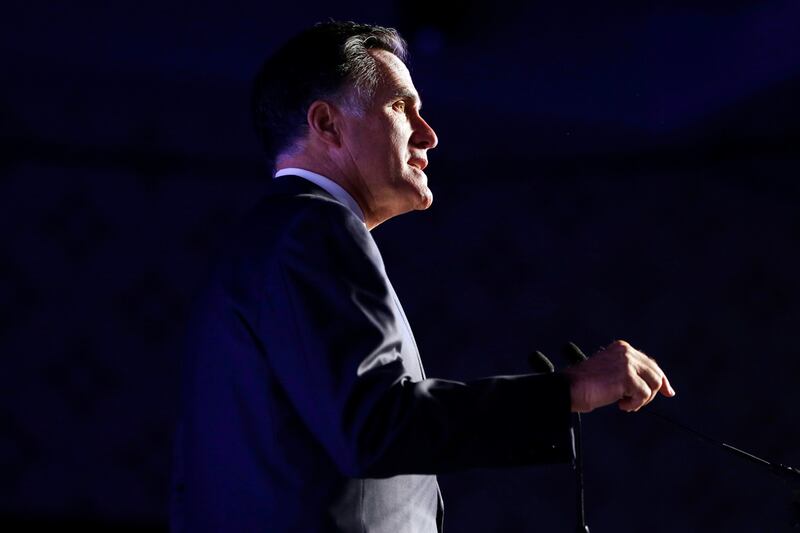
Getting the beneficiary and tax stats right? That’s the “Romney” part. Describing those voters—most of them poor or struggling—as freeloaders, in front of a millionaire-filled banquet hall? Well, that’s the “gaffe” part.
So, Mitt Romney is right that, due to deductions and the rising burden of payroll taxes, 47 percent of Americans don’t pay income tax, and that just as many households are dependent on government transfers in some way. But what about the harder question: Is Mitt right to say that those people are more likely to support Obama?
For the most part, yes. Crunching the Tax Policy Center’s figures, you find that 82.8 percent of those who pay no income tax live in households with income under $33,542. And according to Gallup, among those with incomes under $36,000, Obama has a massive, 15-point lead.
The question of whether those who receive entitlements—Romney’s “government dependent”— are in the bank for Obama is even harder to answer. According to a 2007 Campbell Public Affairs institute survey (PDF), “Democrats are more likely to have used government programs, and much more supportive of government doing more about inequality (74.9 percent) and using government as the vehicle to take action (37.9 percent).” Given a choice between the two parties, 63 percent of welfare recipients go Democratic, 67 percent of food-stamp users, 74 percent of those on Medicaid, and 81 percent of those in public housing.
The Democratic slant extends to those receiving federal unemployment benefits. In a 2011 NPR/Kaiser Family poll (PDF), 42 percent of the long-term unemployed identified themselves as Democrats; only 16 percent went Republican.
Does that mean that candidate Romney should wholly disregard the millions of Americans who don’t pay income taxes, or take federal entitlements? Is his “job,” as he put it, really “not to worry” about them? Who knows. But these groups do lean Obama. And given that fact, Romney’s marginal campaign-donation dollar might be better spent elsewhere—perhaps on Ohio or Florida’s white working class, or on winning the $36,000 to $90,000 income bracket, where the Republicans are much stronger.
In the secretly recorded remarks, Romney also struck a moral chord. The “47 percent”—the income-tax-less, the government-dependent, or both—“feel they are victims,” he said. That near-psychic fact is a bit harder to check. It is true that, amid the anemic recovery, the ranks of entitlement recipients have swelled, while the median wages of the middle and lower classes have remained stagnant. Inequality has risen. The labor force has shrunk. And according to the Labor Department, 23.1 million Americans are unemployed, forced into part-time work, or have given up their job search.
That’s a lot of “victims.” But still, not quite 47 percent.