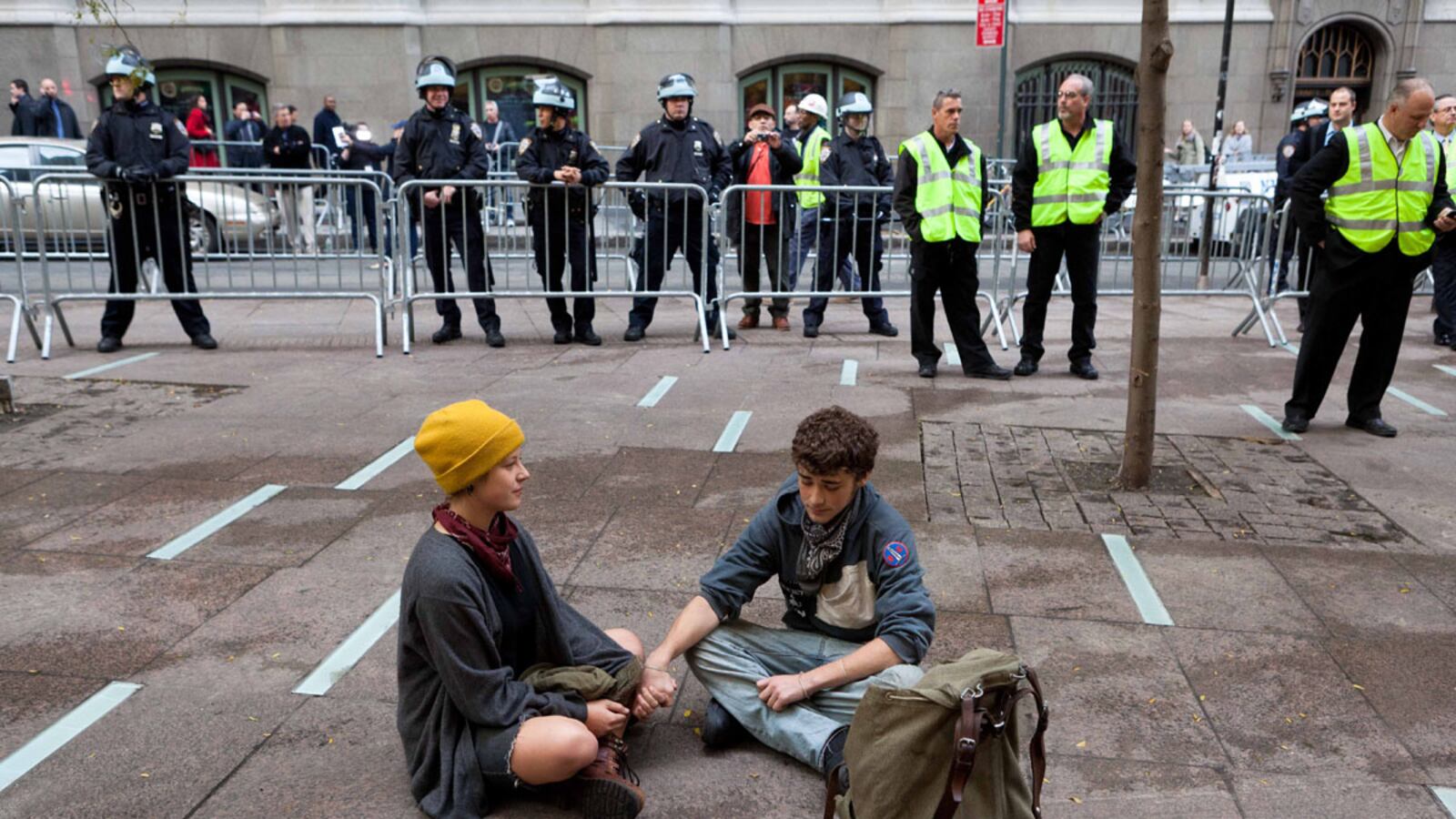
As Occupy Wall Street protesters geared up to mark their first anniversary in Manhattan on Monday, they found themselves operating almost alone, without much of the outside support from celebrities, labor unions, and other progressive groups and leaders that had helped to create a palpable sense of momentum last fall.
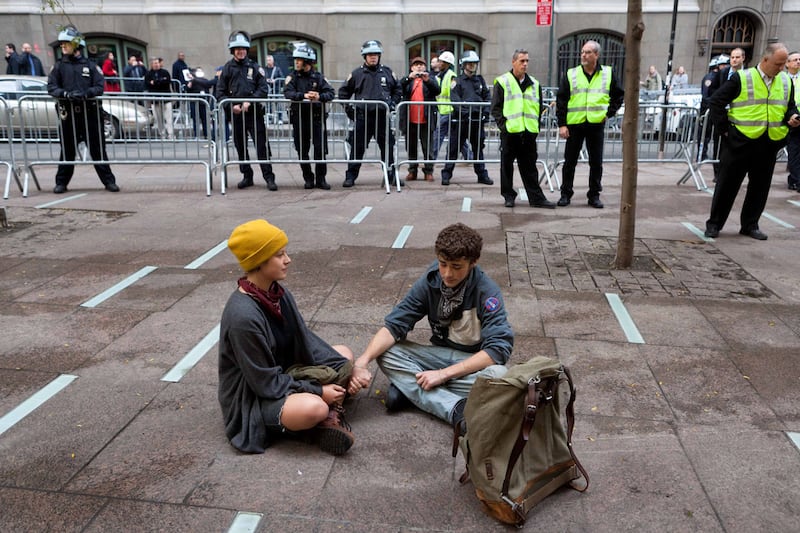
When Occupy began on Sept. 17, 2011, many of the core activists were veterans of Bloombergville, a series of encampments set up in Manhattan earlier that year to protest New York City Mayor Mike Bloomberg’s budget cuts. These folks were committed to open, consensus-based dialogue and angry about the wealth and power of the nation’s richest 1 percent.
They staged a dramatic occupation of a park in the backyard of America’s major financial institutions, and the combination of tepid labor sentiment toward the Obama presidency, massive student debt and unemployment, and a widespread feeling that the bad actors behind the financial crash had slipped away unscathed helped bring out tens of thousands of people to New York and cities across the world.
A year later, just a few hundred hard-core occupiers were on hand for the first two days of celebration leading up to Monday’s anniversary action, which will include what organizers called “an historic act of civil disobedience,” a sit-in demonstration in the streets surrounding the New York Stock Exchange at around 7 a.m.
But it would appear that, some tepid local union supporters in the city notwithstanding, the broader progressive coalition—including organized labor—is sitting this one out, having seen the Occupy movement descend into internal squabbling in recent months over how, and whether, to engage the political system directly.
"Occupy was so concerned about not being co-opted that it deterred people from trying to fill any leadership or organizational gaps that emerged,” a senior labor official in Washington told The Daily Beast. “If Occupy were stronger now, labor’s support for it would be greater. From an earned-media standpoint, Occupy got off of its message of critiquing the economy and got bogged down in process. And it’s not obvious how to support it now.”
Which is not to say that the movement failed to have a lasting effect on American politics, including this fall’s ideologically charged presidential race.
“The difference between Obama’s 2012 messaging and the messaging of the Democratic Party in the 2010 midterms is considerable,” the labor official said. “There’s a significant element of congruity with Occupy’s message that you would not have predicted a year or two ago. The idea of Obama trying to make a grand bargain in the summer of 2011 to undermine the safety net, to now running such a populist campaign is a great turnabout.”
But occasional massive outpourings of support for the big marches last fall, usually in the wake of police violence, masked the fact that Occupy never grew past a few thousand committed activists spread across the country.
“The movement has had a hard time coming up with a second act,” said Michael Kazin, a social-movement historian at Georgetown University. “The May 1st demonstrations largely fizzled, with the usual suspects coming together. If there’s any guiding ideology of the leaders of the movement, it’s a kind of soft anarchism, and that’s not going to capture the country.”
The concern about co-optation by the political parties or other outside groups has always been central to internal dialogue. For instance, when MoveOn.org, a liberal political-advocacy group with close ties to the Democratic Party, and Van Jones, a former White House official, tried to invoke the rhetoric of Occupy Wall Street while essentially asking activists to help reelect President Obama, many veteran Occupiers recoiled.
“MoveOn was closest” to doing anything that could be called co-opting, said the labor official. “Many people at Occupy derided MoveOn’s efforts in that regard. It’s telling that when a group did try to make some of those themes and structure work in a more sustainable way, what they thought was a more sustainable way, they got a ton of backlash.”
But some on the left suggested working with groups like MoveOn, and especially with an activist like Jones, would have represented a massive capitulation.
“He worked for Barack Obama, helping to increase inequality, and then he turns around and berates everyone else for not forcing Obama to do the right thing,” Matt Stoller, a former financial-services staffer to former Rep. Alan Grayson (D-Fla.), said of Jones. “He’s not a leader, he’s funded by the Democratic establishment to channel liberal dissatisfaction into helping Wall Street. You work for Obama, you work for Wall Street.”
Looking ahead to the morning, Occupiers I spoke to—clustered in the vicinity of Foley Square in Lower Manhattan—said Monday wasn’t about demonstrating broad support so much as getting back in touch with what Occupy was about.
“It’s not like May Day, where there was a huge labor rally with a lot of other groups and organizations,” said Ian Williams, a graduate student at Hunter College who lives in Brooklyn. “It’s an inwardly focused day.”
And therein lies the problem: so long as Occupy remains a symbolic phenomenon that exists only to sustain its own subculture—to speak to its own members—it won’t be able to tap into the broader economic anxiety that is still festering across a battered, wary electorate.