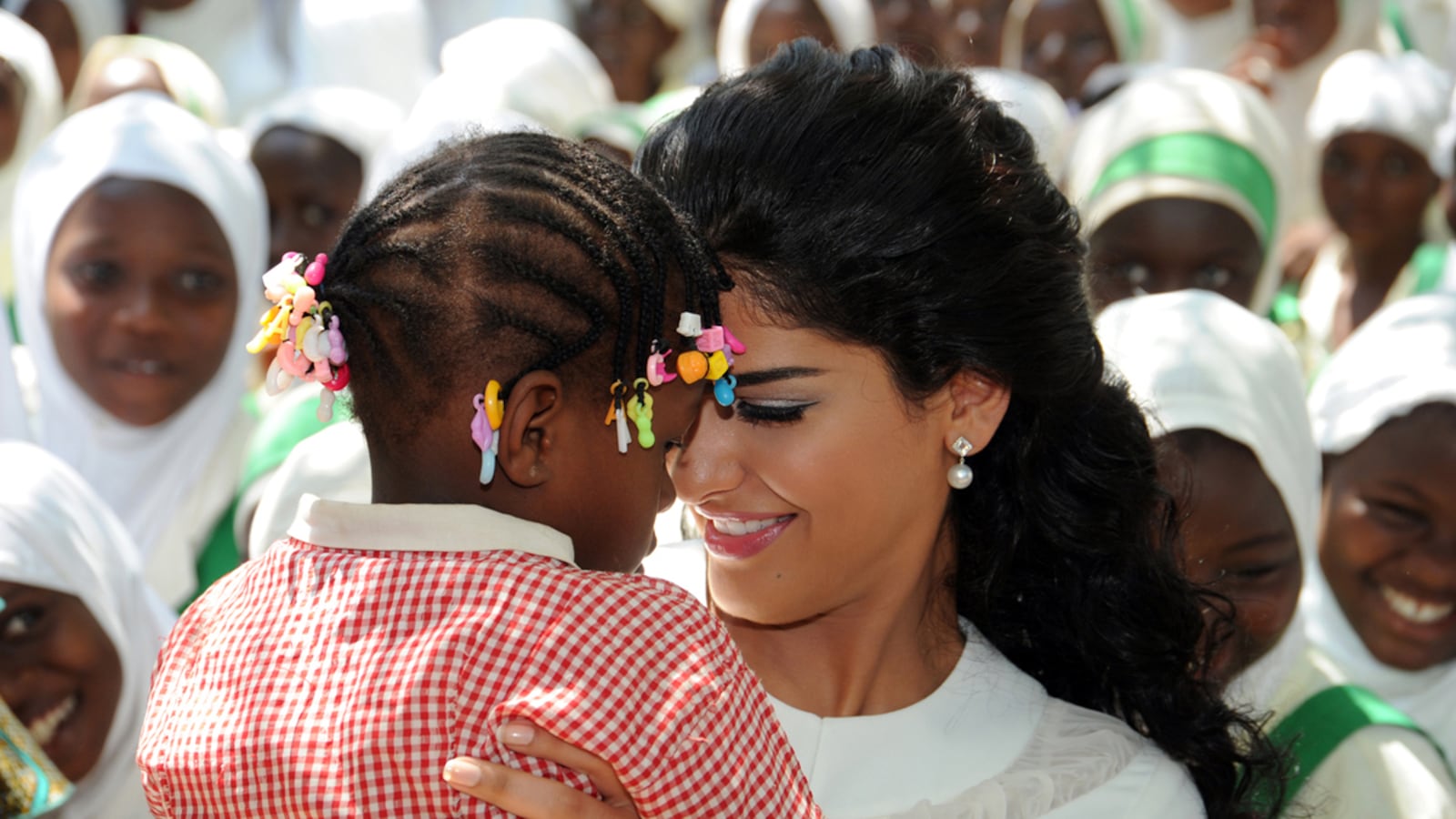
Perched in the lobby of the ritzy Plaza Hotel in Manhattan, surrounded by a stylish posse, Princess Ameerah Al-Taweel of Saudi Arabia is talking about the recent riots in the Mideast. “It’s not just because of the movie,” she says, referring to the controversial anti-Muslim film blamed for the uproar. The protesters were “frustrated, unemployed,” living in unstable nations with governments in transition.
She says she understands how Americans feel—unfairly labeled as supporters of the film that portrayed the Prophet Muhammad in an offensive light. "It doesn't make sense to me," she says, to judge an entire country for a film made by a few of its people. She knows how it feels, she adds: “Arabs were judged by 9/11. We all felt like we were judged by what a couple people did."
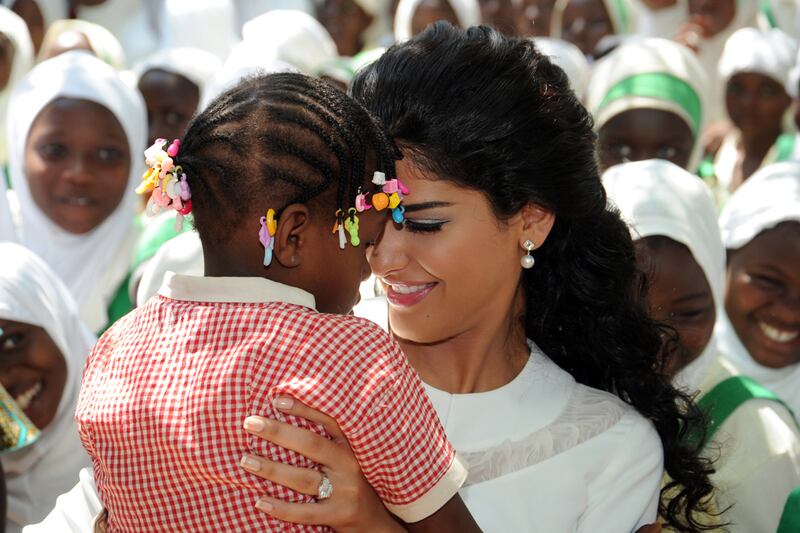
Princess Ameerah, in New York City this week to attend the annual meeting of the Clinton Global Initiative, the group launched by Bill Clinton to tackle world problems such as poverty and disease, is married to Saudi billionaire Prince Alwaleed bin Talal, the nephew of the king. Last week, she and her husband did something that she hopes will help bridge the “interfaith and cultural” gap: The family’s Alwaleed Foundations helped open an Islamic art wing of the Louvre museum in Paris, having donated some $20 million to the project. “Art opens people’s minds in a different way,” she says.
The princess is a fan of opening minds. In her native Saudi Arabia, where women are famously forbidden from driving a car, dating men, and until recently, voting, she has been a vocal advocate for women’s rights. She has spoken up on issues such as the fact that divorced women must give up custody of their daughters, and that women lawyers aren’t allowed to argue in court. And she drives a car “in the desert,” she says, where she can get away with it. “Women in rural areas have much more freedom than in the city,” she says. “They go driving around. They don’t wear abayas.” She herself is wearing a yellow jacket at The Plaza, her dark hair uncovered.
She says she is friends with Manal Al-Sharif, a Saudi activist known for boldly posting a YouTube video of herself behind the wheel, getting herself jailed for a week. The princess calls her “a gutsy woman” and believes the rules on driving can change. “I think it just takes the king to say, ‘Women can drive. Those who don’t want to, don’t have to,’” she says. She calls Saudi King Abdullah’s recent decision to let women vote in municipal elections “bold,” noting that many religious scholars were against it. “He believes in women’s empowerment,” she says. “I think he’s the one who can make it happen.”
The 28-year-old princess denies that her activism gets her in trouble in her social circles. “Everyone knows me,” she says. “I sit with extreme conservatives; I sit with extreme liberals. My agenda is not to create negativity but unity.”

She thinks the West often gets the wrong impression of Saudi Arabia, noting that the good news doesn’t tend to make headlines, only the bad. “Fifty-six percent of university graduates are women,” she says. “We watch Seinfeld, Friends, the presidential debates—a lot of Saudis love America. I swear to God, if you come, you’ll see Saudis watching American TV.” She mentions a recent Newsweek profile of a conservative Saudi woman, saying, “She doesn’t represent all women…she was an extreme conservative. Seventy percent of Saudis are people in the middle.” But she says she respects the story for pointing out that the woman’s family is particularly conservative. And she likes that one of the photos shows young Saudi women at college, laughing in cool sunglasses.
Princess Ameerah studied literature at King Saud University in Saudia Arabia and business administration at the University of New Haven in Connecticut, although she was still based in her homeland during her American studies. She says she knew a professor at the school and that the process was collaborative, involving phone calls and visits. “The thing about American education is that they open you up to so many platforms—classical music, comparative religion…you learn about Hindus and Buddhism,” she says. Beyond that, she declines to talk about her personal history. She has said she is from a middle-class family and that her mother had been divorced.
Her latest project is the launch of an initiative through the Alwaleed Foundations called Opt4Unity. The idea, much like the Clinton Global Initiative, is to bring together an “uncommon table” of business leaders, investors, and philanthropists, she says, to address international challenges in jobs, food, and education. “We’re talking about people who can make a difference,” she says. “Let’s do something.”