
Right now, a yacht chartered by the Dutch abortion rights group Women on Waves is heading toward Morocco, where abortion is severely curtailed. When it gets to the coast, two doctors plan to offer Moroccan women medical abortions in international waters. The mission, says the group’s founder, the Dutch gynecologist Rebecca Gomperts, was inspired by the Arab Spring and the backlash against women’s rights seen in some countries in its wake. “In all the revolutions that have taken place, in all the changes, women’s rights have been ignored,” she says. “We never see abortion as an isolated issue. It’s part of the fundamental human right of autonomy and sexual freedom.”

Women on Waves has done this sort of thing before but never in an Islamic country, and Gomperts, who is flying to Morocco to meet the boat this week, isn’t entirely sure what to expect. She points out, correctly, that Islamic law isn’t as militantly anti-abortion as Catholic doctrine. Yet Islamist movements tend to react furiously to what they see as Western attempts to undermine traditional sexual mores. Women on Waves is working with organizers from a Moroccan movement called MALI, or the Alternative Movement for Individual Freedoms, that has, in the past, been subjected to death threats from religious fundamentalists. Whether those fundamentalists will menace Women on Waves remains to be seen.
But Gomperts, a slight, striking woman in her 40s, has a way shrugging off dangers and obstacles that would derail others. She has a serene sort of audacity, born of her utter conviction of the justice of her mission: to bring safe abortions to women in countries where it is illegal.
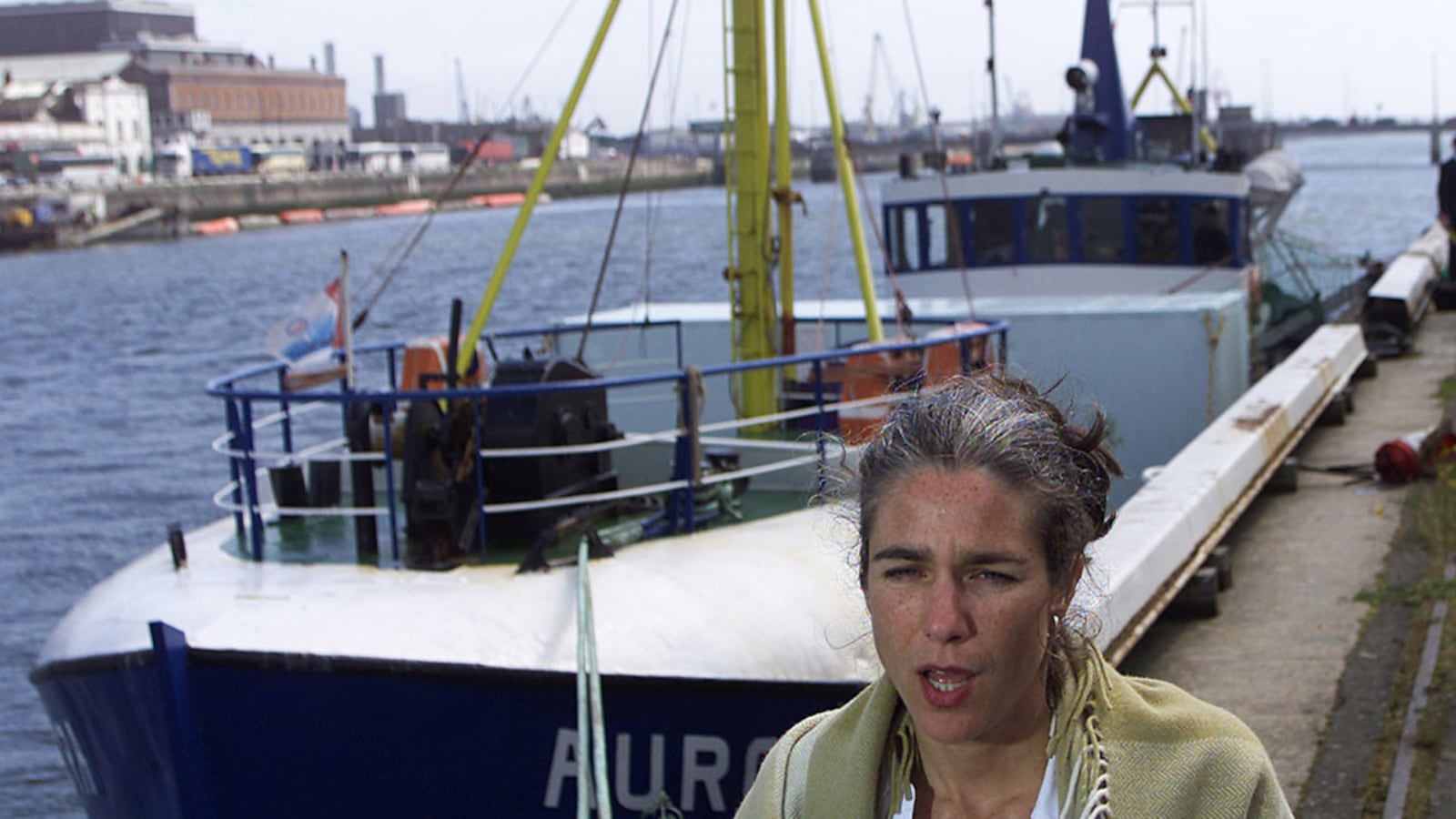
Gomperts was trained in direct action at sea in the 1990s, while serving as the doctor aboard Greenpeace’s Rainbow Warrior II. That experience led to the birth of Women on Waves. As she told The New York Times in 2001, “In my trips with Greenpeace, I became aware of the enormous and invisible suffering of women due to illegal abortions.” She had the idea of creating a floating clinic that would travel around the world, serving women from countries where abortion is banned. In 2001 her first abortion ship, a fishing boat called the Aurora, sailed for Ireland. Onboard were 20 doses of RU-486, myriad types of birth control, and a freight container converted into a mobile surgical abortion facility.
During that trip, more than 50 Irish women called the Women on Waves hotline, desperate enough to consider braving a gauntlet of journalists and demonstrators to seek abortions onboard. In the end, however, the group couldn’t serve them. As long as it was in international waters, the boat was supposed to be under Dutch law, but, amid an international outcry, the Dutch justice minister announced that Women on Waves had failed to acquire all the necessary medical licensing.
That didn’t stop Gomperts. In 2003, Women on Waves sailed to Poland, and that time, they were able to dispense 10 or 11 medical abortions onboard. The next year, they tried to go to Portugal, but the country sent war ships to block their vessel. In 2008, Gomperts brought a boat to Spain, treating four women. That same year, the group tried to sail to Ecuador, but its boat, the Harmony, was wrecked in a tropical storm. And that was the last sea campaign, until now.
Gomperts insists that focusing on the small number of abortions actually done on her boats misses the point. The missions are symbolic, meant to draw attention to the toll of unsafe abortion worldwide. “These few women that we actually help onboard the ship, they are very important, but [they] are not the only women that we help,” she says. “They open up the possibility to reach out to other women. The fact that we can actually do abortions on the ships makes the media interested, the people interested in the campaign. That is how other women know about medical abortion.”
According to the World Health Organization, around 47,000 women die from botched abortions each year, constituting almost 13 percent of maternal deaths. “It’s an outrage, a scandal that the world is just standing by, watching women die of something they really do not have to die from,” says Gomperts. “And it’s not just the women that die—it’s the whole families that are affected by it. And it’s not because of bad health systems. It’s really just because of bad law.”
Gomperts, however, isn’t just focused on changing laws. She also wants to teach women how to safely end unwanted pregnancies even when the law doesn’t allow it, by spreading the word about a drug called misoprostol. In medical abortions, misoprostol is typically administered in combination with another drug, mifepristone. (That’s the regimen Gomperts gives out at sea.) Used in high doses, however, misoprostol can be very effective alone, mimicking the effects of a spontaneous miscarriage. And because it is also sold as an ulcer remedy, it’s relatively easy to obtain, often without a prescription.
For the last four years, Women on Waves has been working with women’s groups worldwide to set up hotlines where callers can learn about using misoprostol to end their pregnancies. Such hotlines are now operating throughout Latin America, as well as in Indonesia and parts of Africa. There are four in Pakistan, for speakers of Urdu, Sindhi, Pashto, and Punjabi. “It’s really cheap, but the problem is that women don’t know about it,” Gomperts says of misoprostol.
Part of the point of sailing to Morocco, then, is to raise awareness about misoprostol in the Arabic-speaking world. “The local women’s movement, they didn’t know about misoprostol,” Gomperts says. “Nobody I talked with in Morocco in preparation for the campaign had any idea about the availability of misoprostol.”
Right now, Gomperts isn’t saying where in Morocco the boat will be landing or exactly when it will be arriving. (She plans to make an announcement on Wednesday.) Wherever she ends up docking, the idea is to stay about a week. If women want to obtain abortions on the ship, they’ll board with groups of supporters in order not to draw attention to themselves. It’s hard to believe that many, however frantic, would risk it, especially if protesters turn out in large numbers. “It might be that for women to go to the ship will be a little more difficult than in a European country,” Gomperts says. “But at the same time, women are pretty strong.” In the end, though, what matters isn’t what happens on the yacht. It’s the knowledge left behind.