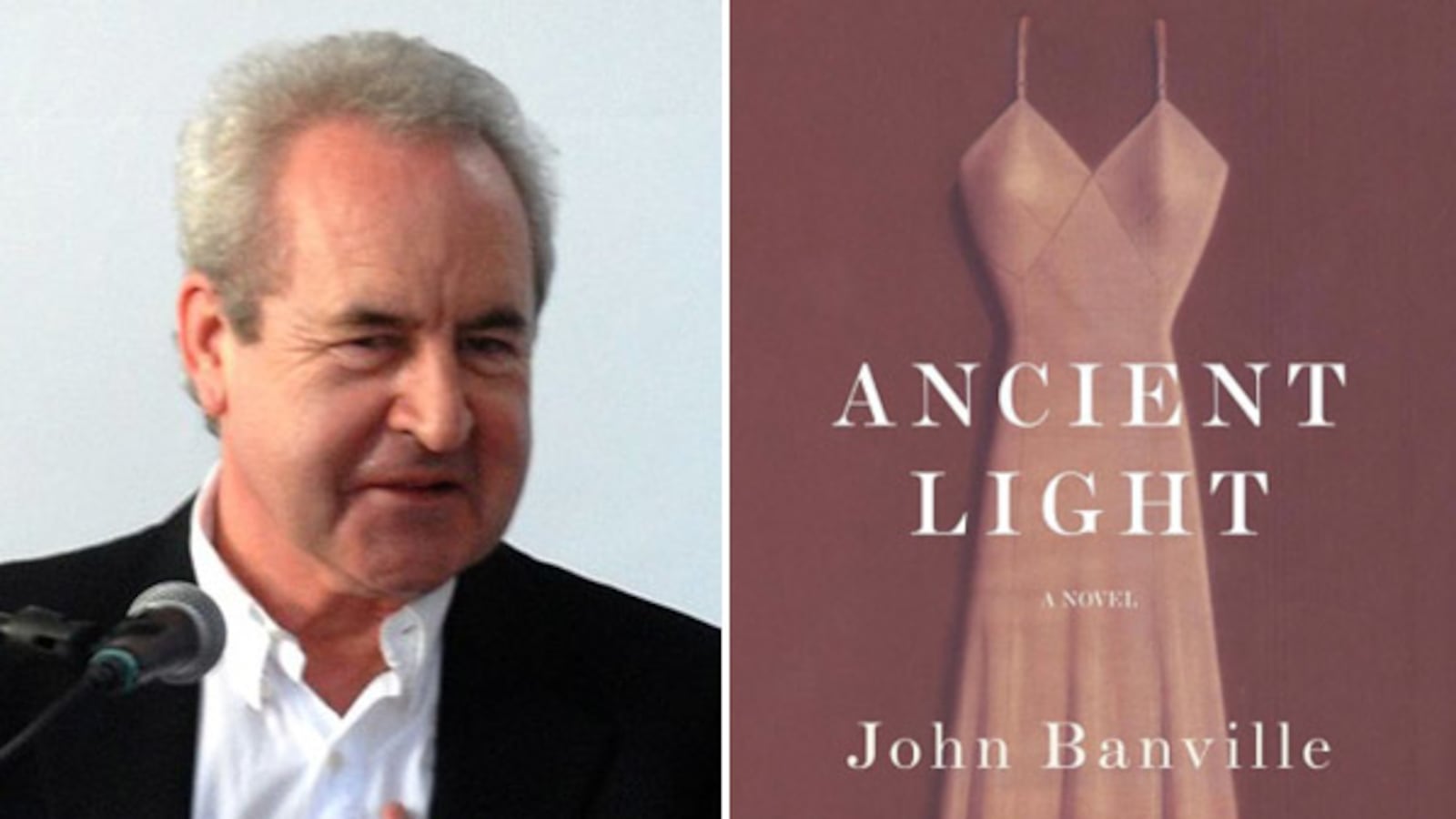

Which novel would you recommend as one’s first Banville reading experience? That’s a difficult question. The Newton Letter recommends itself by being short, The Book of Evidence heralds, I think, what might be called my later style, The Untouchable points to the coming of Benjamin Black; but the most representative is, I should say, The Infinities.
Your work has been variously, and positively, compared to Nabokov, Dostoevsky, and Camus, to name a few. Which authors were formative to your writing style, and which comparison do you think is the nearest approximation? Nabokov was a great love of my youth, but I find his artistic self-absorption and tone of self-satisfaction increasingly irritating. Dostoevsky is such a bad writer it is hard to take him seriously as a novelist, though he is a wonderful philosopher. Ditto Camus, though perhaps “wonderful” is a bit strong. What is odd is that no one ever seems to notice that the two real influences on my work are Yeats and Henry James.
Authors who have not won multiple awards (or indeed any) are always curious how the winning of awards affects one’s career. The effect of prizes on one’s career—if that is what to call it—is considerable, since they give one more clout with publishers and more notoriety among journalists. The effect on one’s writing, however, is nil—otherwise, one would be in deep trouble. All prizes are more or less lotteries. To take the judgement of prize juries as a measure of one’s talent would be disastrous. However, it would be dishonest to deny the childish pleasure that there is in the winning of a prize.
Describe your morning routine.I drive from home to my office, a small apartment on the river in the center of Dublin. I write there from 9 a.m. to lunchtime, I take a simple lunch—bread, cheese, nice cup of tea—work until 6 p.m., then home for dinner. Viewed from outside my head it is a singularly dull and uneventful day, but inside my head … aaah.
Where do you live and why? I live in Dublin, God knows why. There are greatly more congenial places I could have settled in—Italy, France, Manhattan—but I like the climate here, and Irish light seems to be essential for me and for my writing. Certain pearl-gray days in summer, or autumn afternoons under enormous Poussin skies, convince me I belong here. And I suppose Irish voices must be important too. I write in what we call Hiberno-English, and it would be disastrous to lose my literary accent, as both Joyce and Beckett began to do in exile. In their case the unique tone of voice they each unwittingly adopted only made for a deeper poetic intensity; I suspect if I were to undergo a similar loss the result would not be so productive.
Do you have a writer friend who helps and inspires you? What an idea! When young writers approach me for advice, I remind them, as gently as I can, that they are on their own, with no help available anywhere. Which is how it should be. Like Popeye, I am what I am.
Your wife has described you, while you write, as like “a murderer who’s just come back from a particularly bloody killing.” Please describe your writing routine, including any unusual rituals associated with the writing process, if you have them.I have no particular rituals, except utter concentration, or concentration as utter as is humanly achievable. In order really to write one has to sink deep into the self and become lost there. Frequently at the end of my working day I have only a hazy idea of what has been written. And when I stand up from the desk, the artist who writes ceases to exist, as I leap back nimbly into my workaday self and put on a face to meet the faces that one meets. Every artist has a Dorian Gray slaving away in the attic.
Is there anything distinctive or unusual about your work space? Besides the obvious, what do you keep on your desk? What is the view from your favorite work space? I have two desks at right angles to each other. On one I write in longhand, on the other I transcribe from the handwritten version to the screen, or, if I am being Black, I simply face the desk with the computer on it and clack away at the keyboard, making that distinctive sound which always reminds me of my old granny shifting her dentures. I have no view to look at. One desk faces the wall, the other a window through which I think I have looked about once in the past 15 years, and which I never clean, so that by now it as opaque as frosted glass. However, there are sounds that I like, especially that of children at play in the courtyard below, where they gather in the afternoons after school. Their voices seem to me, in my work-drunk trance, the voices of the gods themselves.
Do you have any superstitions? I am incurably terrified of air travel, and never get on a plane unless I have in my pocket a small metal ball, which was given to me as a gift many years ago in Arles. It appears to have been spun in one piece and to be perfectly seamless, but inside there are what seem to be three or four fantastically tiny harpsichords which, when the ball is gently shaken, make a delightfully cacophonous, miniature music. I imagine the plane going down amid the terrible shrieking of engines and passengers, while in my pocket my musical ball serenely plays its tiny tune.
What is the experience of writing a screenplay from one of your own books like? I believe that you wrote the screenplay for a film version of The Sea. In fact, shooting started just this morning on my screenplay of The Sea. I love writing film scripts, they are a kind of transcendent play.
Tell us a funny story related to a book tour or book event.Oh, God. I was in Miami, reading at the book fair. My partner on the platform had won the Pulitzer Prize the previous day. At the book signing afterwards, Pulitzer Man had waiting for him a queue of admiring readers that stretched up the spine of Florida, while I had three people—an academic who was writing something on my work, the usual maniac in a raincoat, and a kindly chap who leaned down and said to me in a confidential whisper, “I’m not going to buy your book, but you looked so lonely I felt I had to come and talk to you.”
What advice would you give to an aspiring author? The same advice that Rodin gave to Rilke: il faut travailler—toujours travailler. I take one of my mottoes from Noël Coward, who said that “work is more fun than fun.”
What is your next project?A novel dealing with, among many other interesting things, the aesthetics of thieving.
What would you like carved onto your tombstone? I’d rather not have a tombstone.