
Two women who rescued a country from civil war—and who shared a Nobel Peace Prize for doing so—now might need a peace plan of their own.
On Monday, Liberian peace activist Leymah Gbowee criticized her longtime ally Ellen Johnson Sirleaf, the Liberian president, for not doing enough to combat government corruption. Gbowee’s comments, in a BBC radio interview, coincided with her resignation as head of Liberia’s Truth and Reconciliation Commission, a group designed to report on human-rights violations during the war, and to promote peace and security. In a statement on her resignation, Gbowee cited “differences in opinion on the pathway for national healing and reconciliation.”
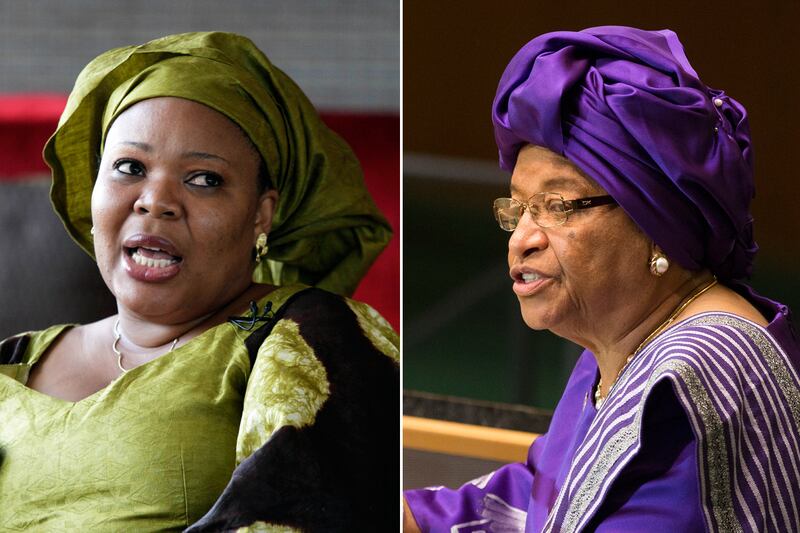
It was a startling move from a globally renowned activist who galvanized women to push for an end to civil war. She and Sirleaf have been working together to reboot Liberia, a place of staggering poverty and illiteracy, where child soldiers and cannibal warlords recently held sway. And although Gbowee’s critical comments may seem offhand to some observers, they have in fact raised profound questions about whether Liberia’s struggling postwar progress could suffer from the women’s apparent divisions.
Gbowee is clearly agitated; she spent a good deal of her statement discussing an accusation from the government that she had misused funds—an accusation she denies. It’s “a shame,” she said, that while Liberians are eager to “chart a new beginning,” some political leaders “see reconciliation as a threat to their personal interest” and are injecting “innuendoes and rumor-mongering in what should be a moral and sacred journey.”
Neither Sirleaf nor Gbowee immediately responded to requests for comment. The Liberian government said in a statement that it had accepted the resignation and that it disagreed with Gbowee, saying much has been done in fostering peace and reconciliation.
The two women received the Nobel a year ago, along with Yemeni democracy activist Tawakkol Karman, marking a triumph for women fighting for human rights and peace. Last year, Beast Books, an imprint of The Daily Beast, published Gbowee’s memoir, Mighty Be Our Powers.
On Monday, Gbowee said her criticism of Sirleaf is not personal. “I’ve been through a process of really thinking and reflecting and saying to myself, you’re as bad as being an accomplice for things that are happening in the country if you don’t speak up,” she told the BBC. “I also want to make it clear that my speaking up against these things does not mean that I hate President Sirleaf or that I am anti her regime.” At the same time, she said Sirleaf should dismiss her three sons from government positions as a sign that she is sweeping out nepotism.
This is the first public sign of discord between the two powerful women, whose relationship is strong, friends of both say. “It’s less a friendship than a relationship of a mother and daughter, or a mentor and mentee,” says Abigail Disney, a filmmaker and philanthropist who produced a documentary on Gbowee called Pray the Devil Back to Hell. “Ellen has been around the political circles a lot longer than Leymah has, and by virtue of her age has a lot more history.”
Disney thinks Gbowee said exactly what was on her mind. “We talk at great length about all of this. Honestly, given how long she has been struggling with her feelings about all of this, I am amazed it took her this long to speak publicly," she says. "It is only out of loyalty to Ellen and a wish to get things improved quietly without causing embarrassment to anyone that she has been quiet for so long."
The two women took different paths to the Nobel. Gbowee, now 40, was 17 when civil war exploded. At the time, she has said, she did a “total flip,” morphing from a teenager with dreams of medical school to an instant adult, responsible for finding food for her family. “Every day, I went out to look for food. I saw bodies, people being shot. You’re just existing. You’re alive. There’s nothing to look forward to,” she said earlier this year at Newsweek and The Daily Beast’s Women in the World summit. She kept waiting, she said, “for a white knight.” Finally, when she was 31, she realized “no one will come.” She mobilized women to demand peace, organizing demonstrations and a “sex strike,” in which women withheld sex from the men in their lives. She is credited with helping to end the war and vanquish dictator Charles Taylor in 2003, opening the door for Sirleaf.
Sirleaf, 73, went to college in Liberia, later marrying and moving to the U.S., where she earned a master’s degree at Harvard. Over the years, she held jobs both at home and abroad, working intermittently for the government in Liberia and in finance—for the World Bank and Citigroup—in the U.S. and Africa. In 1997, she ran against Taylor for president and lost, fleeing the country soon after. In 2005, she faced opponent George Weah, a soccer star, and won, becoming the first woman to be elected head of state in modern Africa. She has credited her mother with encouraging her to pursue an education. She also has said she became president by appealing to mothers who wanted to send their children back to school, after back-to-back wars of nearly 14 years decimated schools around the country.
As her star rose in the global community—she received a Presidential Medal of Freedom, among other honors—she was criticized at home. Her first term was marred by corruption scandals. She described her monumental challenges to Newsweek last year: “We found a totally collapsed economy, dysfunctional institutions, lack of proper laws and policies, low capacity, and a value system upside down,” she said. When she took the helm of Liberia—a country that started as a colony for freed American slaves—she persuaded international creditors to pardon more than $4 billion in debt. She established laws and police units to focus on crimes against women and children. She supported the creation of watchdogs to look for graft in government, firing those who improperly profited.
Last year, soon after winning the Nobel, Sirleaf was elected to a second term. She appointed three of her four sons to government positions, because these are the people she felt she could trust, says MacDella Cooper, a Liberia native who runs a foundation in New York for Liberian children, and who knows both Sirleaf and Gbowee. Sirleaf is “limited in the number of people she can work with” in a country beset by poverty, illiteracy, and unemployment, says Cooper. “She has done everything she could possibly do—she has shuffled people around; she has fired some of her very good friends.” Cooper notes that many of the country’s educated elite have long since cleared out, and aren’t coming back.
Global watchdog group Transparency International said in a report this year that Sirleaf “has demonstrated a strong leadership on anti-corruption issues,” but that corruption “remains endemic and permeates most sectors of the society.”
Gbowee says Sirleaf’s sons need to be swept out. One recently was suspended for failing to declare his assets, but two remain. Gbowee singled out Robert Sirleaf, a senior adviser and chairman of the board of state-owned National Oil Company of Liberia. “This is wrong and I think it is time for her to put him aside,” Gbowee told the BBC. “He’s a senior economic adviser, and that’s well and good, but to chair the oil-company board—I think it’s time he stepped aside.”