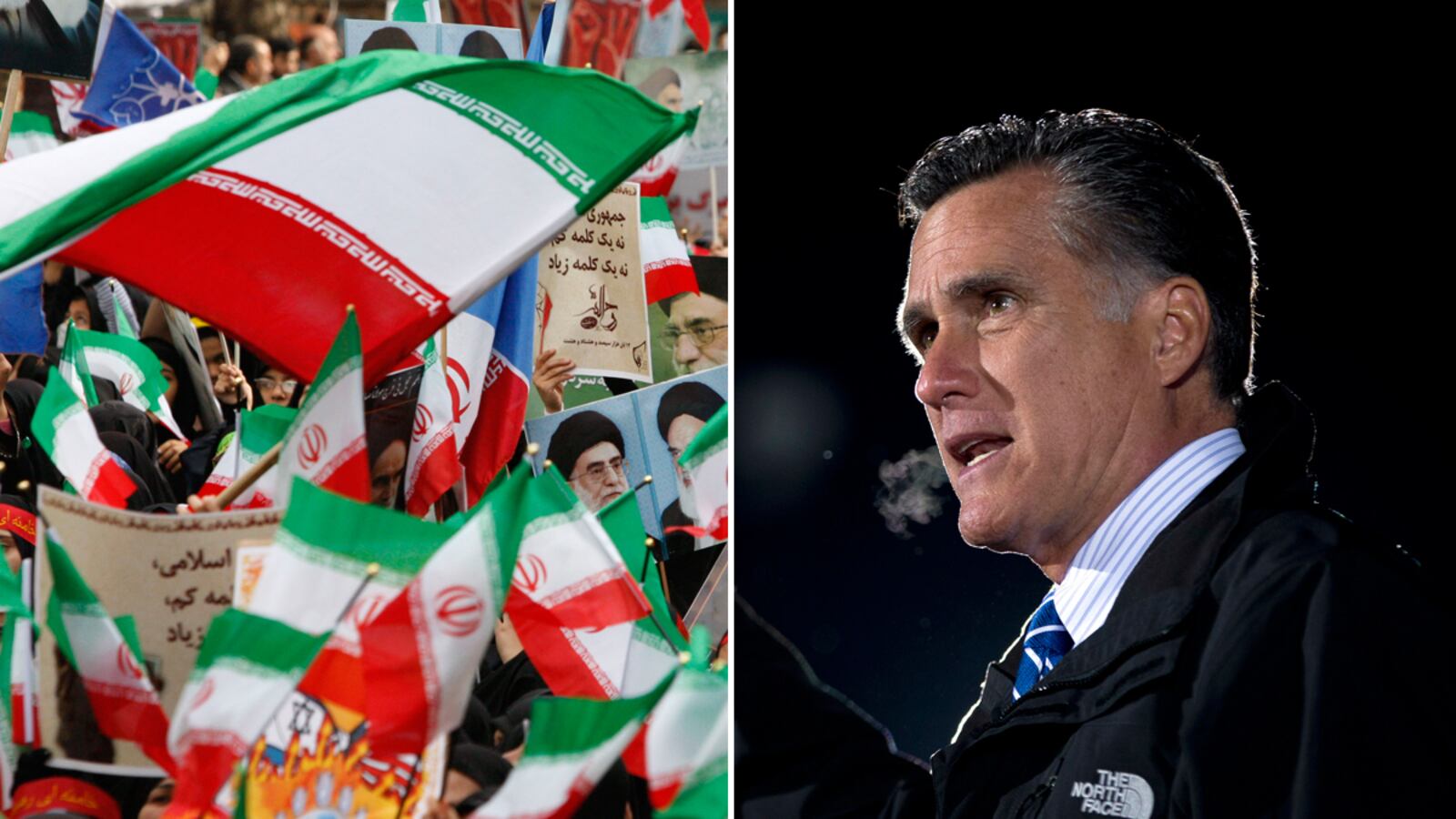
This week, in his first major foreign-policy speech, Mitt Romney excoriated President Obama for not doing enough to support Iran’s Green Revolution. “When millions of Iranians took to the streets in June of 2009, when they demanded freedom from a cruel regime that threatens the world, when they cried out, ‘Are you with us, or are you with them?’—the American president was silent,” Romney said on Monday.
We should be grateful that Mitt Romney was not the president of the United States during those dark days in Tehran, as the actions that he appears to favor would have been an absolute catastrophe for the protesters who risked their lives in the street and for Iran’s pro-democracy movement. Had Romney’s strategy been in effect, not only would more people have been beaten and murdered by the callous regime, but the U.S. would have lost considerable moral authority abroad. What Romney and his coterie of neoconservatives fail to understand is that American support would have ended the political life of the pro-democracy movement in Iran, which remains the only hope for real change in the country.
In advocating against “silence,” Romney wasn’t clear on what path Obama should have taken. Should he have armed the protesters as Romney suggested the U.S. should do in Syria to “ensure that they obtain the arms they need to defeat Assad’s tanks, helicopters and fighter jets?” If that’s the case, it’s important to remember that the only Iranian groups who might favor armed conflict have shown themselves to be the most violent and undemocratic forces in the country. Most are hated by the Iranian people as much if not more than the regime.
Mitt Romney doesn’t seem to have thought through the implications of his rhetoric. As the demonstrations grew, the two main opposition leaders—Mir Hossein Mousavi and Mehdi Karroubi—repeatedly emphasized that the protests were grassroots, peaceful, and unrelated to any foreign governments. And with good reason. For more than three decades, the Iranian regime has accused political dissidents of being American pawns as an excuse to suppress them.
After the 2009 election, when hardliners in Tehran faced a strong and unprecedented backlash from those who were fed up the fraudulent results, the regime claimed that the U.S. had orchestrated the protests. They made these accusations in order to demonize the opposition and to justify one of the most brutal crackdowns Iran has ever experienced.
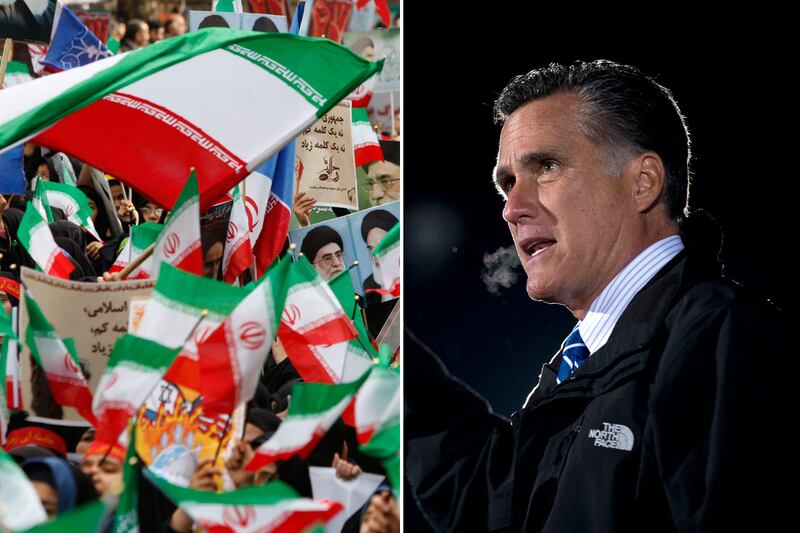
If President Obama had publicly supported the pro-democracy protesters, he would have played right into the regime’s hands. The movement would have lost its authenticity in the eyes of a wide range of supporters, irrespective of class, ethnicity, or political beliefs. Remember that in 1953 the CIA helped overthrow the most democratic government Iran had ever seen; for years, the American government also helped prop up the corrupt and feckless government of Shah Mohammad Reza Pahlavi. It’s no wonder that people in Iran, and the Middle East, are highly suspicious of any U.S. political interference.
In his speech, Romney seemed completely oblivious to this history. Indeed, in saying that he would “put the leaders of Iran on notice,” Romney was essentially threatening to attack Iran if the regime did not comply with the wishes of the White House. With this bombast, however, Romney’s campaign is doing exactly what the hardliners in Tehran want him to. Fear of an inevitable U.S. or Israeli attack allows the regime leverage; suddenly any disagreement can be construed as a “threat to national security.”
These empty threats also tarnish America’s moral authority, something which is in short supply after two disastrous wars during the Bush years. If anything, Romney—with all his irresponsible boasting—has simply reminded the world how American ignorance and bravado can embolden the enemies of freedom and democracy, just as it did during between 2001 and 2008.
Both as a candidate and as president, Obama has made it clear that he aims to restore the U.S.’s moral authority across the globe. In dealing with Iran, Obama has engaged the international community, including the U.N., the European Union, and among others, to establish a powerful and unified front against Iran. Obama was the driving force behind securing multiple rounds of crippling U.N. sanctions against the Islamic Republic, which have shown the Iranian leadership the true costs of behaving irresponsibly on the global stage.
The move toward sanctions has deftly been accompanied by a consistent effort to highlight Iran’s human rights violations. Throughout Obama’s presidency, dozens of Iranian officials have been blacklisted by the U.S. government and much of the international community. These moves make human-rights violations costly for perpetrators and act as a deterrent for potential wrongdoers. They also send a strong signal to the Iranian people that the U.S. and the international community aren’t forgetting them, even as sanctions cause prices to skyrocket.
The U.S. can and must do much more to support the Iranian people in their fight for freedom. But judging by his rhetoric, what Mitt Romney intends to do would set us back considerably; it would make life harder not only for Iranians, but for everyone else in the already volatile Middle East.