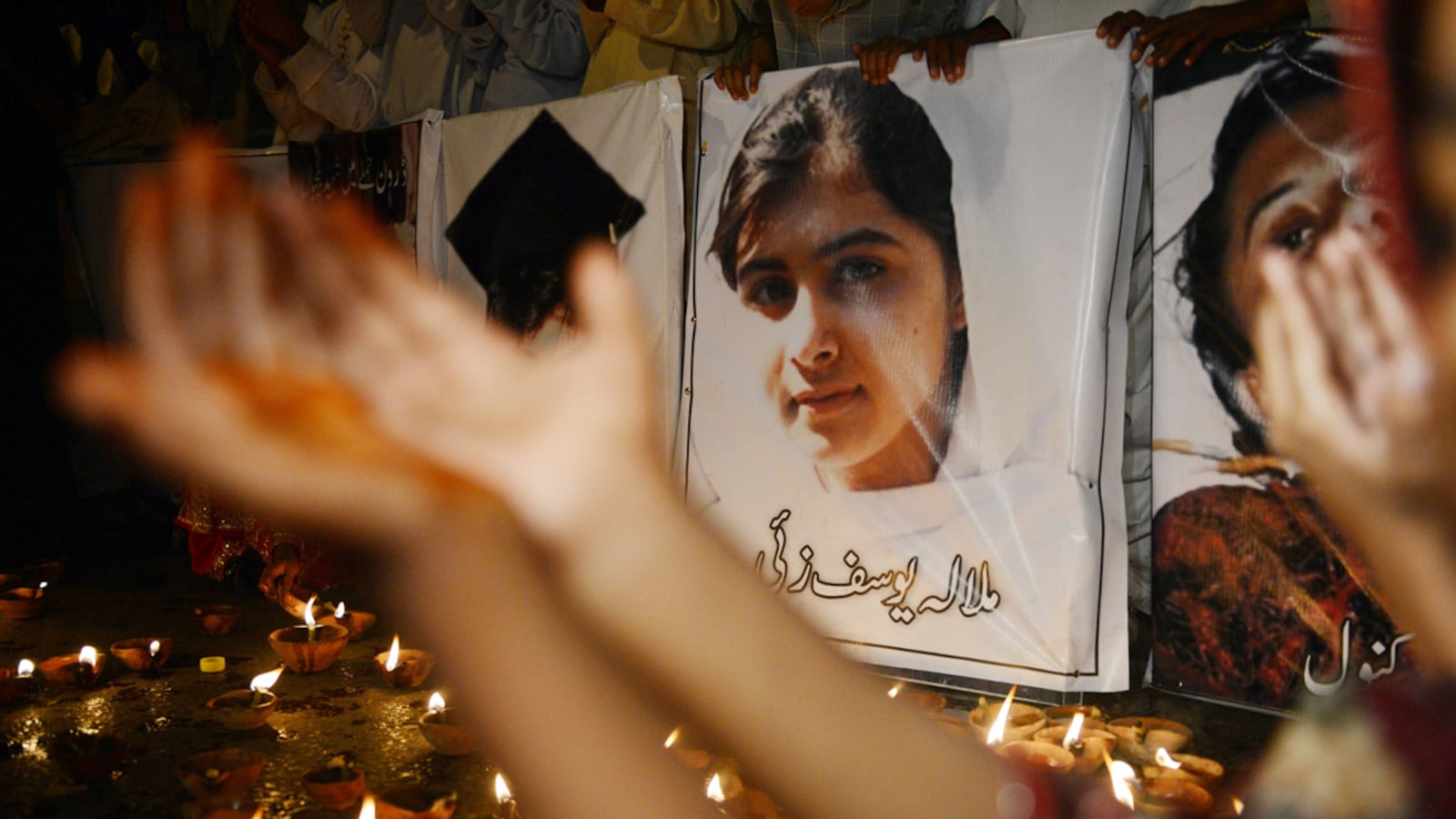
Malala Yousafzai is still fighting for her life three days after the Taliban shot her—along with two female schoolmates—-at point-blank range. The 14-year old Pakistani activist, who campaigned for girls’ education, lies unconscious in an army hospital in Rawalpindi, surrounded by pediatric trauma experts. Her condition remains uncertain. Doctors say the next 48 hours could determine not only her ability to user her left arm and leg, but also the course of her potential recovery. CAT scans have also reportedly shown a possible brain injury.
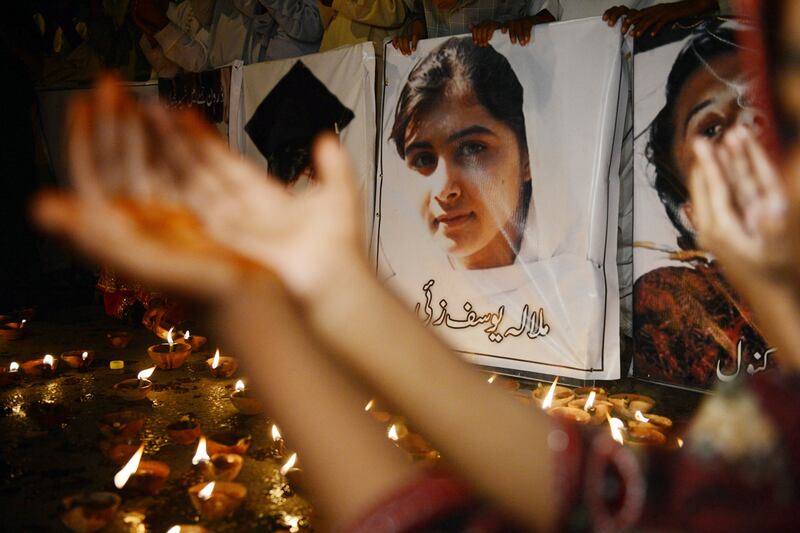
Meanwhile, outside her hospital room and across Pakistan, there is a sense of anger—and of déjà vu.
The brazen attack on the lovable teenager has shaken the country down to its core, sparking many rallies in her support. Meanwhile, in Pakistan’s electronic and print media, the outrage is aptly pouring out. Even religious talk show hosts are discussing how such a crime has nothing to do with Islam.
The country’s anger is not only directed towards the gunman—though it has spurred a massive hunt for those responsible for the shooting, with news breaking on Friday that police had arrested four suspects in the Swat Valley, where the attack occurred, and had identified a mastermind, who remained at large. The fury is also directed towards the Taliban as an organization that would mastermind such an attack, and that has said it would hurt Malala again if she survives. More than 50 Islamic scholars affiliated with the Sunni Ittehad Council (SIC) have issued a joint fatwa calling the attack un-Islamic. Political party leader Ataf Hussain, from the powerful Muttahida Qaumi Movement (MQM), appealed to his supporters to not attend prayers led by any cleric that does not condemn the attack.
Pakistan has been here before. In April 2009, a video of a girl being flogged by the Taliban surfaced on YouTube and similarly bound the whole country together in collective outrage. That time, the video gave the Pakistani army a mandate to mount an attack of its own, with the result being a massive military operation to drive the Taliban out of Swat.
This time, an innocent teenager has been caught in the crossfire. Now, Malala’s story is being shaped in the country’s media as Pakistan’s version of Rosa Parks. Like Parks--whose refusal to sit in the colored section of a public bus in Montgomery, Alabama made her into a leading symbol for America’s Civil Rights movement—Malala is now being turned into an icon of resistance to injustice. She was on the Taliban’s radar in the first place because of her outspoken criticism of their regime in Swat after they banned girls from going to school past the fourth grade. She started expressing her disdain for the cloistered way of life under the Taliban by writing for BBC Urdu under a pen name. She eventually spoke out on national and international platforms championing her cause for girls’ education in Pakistan.
History is peppered with turning points where certain events determine the course of actions for nations, be it Pearl Harbor or Sept. 11. If Malala’s shooting proves to be the turning point for Pakistan’s fight against the Taliban, she will be the symbol of that turn, no matter which side wins.
Much of the discourse in Pakistan in the last few weeks has been about the power of negotiations—despite the Pakistan army’s continuous reassertions that the Taliban must be crushed. During a speech on Pakistan’s Independence Day, chief General Ashfaq Parvez Kayani told the nation, “The fight against extremism and terrorism is our own war and we are right in fighting it. Let there be no doubt about it, otherwise we’ll be divided and taken towards civil war. Our minds should be clear on this.”
But getting the rest of the nation behind the idea of an internal war against the Taliban has been an uphill battle. Until, perhaps, now. Malala’s shooting seems to have united Pakistan against the Taliban. Nobody wants to negotiate with barbarians.
Editorials like the one published in The Express Tribune are questioning, “Will Malala unite us against terror?” The battle lines are being drawn, asking the nation to choose which version of Pakistan they would like to be a part of: one that Malala represents, or the one that the Taliban represents. Achieving Malala’s version of Pakistan means yet another military operation. But this time, let’s hope the results are not the same as always, pushing the Taliban far enough away but not fully out.
Both Pakistan’s future and Malala’s life seem to hang in the balance.