Anyone who’s ever been captured knows the punishing fantasy of rescue. During the 410 days that I was held hostage in Iran, the most common escape scenario I played in my head involved the door of my cell bursting open in the dead of night to reveal a group of heavily armed men who, with my now-husband Shane Bauer and friend Josh Fattal in tow, would lead us to a helicopter waiting nearby to fly us to safety.
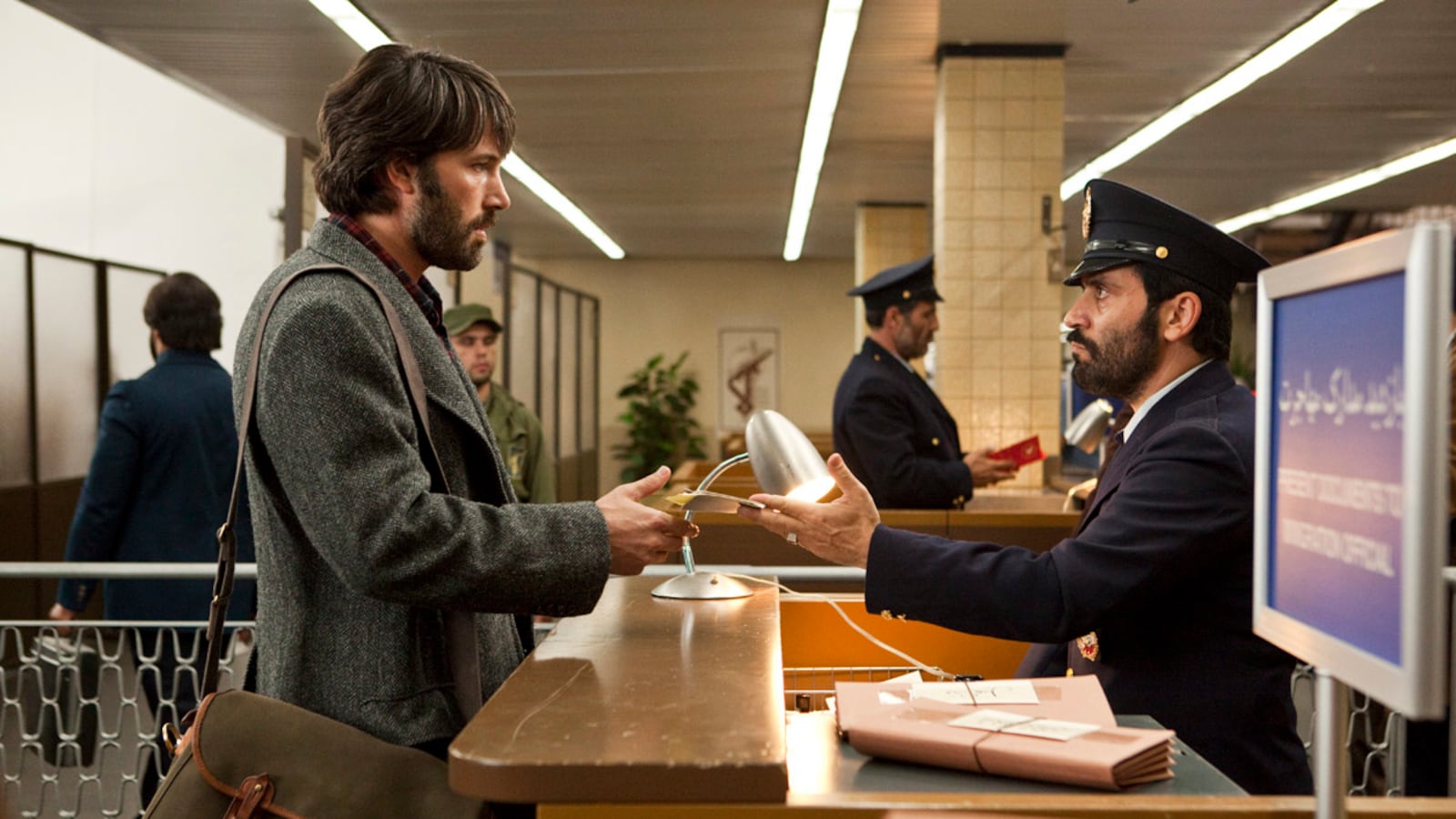
I went to see Ben Affleck’s new film Argo as soon as it hit the theaters last week. I was eager to learn more about the most outlandish, and perhaps least known, rescue of Americans in history—and see it play out on the silver screen. I was curious to note the similarities and differences to my own situation and, perhaps most important, to tease out the perspective that, in portraying the historic events that set the stage for U.S.-Iranian relations for the next 30-plus years, Affleck could not help but present.
The film tells the little-known story of six U.S. diplomats who escaped the American Embassy in Tehran immediately after it was stormed by a crowd of angry Iranians during the aftermath of the Islamic Revolution of 1979. The 66 other diplomats were subsequently held hostage for 444 days, while these lucky six made it to the residence of the Canadian ambassador to Iran, Ken Taylor, where they secretly lived for 79 days before they were effectively rescued with the help of the CIA, using the most unlikely cover story of being in Iran to scout out the location for a Canadian film project.
Argo’s stunning cinematography and incredibly realistic acting impressed and entertained me. The story itself, even if it is only loosely based on history (as Affleck took pains to point out), is fantastic and timely. Still, when I left Argo, I found myself worried about the incomplete, and at times inaccurate, impression that many viewers would walk away with.
First, in an attempt to set the stage for his audience, Affleck begins the film with a two-minute rough sketch of Iranian history. Presenting centuries of Iranian history in two minutes is of course an impossible task, and the result is grossly oversimplified and ultimately falls short of providing the viewer with much-needed context for the events about to unfold. For example, the film states that Iran’s prime minister, Mohammad Mosaddegh, was replaced by the shah in a coup d’état orchestrated by the U.S. and Britain in 1953. It’s true that Mossaddegh was overthrown in a U.S.- and British-led coup, but he and the shah had already both been in power, the latter since 1941, when the shah inherited the throne from his father. The coup did give far more power to the shah, but it’s misleading to give the impression that the shah was installed by foreign powers when in fact—though he was greatly weakened—he hadn’t left power. As we all heard Vice President Joe Biden articulate last week in the debates, “the facts matter.”

Any time is a tricky time to make a film about the 1979 Iranian hostage crisis, but at this particular moment, the stakes are as high as ever. Iran’s economy has been hit by the most crippling international sanctions in history, up to the point where it’s not just luxury goods but bread that has become unaffordable for many Iranians. Diplomacy has slowed down Iran’s nuclear program, but has yet to be successful in stopping it, and both U.S. presidential candidates have made it clear that they will resort to military action if Iran begins to build a nuclear weapon. In the meantime, the Iranian government’s brutal repression of its people continues unabated, with hundreds upon hundreds of political prisoners illegally detained. Military intervention in their country would only give the regime an excuse to consolidate power, making an already sad human-rights situation in Iran even worse.
For those reasons, the timing of this film’s release gives its content, and the politics it conveys, that much more weight and importance. In my opinion, despite its big Hollywood stars and breathtaking cinematography, the historic lesson would be all but lost if it weren’t for the film’s most minor and most easily overlooked character: the Iranian maid.
Her appearance is so brief and unnoted that I don’t even remember if we learn her name. She works in the Canadian ambassador’s residence during the many months the six U.S. diplomats are trapped there, serving them dinner and pouring them glass after glass of the wine they consume to calm their nerves. At first, she doesn’t know who they are or that they are in hiding, but she eventually begins to wonder why they never leave the house, puts two and two together, and figures out just how deeply in trouble they are.
In the moment leading up to the diplomats’ escape from the country, Revolutionary Guards come to the house to question the maid. They know that six American are missing. “How long have these six Canadians been here?” they ask her. The camera zooms close to her frightened eyes, we watch her hesitate for a fraction of a second before she decides to cover for them. “Two days,” she lies. “The people in this house are all friends of Iran,” she continues, thereby saving their lives.
I told my captors the same thing many, many times. “I’m a friend of Iran,” I would say, and many of them believed me. For me, this young woman’s character represents the courage shown by ordinary people when they simply do the right thing, despite the consequences. I myself witnessed this same courage from other political prisoners in my ward, many of whom shouted words of love and encouragement to me down the hall, and from our incredibly brave lawyer, Masoud Shafii, who currently can’t practice law or leave the country because of his work on our case.
This is the side of Iran that Americans need to see, particularly in a film depicting a CIA intervention in Iran. It must be starkly clear what the difference is between saving Americans lives and the all too real prospect of military intervention in this country, which would no doubt result in the death of innocent Iranians. Now, more than ever, it’s important for Americans to understand the difference between the majority of Iranians and this cruel, Machiavellian regime that holds their country hostage.
At the end of the film, while the six Americans are popping champagne bottles on the airplane on their way home, their Iranian maid is seen fleeing the country into Iraq. We have no idea what happens to her, and we leave the film knowing that those six, lucky Americans will never know who their real hero is. They will never know she saved them.
In the end, it wasn’t a dramatic rescue, but the no-less-incredible maneuvers of international diplomacy that led to my release, as well as that of my companions. Still, the foreign diplomats of Oman and other countries, as well as the ordinary Iranians who stood up and took risks for Shane, Josh, and me, didn’t do it because they love America, they did it because they followed their own humanity—just like the young maid depicted in Argo—and decided to stand up for what they knew was right.