

Something comparatively unusual happened on Friday: no banks failed.
Since the onset of the financial crisis, the last day of the work week has typically been Failure Friday. After the markets close, the FDIC's SWAT teams swoop in, close down listing banks and then transfer ownership to a new entity who can reopen for business on Monday. After years in the middle part of the last decade when no banks went down, bank failures rose sharply: 30 in 2008, 140 in 2009, and 157 in 2010. (The FDIC's complete failed bank list can be seen here.)
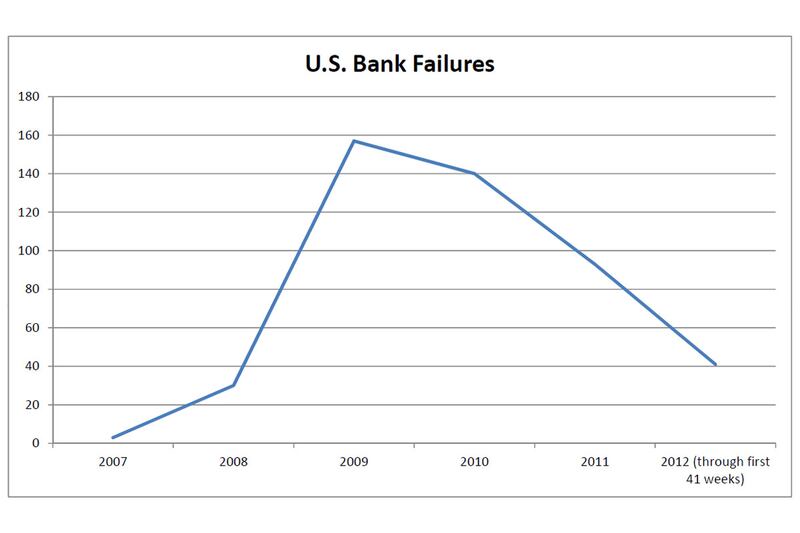
But the wave of failures has subsided. Bailouts, government guarantees, and the Fed's easy money policies helped buoy banks. Meanwhile, American companies, borrowers, and consumers started to do a much better job keeping up with financial obligations. This is one of the great underreported and underdiscussed features of the current economic expansion. As defaults on mortgages and other debt declined -- as financial failure declined, in other words - bank failures started to go down, too. In 2011, 93 banks failed. That's high by historic standards, but it was down 40 percent from 2010. And the size of the banks failing fell, too. All of which meant the systemic implications of bank failures became far less severe in 2011 than they were in 2010.
That trend is continuing through 2012. Through the first 41 weeks of 2012, 43 banks have failed. That's still (duh!) a pace of about one per week. But, again, it is down sharply from 2011. In the first 41 weeks of 2011, 80 banks failed. So far through 2012, then, bank failures are down 46 percent from 2011. And in the past 11 weeks, only four banks have failed.
That's good new for owners of banks, for depositors who tend to get stressed out when their bank fails, and for the FDIC deposit insurance fund, which continues to replenish itself. It's also good news for the economy at large.