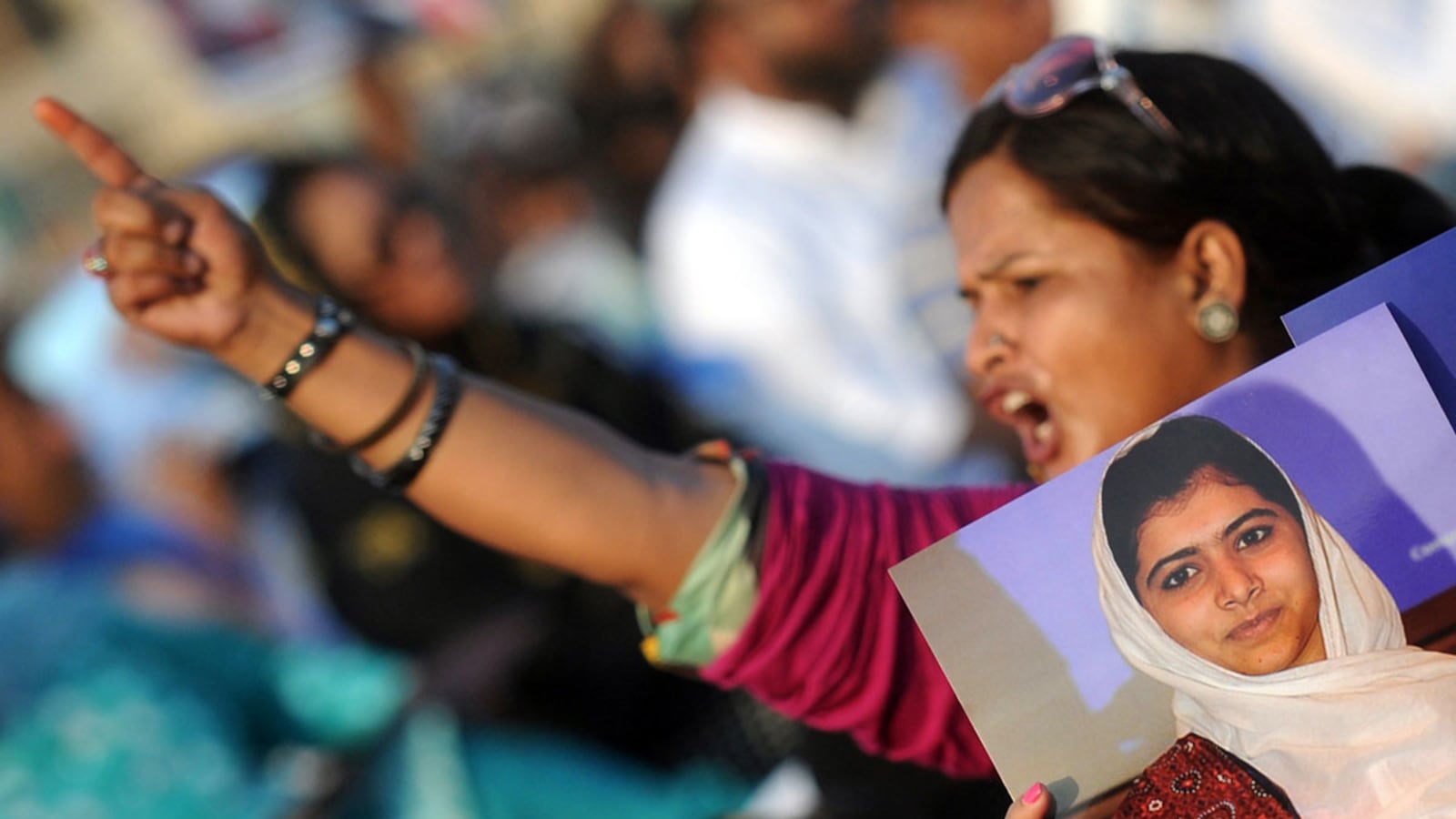
Malala Yousafzai has taken one more step in her very long and difficult journey. Separated from her family for now, the 14-year-old Pakistani schoolgirl arrived today at Birmingham’s Queen Elizabeth Hospital, Britain’s primary receiving facility for military casualties returning from overseas. Doctors say she still has not regained consciousness since being shot in the head by a Pakistani Taliban gunman who forced his way into a van full of schoolgirls, asked for her by name, and opened fire.
The attack has provoked unprecedented levels of public outrage, both in Pakistan and Afghanistan—even among people who have in the past sympathized with the militants. “First of all, attempting to kill a 14-year-old girl is a low act,” says Mullah Yahya, who was a high-ranking Afghan Information Ministry official back in the 1990s, when Mullah Mohammed Omar’s regime was in power. “Second, claiming responsibility for it is a sign that the [Pakistani] Taliban are not aware of the media’s importance. I have seen more anger against the religious elements in the past week than in all my 40 years of life.” Pakistan’s interior minister, Rehman Malik, says the government has posted a $1 million bounty on Ehsanullah Ehsan, the Pakistani Taliban spokesman who claimed responsibility for the shooting.

So how are the Pakistani Taliban responding to so much public condemnation? By declaring war on individual journalists and the media, of course. “For days and days, coverage of the Malala case has shown clearly that the Pakistani and international media are biased,” says a Pakistani Taliban commander in South Waziristan. “The Taliban cannot tolerate biased media.” The commander, who calls himself Jihad Yar, argues that death threats against the press are justified: he says “99 percent” of the reporters on the story are only using the shooting as an excuse to attack the Taliban.
Jihad Yar does not apologize for the attempt to assassinate the girl, who was passionately opposed to the militants’ efforts to close girls’ schools. “We have no regrets about what happened to Malala,” he says. “She was going to become a symbol of Western ideas, and the decision to eliminate her was correct.” There’s proof, he says: video footage of her meeting America’s ambassador to Pakistan. “If she was not important for the West’s agenda, why would a U.S. ambassador meet her?” In the next breath, the commander insists that “Malala’s case is not important. The Taliban will not spare journalists who focus on this one girl and never talk about dozens of girls who have been killed by U.S. drones in tribal areas and Afghanistan.”
It may be possible that “dozens of girls” have died in drone attacks against the militants, but all too often there’s no way to investigate such accusations. Independent reporters seldom dare to visit Taliban-controlled territory these days. “It isn’t possible for the press to trust the Taliban,” says Noor Rahman Sherzad, an Afghan journalist now living in Sweden. “They’ve kidnapped and killed too many reporters.” He was based in Jalalabad until 2007, when the Taliban bombed his house. “I used to get calls every day from the Taliban, saying ‘we killed dozens of U.S. soldiers,’ but how could I report that without confirmation? The Taliban never understood the basic rules of journalism.” They didn’t give up even after he left the country. Instead, Sherzad says, they kidnapped his brother, a TV cameraman. They promised to release him—if Sherzad would return to Afghanistan and appear before a Taliban court. Luckily his brother escaped.
Mullah Yahya agrees with Jihad Yar that the media and the Americans are side by side against the Taliban. “But I would blame the Taliban as well,” he says. “If they allowed independent media to visit Taliban-controlled areas, it could have a very positive effect on their coverage. In fact we have suggested this to their media department, but they’re only interested in kidnapping reporters, not in cooperating with them. Their information ministry thinks all other journalists are spies or are working for Western goals. They’re wrong, but we don’t make their decisions.” Anyway, he says, it’s probably too late to mend relations now. (In fact, the Afghan Taliban used to welcome foreign journalists until a few years ago.)
Mullah Yahya says his biggest complaint against the press these days is that when the Americans or Kabul government forces claim to have killed scores of Taliban fighters in battle, the story makes headlines, whereas if the Taliban say they’ve inflicted similar numbers of casualties, no one seems to believe them. Jihad Yar agrees: “Pakistani and Western media never accept our claims of success,” he says. “They only report whatever they’ve been told by the Pakistani Army and [Pakistani Interior Minister] Rehman Malik. “
The interior minister is only one among a vast number of people Jihad Yar regards as the Taliban’s enemies. They include Americans and secular Pakistanis and “Jewish-funded international TV and newspapers,” predictably enough, of course, along with various other members of the media, including “Pakistan’s Shia TV channels,” which “have been against the Taliban from day one” and a long list of female journalists: “They were at the U.S. Embassy party with wine glasses in their hands and wearing un-Islamic dress with Americans.”
The militants have waged a fear campaign against journalists in Pakistan for years. Back in 2009 a suicide bomber hit the Peshawar Press Club. The Taliban didn’t claim responsibility, but they did issue threats beforehand. Now they’re continuing their war of nerves. “The anti-Taliban coverage surrounding the Malala case will force the Taliban to teach a lesson to Pakistani and Western media,” says Jihad Yar. He and his associates can threaten the messengers all they like, but he needs to understand that the message is coming not from the press but from the ordinary people of Pakistan and Afghanistan, who refuse to believe that the deliberate shooting of schoolgirls could ever be described as “holy war.”