In April, Khadija Ismayilova received an anonymous letter in the mail. At the time, the Azerbaijani journalist, a reporter for Radio Free Europe, was investigating whether the president’s family members had received kickbacks from lucrative construction projects in the capital of Baku. Inside the package, Ismayilova discovered intimate pictures of herself and her boyfriend, apparently taken by a hidden camera installed somewhere in her apartment. With the pictures, a note: “You whore, behave or you will be defamed.”

Ismayliova did not behave. Instead, she went public with the threat, vowing to continue her stories on high-level corruption. The sex tape was released online, and government-backed newspapers denounced her as a loose woman—a dangerous charge in conservative Azerbaijan, where honor killings still occur and where the editor of an opposition newspaper was murdered near his home in 2005. Ismayilova’s friends took up shifts to guard her apartment—where she had uncovered the hidden camera, along with taps on her phones—because the government refused to provide her with protection. Still, she remained undaunted; while she has acknowledged that her investigations are dangerous, she says that’s no reason to stop them.
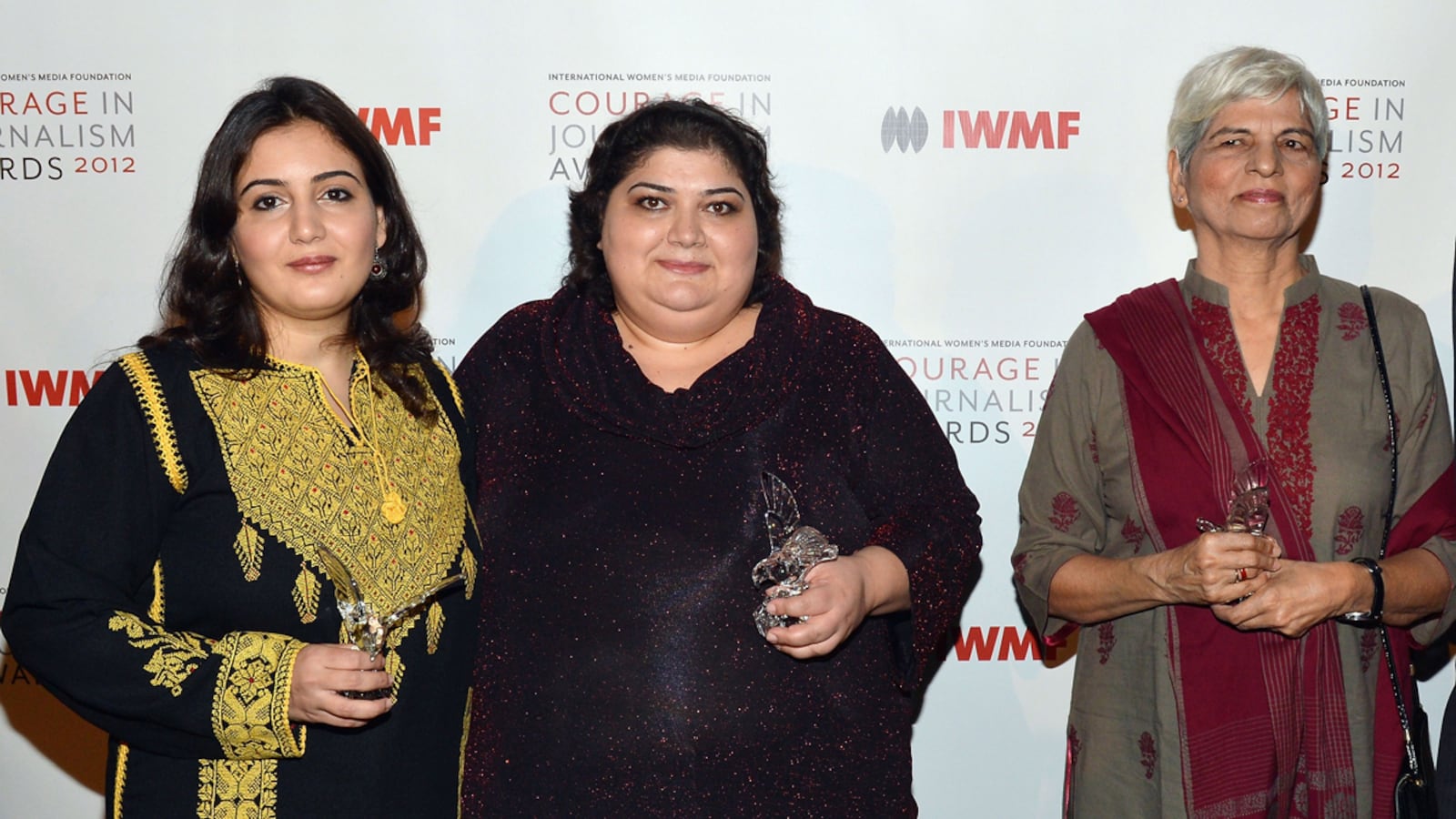
Ismayilova was among four trailblazing female journalists honored by the International Women’s Media Foundation (IWMF) at the group’s Courage in Journalism and Lifetime Achievement Awards, held Wednesday in midtown Manhattan. The ceremony, which took place over lunch in the grand, cavernous space of Cipriani’s 42nd, was co-hosted by Christiane Amanpour and Cynthia McFadden of ABC News, with Lesley Stahl, Brian Williams, Judy Woodruff and Ann Curry presenting. (A separate ceremony will take place in Los Angeles on October 29, with comedians Chelsea Handler and Olivia Munn among the presenters, as well as broadcast legend Maria Shriver.)
The IWMF has long been devoted to shining a spotlight on journalists—and particularly female reporters, columnists and anchors—who fight to expose corruption and speak for the voiceless in countries where, as Amanpour put it, “doing the work of a journalist and calling yourself a journalist is a life-threatening experience.” This year, the honorees ranged from the Azerbaijani Ismayilova to a Palestinian writer targeted by Hamas, an Ethiopian columnist jailed as a terrorist for criticizing her government, and Pakistan’s first mainstream female journalist, whose articles on family planning, breast cancer and abortion helped pave the way for a whole generation of female reporters in her country.
For these women—and countless others in the regions where they live and report—“to be an independent journalist is to be an enemy of the state,” as Stahl said in her introduction to Ismayilova. Indeed, in a U.S. diplomatic cable from 2009 released by WikiLeaks, Azerbaijan’s President Ilham Aliyev complained that Ismayilova was an “enemy of the government,” and later tried to get her fired from her job.
Ismayilova prefers to characterize what she does as “reporting the truths about the cruelest regimes.”
“Silence is what these regimes need,” she told the audience. “Silence helps them to continue depriving their people of opportunities…the silence is so loud that it might deafen society.”
Silence is what Ethiopia might have hoped to impose on award winner Reeyot Alemu when it arrested her in June 2011. Alemu, a columnist for the independent journal Feteh, has been a tireless voice on issues such as poverty and gender inequality in her country, and has criticized the government of Prime Minster Meles Zenawi—a man in power for the past 21 years—for violently cracking down on pro-democracy demonstrators and for trying to suppress free speech. In retaliation, Alemu has been imprisoned under charges of anti-terrorism in a rat-infested jail on the outskirts of Addis Ababa. (In August, a court reduced her sentence from 14 years to five, but insisted she remain in jail even after an operation to remove a lump in her breast.) “I knew that I would pay the price for my courage, and I was willing to accept the price,” Alemu wrote in a letter read aloud at the awards ceremony, which she was unable to attend due to her imprisonment. “Journalists are the voice of the voiceless.”
The voiceless in Gaza these days are often women, the primary targets of the ruling Hamas party in their campaign to make Gazan society more conservatively Islamic. They have berated women for wearing tight jeans—calling the style “satanic”—and for refusing to wear the hijab. They have beat and detained groups of unmarried men and women found in public together and ordered shopkeepers to not display lingerie in shop windows. They have tried to force female lawyers and schoolgirls to adopt a more conservative dress code, and have banned women from riding on motorcycles. The fervor to control females has even lead to bloodshed, as in the case of a young woman murdered by her extremist brother after he became unhappy with her for holding a job outside the home.
Asmaa al-Ghoul, a contributor to the Palestinian daily Al-Ayyam, has reported tirelessly on stories such as these, and that has earned her the ire of Hamas—she and her young son have received death threats from the group. “They say they will burn her alive and destroy her family. And still she does not stop,” said Curry, who presented the IWMF courage award to al-Ghoul.
The young Palestinian first angered Hamas with a groundbreaking story—addressed to her uncle, a senior Hamas official—entitled “Dear Uncle, Is This A Homeland We Want?” In the piece, al-Ghoul revealed that her uncle had been using the family home to detain and torture members of the rival Fatah party. Her uncle issued a death threat against her, but she went on to report on rallies calling for Hamas and Fatah to reconcile—an act that lead to her own arrest and beating by Hamas security forces in 2011. “It’s hard to say courage is a mere decision you make,” the visibly-overwhelmed al-Ghoul told the audience. “In fact, it’s an inner power that can shake you sometimes with alarm. You feel there is another person inside you, angry and steadfast in unjust situations, in a way that scares you at first.”
“But you get used to this person,” she said, “and you understand it is a part of yourself.”
Zubeida Mustafa knows a thing or two about courage. The 70-year-old winner of the prestigious Lifetime Achievement Award was Pakistan’s first mainstream female journalist, reporting for the English-language newspaper Dawn in the 1970’s, a time when—if the government didn’t like a media story—it would shut a newspaper down and throw editors and writers in jail.
“The journalist in you never dies,” said Mustafa, who paid tribute to “the women journalists in my country who followed the path I charted out. Had they not done so, I would not have been labeled as a pioneer.”
“President Zal ul-Haq refused me entry to his entourage, saying it was a stag party,” Mustafa told the audience. “Today, in Pakistan, the hens are having a field day!"
Though Mustafa initially found herself to be the only female journalist in a newsroom full of men, she used her gender to her advantage, going places—among Afghan female refugees, for example—that her male colleagues could not, to get unique angles on stories. She also was among the first to write women’s issues such as breast cancer, access to contraception and family planning—topics that outraged extremist readers, but that Mustafa and her editors understood to be serious issues to which Pakistani readers needed access.
In an interview with The Daily Beast, Mustafa said that conditions for Pakistan’s women are far better today than they were during the country’s successive military regimes in the past. Women have seats reserved for them in parliament, and run NGO’s dedicated to helping other women escape domestic violence and gain access to education. On the topic of schooling for girls—an issue that made young Malala Yousafzai a target of the Taliban in Pakistan’s Swat Valley—Mustafa says that the outrage over the shooting has shown that Pakistan “is interested in women’s education.”
“Sometimes the general impression is that the establishment thinks that it’s not worthwhile to educate a girl,” she told the Daily Beast. “But I think this showed that people do want to [support female education]…the whole country rose like one. There was no one who was against what she was doing.”
Still, as Mustafa pointed out, “it’s up to the government to show the political will to do something” on women’s rights and human rights. It’s a sentiment that the other Courage Award winners would surely agree with. “The struggle goes on,” Mustafa told the IWMF audience. “That is what journalism is.”