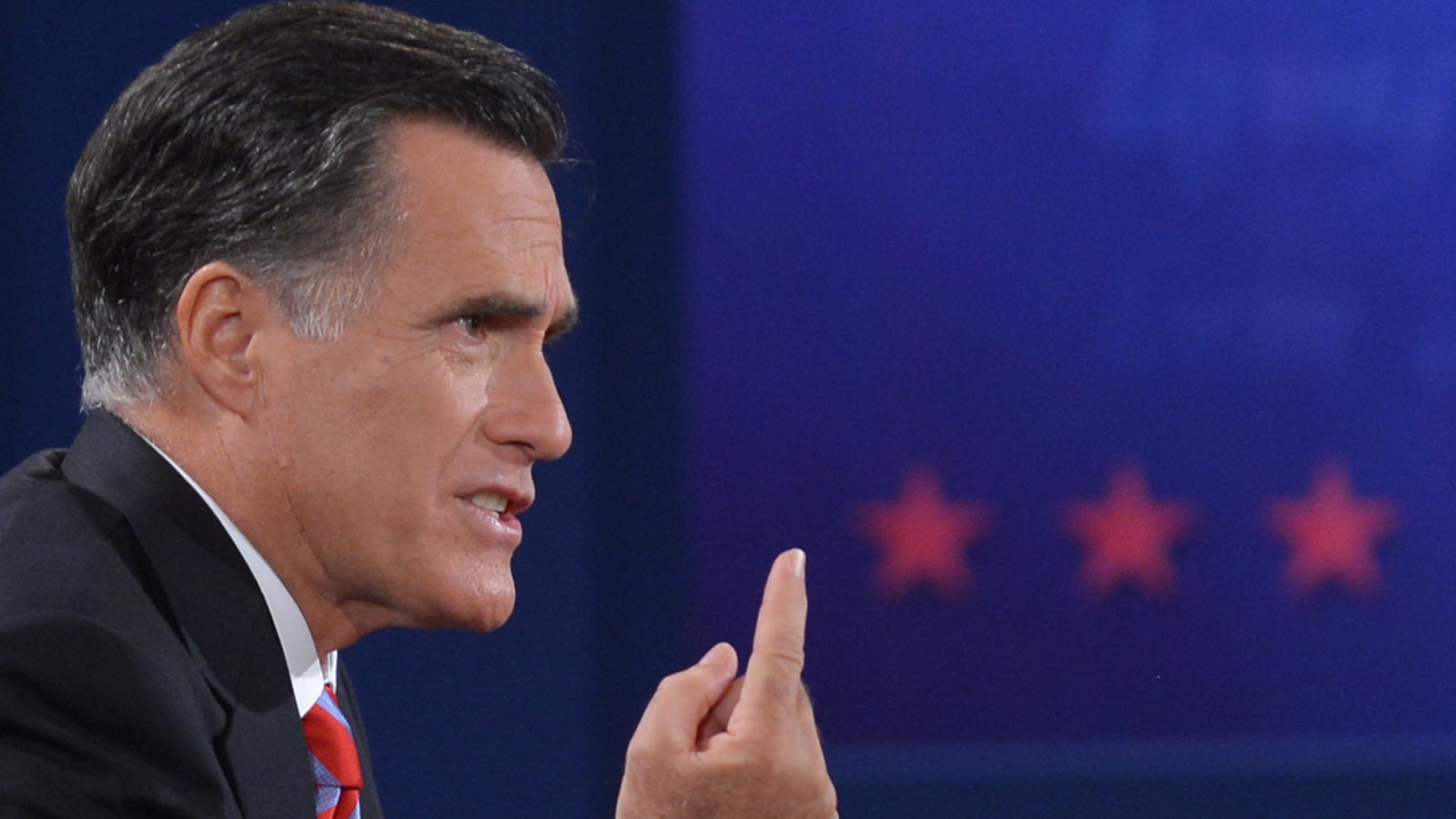
The Mitt Romney who has been selling himself to America in the three presidential debates seems like a reasonable, common-sense fellow.
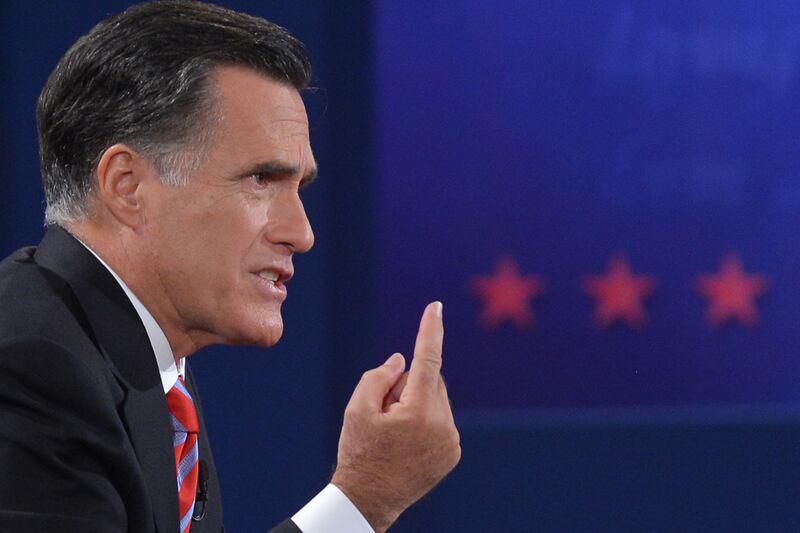
On foreign policy, as we saw Monday night in Boca Raton, Romney essentially agrees with President Obama on Afghanistan, Syria, and Libya.
On health care, Romney says he wants to cover preexisting conditions, just like the much-reviled Obamacare. On taxes, he doesn’t want to reduce the share paid by the rich. On bank regulation, he’s found some things to like in the dreaded Dodd-Frank law. On education, he praises the Pell Grant program. On immigration, he’s no longer calling for those here illegally to self-deport. On abortion, Romney (who was once a proud supporter of abortion rights) says he has no legislative agenda to change things.
Why, the man is practically a centrist.
But this is not the presidential candidate we have seen for the last two years. And if he had run as “Moderate Mitt,” as Bill Clinton derisively calls him, there is no way he would have gotten the Republican nomination.
Some in the pundit class may object, but here’s the thing: Romney’s strategy seems to be working. And he appears more comfortable in this back-to-the-future role.
Romney’s advisers insist he hasn’t changed, that some of the earlier nuances in his policies were simply overlooked. But it’s hard to avoid the conclusion that the image Romney is projecting changed rather abruptly, starting with that first debate in Denver.
Only journalists and other political junkies have been obsessively following the campaign since the early days of 2011. Many Americans are like casual baseball fans who only start paying attention at World Series time. They don’t know, and maybe don’t much care, what Romney said during the regular season.
So if Romney has been “all over the map” on foreign policy, as Obama repeatedly charged in their final debate, that may not matter. Swing voters want to be assured that he won’t start a crazy war, and Romney, with his deliberately passive performance, certainly conveyed that message. Never mind that in the past he’s said he wouldn’t yank U.S. troops from Afghanistan in 2014 without the consent of military leaders; he now says he’s pulling out, period.
All candidates gravitate to the center in a general election; you don’t hear Obama talking much about gay marriage these days. But Romney’s abrupt evolution has been so audacious that it must be a feat of mental gymnastics to keep in his head all the past statements and current iterations.
What’s fascinating is that the press, so enamored of the flip-flop theme in the past, hasn’t really challenged the New Mitt, perhaps out of concern that it would seem unfair in the closing weeks to be harping on his latest menu of positions.
Sometimes the Romney presentation is a matter of emphasis. He may have mentioned in the past that he didn’t want to cut the share of taxes paid by the wealthy, but his emphasis was on slashing rates 20 percent for everyone, including the wealthiest Americans (offset by abolishing certain deductions he still won’t identify).
When Romney spent the primaries denouncing Obamacare, he didn’t talk much about not letting insurance companies deny coverage for preexisting conditions—and despite his vow to take care of that, the former governor’s approach would affect only those who already have employer-paid insurance.
The list goes on. In the past, Romney argued that Pell Grants had grown too fast and had to be limited to the neediest students. But addressing a college student in the town hall debate, Romney praised the program without reservation. He now says there was little difference between his position and Obama’s on the auto bailout, though he argued in a 2008 op-ed that if there was a federal bailout “you can kiss the American automotive industry goodbye.” And Romney’s campaign had to walk back his recent comment on abortion by saying that of course he would sign anti-abortion rights legislation.
Perhaps the biggest change is Romney’s late-breaking decision to stress that he took a bipartisan approach in Massachusetts, where the legislature was overwhelmingly Democratic. During the primaries he barely mentioned being governor at all, in part because he wanted to avoid being entangled in arguments about his health-care law.
Presidential campaigns are about more than a collection of issue positions. If they gave purity tests for consistency, most politicians would fail. And Romney, who has the polling wind at his back, gets to make any kind of closing argument he wants. His main goal now is to reassure people who are growing inclined to trust him with the keys to the country.
But the contrast between the Romney who once called himself severely conservative and the Romney running now is striking enough to stir doubts about how he would govern. It’s a subject the press needs to explore in the final sprint to Election Day.