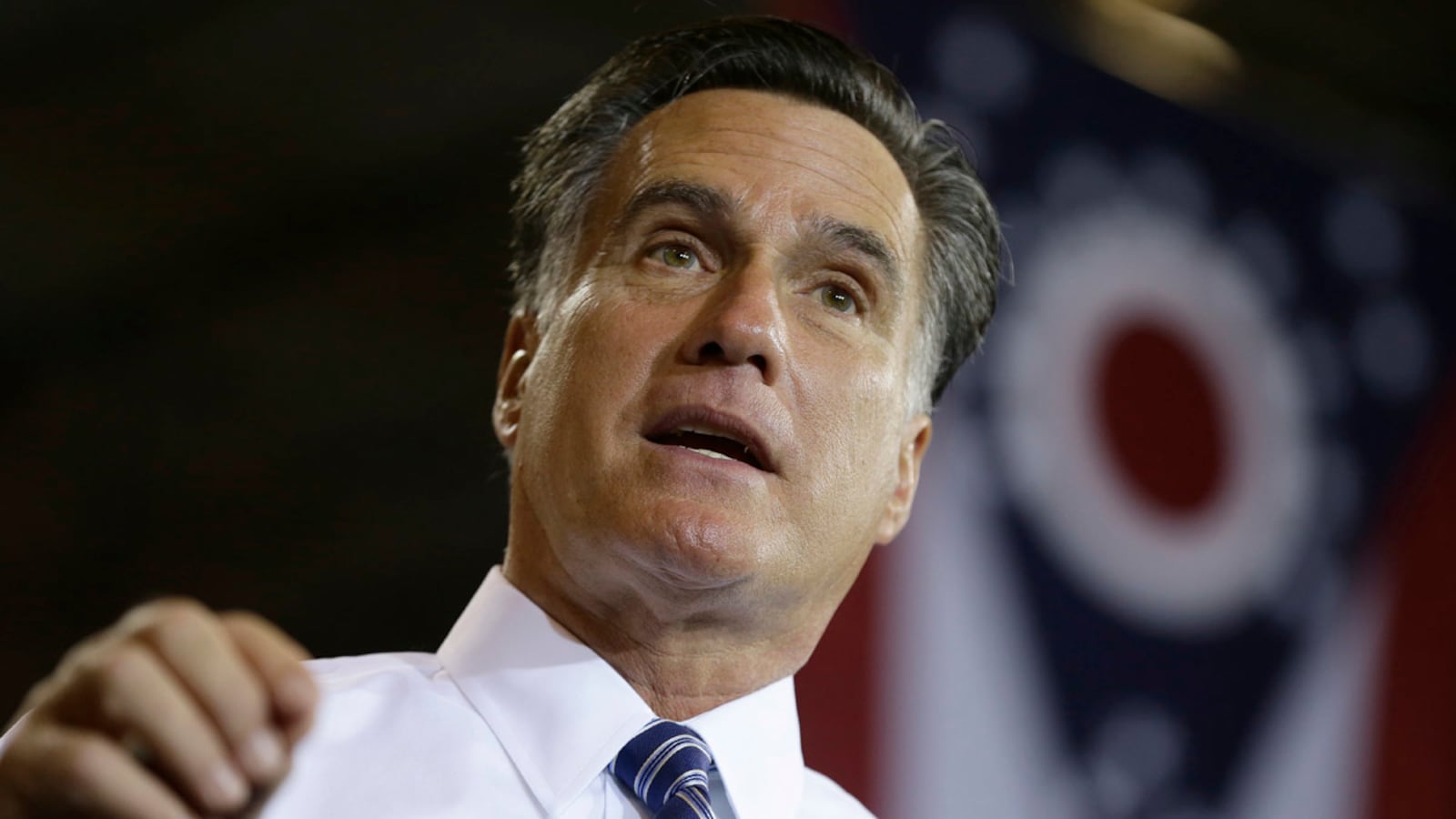
Planning for a possible Romney presidency is well underway with a transition office open in Washington and the FBI doing background checks on likely appointees. House Republican leaders regularly convene “two scenarios meetings” to calibrate “the tone and tenor” of their response depending on the election outcome. “One thing we don’t know,” says a Republican leadership aide, “is whether a victorious Romney-elect transition would say ‘clear the decks, this is your problem’,” staying on the sidelines and letting the defeated incumbent president and lame-duck Congress stew in their partisan juices. That would buy time and deflect the political heat.

A Romney victory would likely mean the country’s looming budget problems would be put off until after the new president took office in January. It would also mean an explosion of expectations among the Republican faithful. “A lot of people are going to want to go full bore,” says the aide. That includes everything from an overhaul of the tax code to a social agenda that many Americans find extreme, and that Romney has tried to distance himself from. “Our members think if we win, well that’s it—now we’ll be able to really enact our agenda, and we want to temper that, inject some reality.”
Senate candidate Richard Mourdock’s comment that pregnancies resulting from rape are “God’s will” is the latest cautionary note for voters wondering what a GOP sweep in November might mean. The next president faces a host of problems, and solving them will require finding or creating a vital center in Washington. Romney in the last month has moved toward the political center, adopting a more dovish and internationalist stance on foreign policy and moderating his opposition to abortion, shifts that six months ago would have inflamed his conservative base. Polling and political analyst Bill Schneider sums up the right’s silence in the face of such apostasy this way: that with Republicans likely to control both chambers of Congress if Romney wins, “We want Romney in the White House to sign our legislation. He’ll be there to sign our bills.”
The Obama campaign is a victim of its own success: it turned Romney into such a cartoon of an unfeeling, rich guy that it was relatively easy for him to shed his extremist image. But how would he govern? Would he bring his party with him to the center? Or would he capitulate to the right, a repeat of the George H.W. Bush presidency, an ongoing exercise in navigating the ideological strains within the party, symbolized by Bush’s broken “no new taxes” pledge, the Supreme Court appointment of conservative justice Clarence Thomas, and then a failed reelection bid because the right never trusted him.
The right’s confidence that Romney would do their bidding is based on the expectations that Republicans will hold the power on Capitol Hill, and that Romney would not stand up in any meaningful way to his party’s right wing. “He is a lot like (George) H.W. Bush in many respects—the moderate background, the move to the right, the persistent accusation that he’s a rich guy out of touch,” says Jack Pitney, a professor of government at Claremont McKenna College. Where the analogy breaks down, says Pitney, is the absence of moderates in today’s GOP and the growing dominance of conservatives, along with a far more daunting fiscal picture than Bush faced.
“I don’t think H.W. (Bush) felt nearly as indebted as Romney does now,” says former Democratic Senate leader Tom Daschle. “Romney won the primaries if not with the blessing, with the consent of, the far right. He will be under enormous pressure to appoint people as ideologically pure as they are, and there won’t be any pushback because the moderates don’t exist. He will make W. (Bush) look like a moderate.”
Any “grand bargain” on the budget would require compromise across party lines. Obama has been faulted for not schmoozing lawmakers, and Romney seems just as reserved when it comes to establishing political intimacy. When he was governor of Massachusetts, he reserved an elevator for his exclusive use rather than rub elbows with legislators. Pitney thinks if there’s going to be a grand compromise it will not be because of Romney’s skill, but because of economic necessity. “To use the president’s phrase, it’s arithmetic.”
Daschle expects a Republican Senate to push the rules to pass legislation with a simple majority (a process called “reconciliation”) but he also anticipates that Democrats, who have more of an inclination to want to govern, would cooperate with the new president. “I don’t think I know of a single Democrat who says entitlements are off the table,” he says, contrasting that with GOP insistence there be “no new taxes.”
No new taxes doesn’t mean “no new revenue,” says a Capitol Hill hand, and the expectation is that Romney will find a way to get around the antitax pledge. If the two parties agree on tax reform and close loopholes, Daschle expects they will look for “tax-loophole offsets,” the kind of wordplay that policymakers used during the Reagan era when tax increases were called “revenue enhancements.” Daschle is skeptical about extensive tax reform. “When all is said and done,” he predicts, “more will be said than done.”
Most analysts think that Romney, left to his own devices, would govern moderately, “a Republican version of Clinton, someone who can make deals, that’s what he does,” says one, adding, “the Tea Party will be upset.” But not for long, he adds, because the most important thing Romney will do as president is nominate a rock-solid conservative to the Supreme Court, insuring the right’s values and priorities carry the day for the foreseeable future. “The pickings were kind of slim for Reagan,” recalls Pitney. “Sandra Day O’Connor would never be a top-tier pick today.” Whatever Romney’s core beliefs—and they’re hard to determine—a conservative movement is fired up and ready to go should he win.