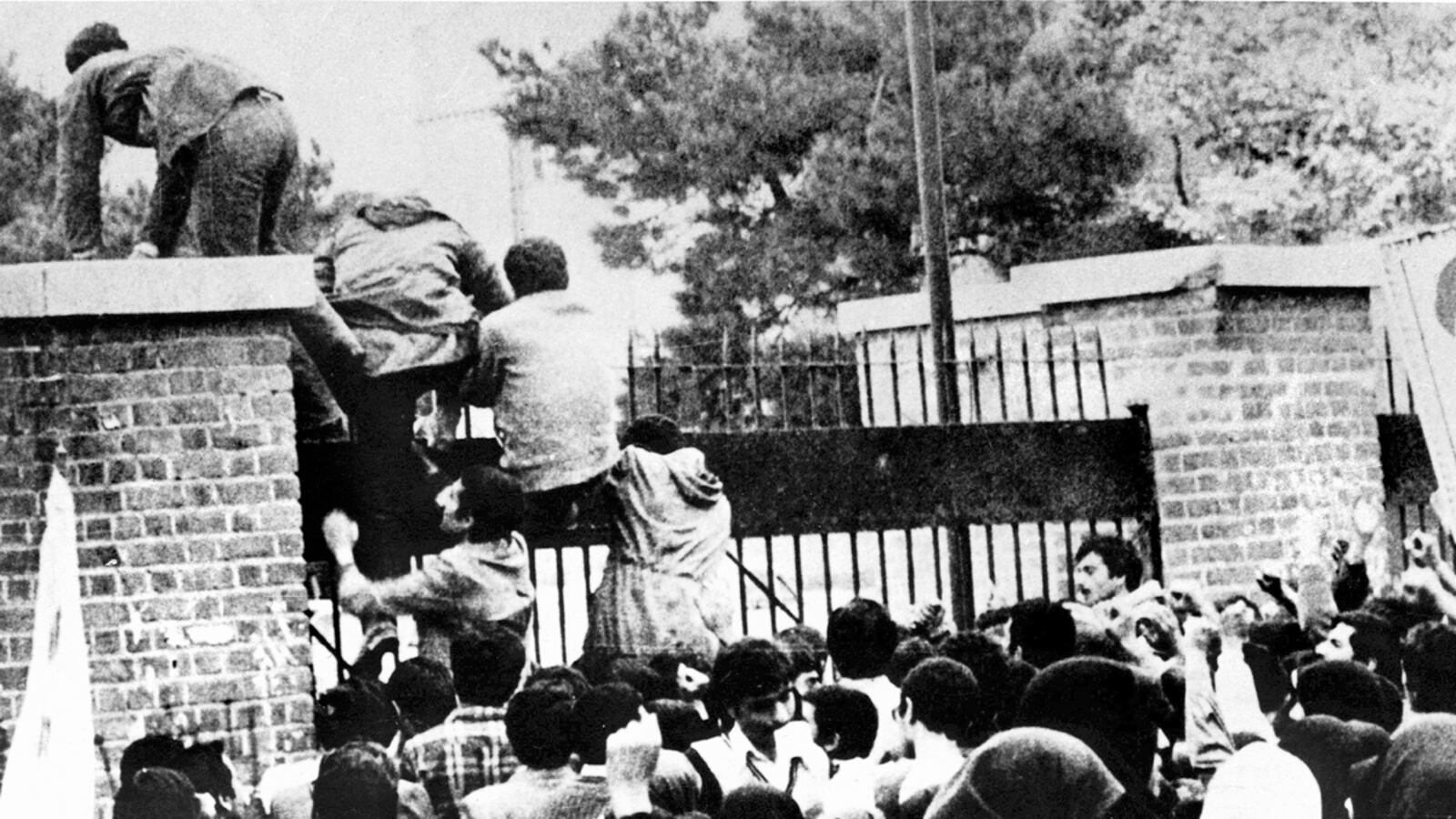
You have to watch Argo in the South as I did, in Burke County, N.C. to be exact, to feel that revisiting the hostage crisis between Iran and the United States still touches a raw nerve. Here, people came to let an old, still-nagging wound soak in cinematic brine. The film’s sharp and witty lines landed in this theatre like hail on plush carpeting. There was no sound of laughter. My fellow matinee viewers had hardly recovered from the humiliation of Vietnam when the assault on the U.S. embassy, and the parade of the helpless blindfolded American diplomats, had come. Thirty-some years later, the takeover is still a trauma of very high and personal order.
But you have to have been a witness to that history to appreciate the farcical beat at the heart of it all. Even as John Goodman and Alan Arkin’s bubbling comedic chemistry offered plenty of opportunities for guiltless laughs—those originating from cynical, self-deprecating insights—the truth, the actual history as it had occurred, was far more outrageous. A former hostage had once recalled to me that the Kalashnikov-wielding, radical Islamist teenager in charge of guarding him in solitary confinement had nearly begged him, “When you get out of here, can you help me get a visa to the US?”

I had been among the angry fist-throwing mob in front of the embassy enough times to know that the answer to the question Goodman and Arkin contemplated as they watched the footage of the demonstrations—“Is this all for the cameras?”—was, for the most part, yes. Feverish dramas of such magnitude and intensity are impossible to sustain for long. People eventually sweated and deserted the embassy gates. The crowds who showed up long after the excitement had ebbed were not driven there by ideology. For school-averse fledgling teenagers such as myself demonstrating before the US embassy was a legitimate excuse to miss math or skip an exam—the greatest snow day in the history of elementary education.
Mature humor is one of the qualities of Argo. The other is the cool-headedness by which the protagonist, the heroic CIA officer played by Ben Affleck, acted and the narrative unfolded. The tale begins at the climactic moment of the take-over, and somehow the suspense keeps on rising with every passing sequence. Even though the audience knows that all the hostages, including the six who are the focus of Argo, all return to the U.S. safely, the film’s thrilling quality and the viewer’s quickened pulse, do not lessen.
Yet Argo does not land in the canon of all-time classic political or liberation struggle genre in which the likes of Z or the Missing belong. In the best of that genre, the audience roots for the American hero while having fallen in love with the cause which took that American to the troubled spot in the first place. A handful of the former hostages have told me that the devastation they still feel is from knowing that their captivity led to the American hatred toward a nation and a culture that they, despite their suffering, continue to love.
What gets in the way of Argo reaching classic status is the flawed historical premise of the opening sequence, which aims to somehow justify the origins of the brutality that later unfolds. That flaw isn’t a misperception unique to filmmakers in Hollywood but policymakers in Washington, too. The voice of the female-narrator booms: “In 1950 the people of Iran elected Mohammad Mossaddegh, a secular democrat, as prime minister. He nationalized British and U.S. petroleum holdings, returning Iran’s oil to its people. But in 1953 the U.S. and Great Britain engineered a coup d’état that deposed Mossaddegh and installed Fazlollah Zahedi as Shah … Dying of cancer, the Shah was given asylum in the U.S. The Iranian people took to the streets outside the U.S. embassy demanding that the Shah be returned, tried and hanged.”
But in truth, under the monarchy, the people did not elect their prime minister. Rather, it was the Shah who appointed the prime minister based on the recommendation of the parliament, or Majles. The US had no petroleum holdings in Iran at the time. And the infamous coup that has been attributed to the CIA only succeeded because a few prominent Shiite clerics—precursors of Ayatollah Khomeini—lent their guidance and support to it. Lastly, the “revolutionaries” didn’t need the Shah to be admitted to the US to seize the embassy, for they had already done so twice prior to the final takeover. Nonetheless, the misguided account, meant to legitimize Tehran’s wrath toward Uncle Sam, perfectly suited the myopic, guilt-ridden American psyche which has readily embraced it.

The enduring story that Americans have yet to learn is of the purpose the short-term captivity of their hostages served in guaranteeing the long-term survival of Iran’s theocrats. It was in protesting the take-over of the embassy that the moderate interim post-revolutionary government resigned. Once the shredded documents were pieced together again, several moderate members of that very government were falsely accused of espionage for the US, and in the case of its spokesman, Abbas Amir-Entezam, imprisoned for twenty years. While the world’s eyes were fixed to the chained embassy gates, the hardline radicals solidified their hold on power and annihilated their opposition. 444 days later, the captivity of the US hostages ended. But that of a nation still continues.