
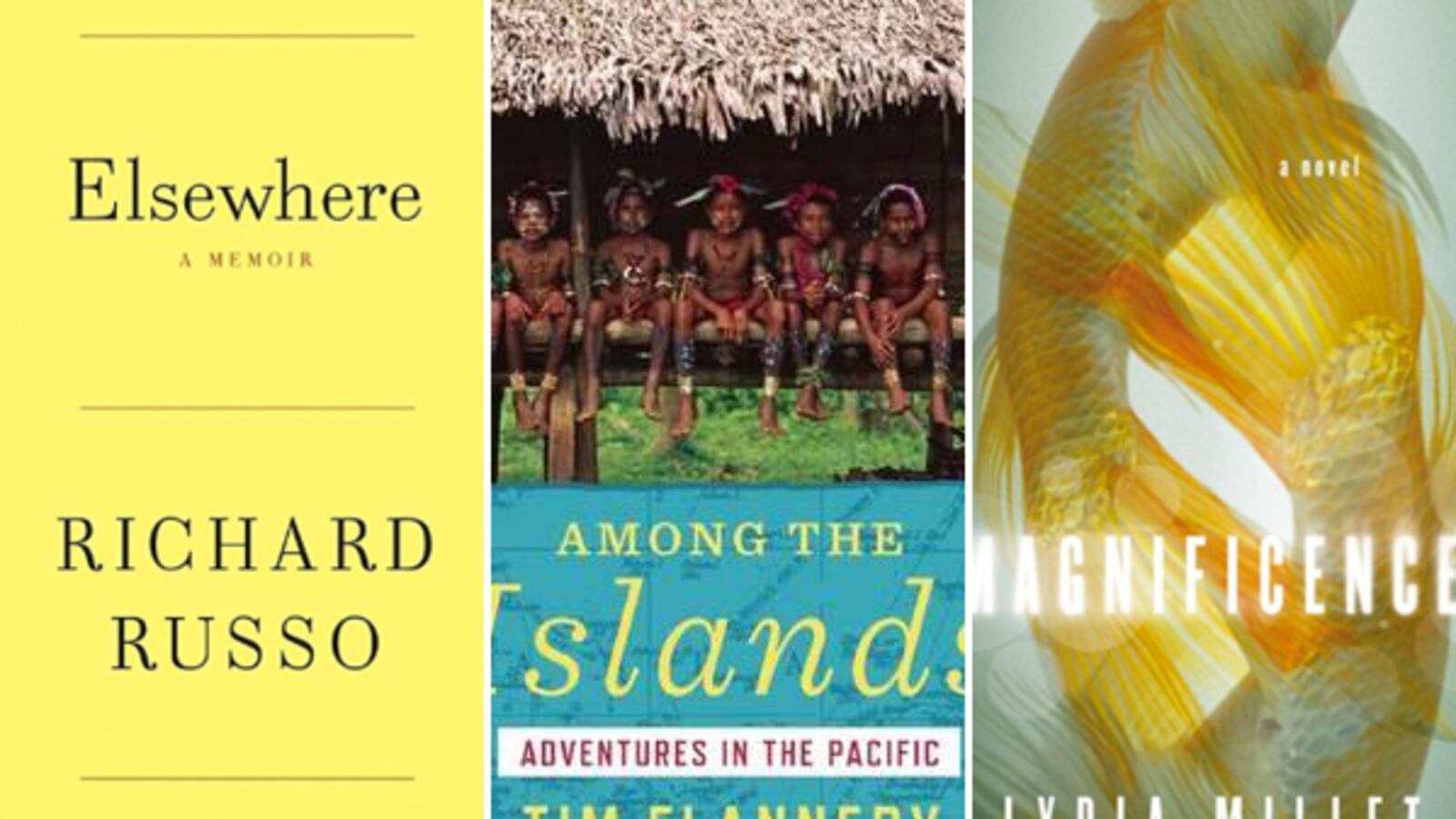
ElsewhereBy Richard Russo
A novelist recounts his upbringing, when he and his mother stood against what life threw at them.

We read novelists’ memoirs to get a sense of an author’s success—a formula that can be followed, if not to be mimicked, then to at least give us the illusion of causality and explanation. This is a fool’s errand, but one encouraged by the search for what makes an artist an artist. But memoir functions best when it cleaves to memories, rather than self-psychoanalysis, as Richard Russo (winner of the Pulitzer Prize for Empire Falls) has done in Elsewhere. There is vivid imagery of a child’s view of post-war America: baseball, big cars, the decline of heavy industry, and the economic shift from craftsmanship to cost-cutting. But these things serve only as set dressing for the real story, which is the long arc of Russo’s relationship with his mother, as she ages and battles neurological demons, and the two swap traditional roles. A son being the parent is common enough, but Russo conjures the incredible bond between single mother and only child in a way that makes his story particularly powerful.
The Great Charles Dickens ScandalBy Michael Slater
A scandal that stuck with the memory of the great Victorian writer.

The only thing that people love more than a sex scandal is when the man caught with his pants down is known to champion warm family values. If he also happens to be a cultural titan, then scholars will be happy to dig up the incident and revisit it over 150 years later. In The Great Charles Dickens Scandal, Michael Slater, emeritus professor of Victorian literature at the University of London, details the salacious rumors that nearly derailed the life and reputation of Charles Dickens, at one time synonymous in England with “hearth and home.” The scandal still haunts his legacy today. Dickens’s marriage had fallen apart due to his interest in a teenage actress, with whom he spent the final years of his life. The book traces the evolution of the episode from whispered scuttlebutt to an explosion of speculation that happened in 1934, when Dickens's last living son died—people had restrained themselves partly due to a sense of decorum entirely foreign to the modern reader. Slater’s work is a fascinating investigation into the nature of scandal itself as much as it is a look at the particular episode.
Magnificence By Lydia Millet
A woman moves into an old house full of taxidermy in the aftermath of trauma.

Here is a storytelling cliche: a house—building it, restoring it, moving into it, living in of it—becomes a metaphor that overflows with meaning. The author will invest too much in the house as a character and fail to do justice to the humans inside of it. Not so in Lydia Millet’s Magnificence, the third in a trilogy beginning with How the Dead Dream and Ghost Lights, in which a woman inherits a mansion (filled with taxidermy) in the aftermath of her husband’s murder. As her domestic life falls apart, she takes it as her charge to refurbish the house and its lifeless inhabitants. But if the house in this story is a metaphor, and it certainly begs to be one, it takes nothing away from the humanity of these characters, brought to life with acute, deeply imagined realism in both their actions, and, more important, their emotions. Millet is simply an incredible writer. Her prose displays the exceedingly rare combination of philosophical introspection with poetic grace and dark flourish. Just about every page has a passage worth excerpting, but here’s one, almost at random: “In an instant the whole of existence could go from familiar to alien; all it took was one event in your personal life. You might think you were only a mass of particles in the rest of everything, a mass exchanging itself, bit by bit, with other masses, but then you were blindsided and all you knew was the numbness of separation.”
The Liberator By Alex Kershaw
An officer and his unit experience the full scope of the Second World War.

So much ink and film has been expended in the service of the world’s largest conflagration that it’s a testament to the scale of the endeavor that 70 years later, stories of certain heroes have still gone untold. In The Liberator, best-selling historical writer Alex Kershaw recounts the 500-day odyssey of field officer Felix Sparks and his 157th infantry regiment of the 45th “Thunderbirds” division, from Gibraltar to the shores of Italy, up through Fortress Europe and through the gates of Dachau. Their story is almost a history of the American war experience in miniature, from the hard-charging enthusiasm of the initial landings to the clear-eyed horror of the liberation of the concentration camps. Sparks’s unit was the first to liberate Dachau, and Kershaw’s prose effectively evokes the stunned horror of the men in his command, and the blood-lust toward the SS men that followed. (Sparks had to regain control of the situation in order to stop a revenge-driven massacre.) This is an uncynical, patriotic look at our finest hour, perhaps in the literal sense of the first 60 minutes of liberation; when the emaciated inmates saw the green American helmets from their longhouse windows, they knew that freedom had arrived.
Among the IslandsBy Tim Flannery
An eminent zoologist reports from his adventures through the South Pacific Islands.

Australian scientist and writer Tim Flannery is credited with discovering more species than Charles Darwin, but after reading his new book Among The Islands: Adventures In the Pacific, it’s clear this was hardly a monomaniacal goal, and more a byproduct of his wanderlust. In his chest beats the wayfaring heart of a discoverer, and in this book, which details his colorful adventures among the flora and fauna of the South Pacific Islands, he reminds us that even right here on Earth, incredible things are waiting to be known. From exploring dark caves full of gigantic bats to getting drunk on kava-filled coconuts with tribal chieftains, the book blurs the line between biology and anthropology, and shows how it’s hard to explore one without exploring the other. There are also engrossing digressions on the history of the various peoples he encounters, generally filled with the struggle for autonomy in the face of colonialism, but the book works best when Flannery describes what it feels like to encounter a new creature, as if reporting from another planet.