Many Chinese appeared to breathe a sight of relief on Tuesday as U.S. President Barack Obama won re-election—not necessarily because they like his politics (or even know much about them). But rather because he seems to symbolize the prospect of much-needed stability between the U.S. and China.
In a bureaucratic quirk, the U.S. election came just two days before China’s once-in-a-decade leadership transition, so Chinese interest in Obama’s victory was high. Independent polling consistently showed Chinese respondents to favor the president over Mitt Romney, who repeatedly called China a “currency manipulator” on the campaign trail.
“I like Obama because he stands for certainty,” said Dr. Huang Haitao, who teaches international relations at the prestigious Nankai University in Tianjin, not far from Beijing. “The Chinese government has dealt with him [Obama] for four years. He symbolizes continuity in policy.”
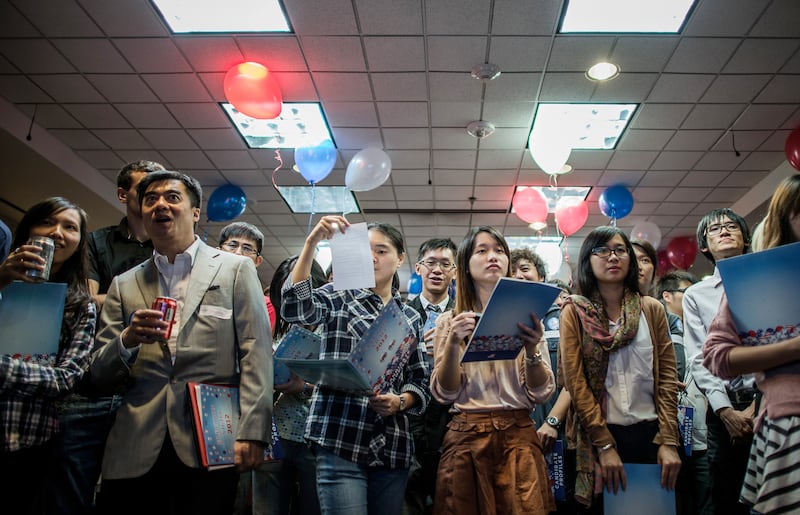
Huang woke up early Wednesday morning in China and headed to a U.S. election center set up in a vast hotel ballroom near the American embassy in Beijing. Surrounded by six large television screens, Huang and other Chinese guests of the U.S. embassy had a chance to cast ballots—albeit in a mock voting booth—for America’s next president.
Ordinary Chinese don’t have the opportunity to vote for the top leadership positions in their country; those jobs are normally allocated after years of jockeying and horse-trading between factions, senior officials, and party elders. Perhaps because of the pointed contrast in the way Chinese and American leaders are chosen, dozens of official Chinese VIPs invited to the election-night event declined to show up. Communist party censors also instructed mainstream media outlets to strictly follow the state-run Xinhua News agency's copy when reporting on the contest.
Obama's victory—and the expectation of stability-—comes at a time when the U.S. and Chinese economies have become increasingly intertwined, but tension between the two countries is high, at least partly due to election year rhetoric. The prospect of steady American leadership is especially important to China as the country awaits the unveiling of Beijing’s new leadership team at the end of the 18th Communist Party Congress, which opens Nov. 8 and is expected to last about a week.
Yet even with a familiar face in the White House, Beijing may struggle to keep Sino-U.S. relations on a steady course. Through Twitter-like microblogs, Chinese citizens are becoming more and more critical of the government’s authoritarian rule. Meanwhile, hawks in both countries have become increasingly vocal, both on military and economic issues. “In terms of national security, China’s of more concern [to Washington] now,” said Robert Kapp, a China consultant who watched the results come in at the election center in Beijing. “China’s success has led to structural changes. Some people believe these issues and problems need resolution and cannot be postponed any further.”
Many Chinese agree. Which is perhaps why Beijing was so concerned about what appears to be growing Chinese interest in the American electoral process: it underscores the fact that ordinary Chinese won't be voting for their own leaders--not this week or anytime soon.