
Most nights I go to bed with FOMO, or “fear of missing out.” I forgot to call my brother on his birthday, skipped yoga again, and cancelled dinner with a friend for the third time, all so I could finish that article I’d been agonizing over for days. But I’m convinced it’s still sh*t, I feel guilty for being a bad friend and sister, disconsolate that I can no longer touch my toes, anxious about being replaced at work by that new Yale kid. I pour myself a glass of whiskey, post some inane comment on Facebook, pop an Advil PM, and wake up six hours later—still suffering from FOMO.
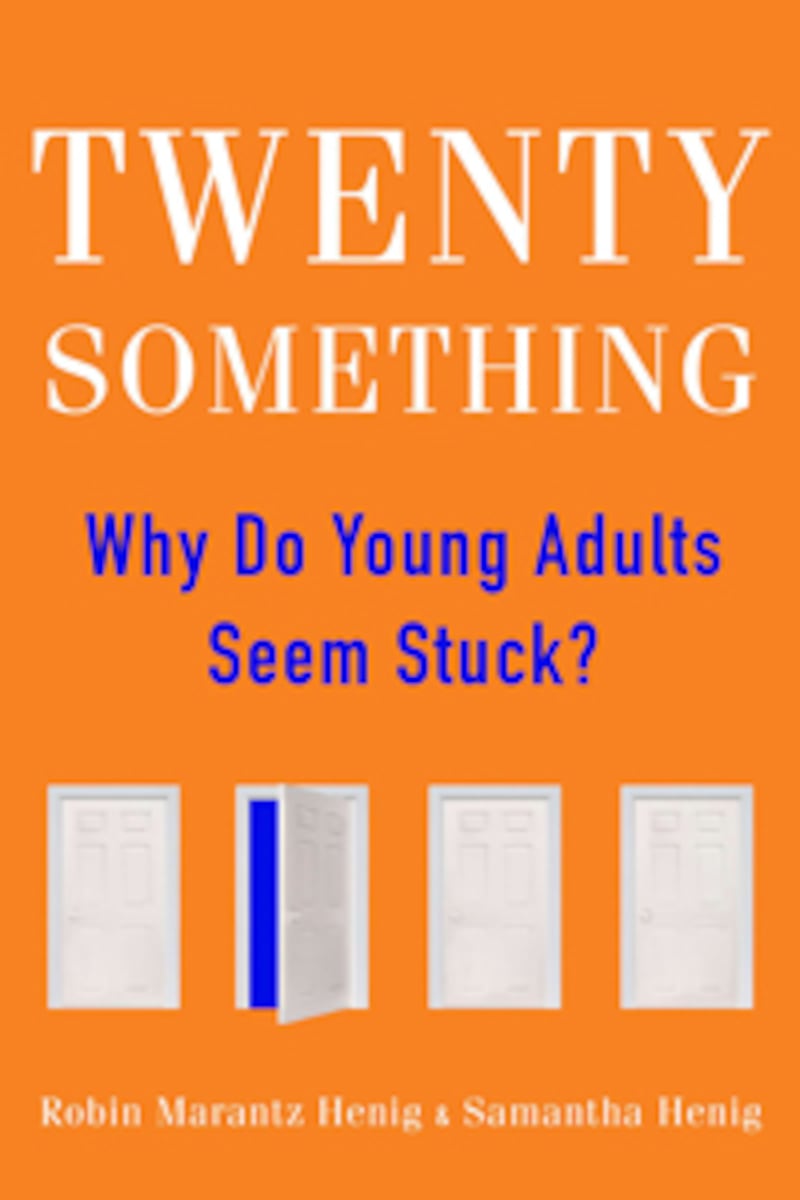
This is nothing unusual. It’s a typical day in the life of a privileged twentysomething, a subset of the Millennial generation analyzed in Twentysomething: Why Do Young Adults Seem Stuck? Penned by Robin Marantz Henig, a contributing writer at The New York Times Magazine, and her daughter Samantha Henig, a 28-year-old editor at the same establishment, Twentysomething surveys more than 120 Millennials (loosely defined as people born between 1980 and 2000) and Baby Boomers. Incorporating research on a slew of age-appropriate topics— from marriage and fertility to student debt and social media—the Henigs conclude that the biggest thing that distinguishes Millennials from previous generations of twentysomethings is an overwhelming deluge of choices. Constantly weighing options in every aspect of our lives, we end up with “decision fatigue” and the dreaded FOMO.
The acronym has previously been defined as a syndrome born from the constant pressure of social media, and it is in that context that Twentysomething addresses FOMO. But FOMO should really be understood much more broadly than that; by limiting itself to the strictly social elements of the syndrome, the book only scratches the surface of the term’s emerging ubiquity amongst Millennials and the extent to which it shapes our lives.
“I moved to New York City after college purely because of FOMO,” said Sarah Muir, 25, who grew up in Portland, Maine. She explained that the move was a lifestyle choice rather than a career one. Muir, who double-majored in International Studies and Spanish and always saw herself doing something “meaningful”, took an entry level job in Search Engine Marketing because it paid the bills. “I hated the work, but it allowed me to live this glamorous urban lifestyle that I’d always dreamed about,” said Muir.
Even living the life, Muir’s FOMO persisted, only now she found herself wondering if she was missing something else, somewhere else. She found herself scouring travel blogs at work, dreaming of backpacking through Asia or moving to Argentina, where she studied abroad in college.
The Henigs have a different term for this kind of decision. They chalk it up to “regret-avoidance,” and suspect someone like Muir simply is simply “forestalling any kind of commitment,” citing a longitudinal study that found people tend to feel deeper regret about the things they didn’t do than the things they did. That analysis sounds a lot like FOMO to me, not just of missing the best party Friday, but of missing the best adventure, the best partner, the best life.
The more you talk to people who have so many choices, the more you see how plagued they are by the very length of the menu in front of them. “I had a fear of missing out a lot in my twenties, I just never knew there was a term for it,” said J.C. Chandor, 38, a filmmaker in New York. Chandor always knew he wanted to make movies, but he turned down job after job because he says he was waiting for a golden opportunity. “I was essentially afraid of missing out,” he said, “afraid that if I took some production job I would be derailed from what I ultimately wanted to do, which was to write and direct my own movie.”
In Chandor’s case, FOMO was actually useful. The movie he slaved over in his twenties never came to fruition, but still he persisted with the kinds of films he cared about, keeping himself afloat with jobs in construction and real estate. At 33, he wrote his first feature film in three days, Margin Call, which earned an Oscar nod for Best Original Screenplay last year.
Does Chandor’s story mean there’s hope for us Millennials, that what we’re really doing when we jump from choice to choice and worry about every move is actually something much more positive, holding out for what really matters? Or did he just get lucky? And if so, is FOMO just another word for a decade or more of waiting and wanting without even knowing quite what we’re wanting or waiting for?
FOMO is our generation’s cross to bear. This is not, it should be said, borne by everyone in our generation, not by a long shot. The Henigs’ book has been criticized for focusing on children of relative privilege, for whom the choices are often between the good, the better, and the best. But for those of us with education, a few skills, not a little bit of ambition, and sufficient cash, it is our birthright. Not only do we throw the term around on Instagram and in daily conversation, but we’re part of a social experiment examining the effects of this new syndrome. Twentysomething acknowledges that FOMO is a result of choice-overload, but it doesn’t capture the extent to which it’s integral to the Millennial experience.