Of Africa by Wole Soyinka
The Nobel laureate and Nigerian playwright tries to rescue Africa from racism, ignorance, and stereotype in this forceful manifesto.

In 2009 a young man in Germany said to Soyinka: “Africans, you must admit, are inherently inferior. You must be, or other races would not have enslaved you for centuries.” Everyone at the table fell quiet, and “with equal quietness” Soyinka simply changed seats. But he couldn’t stay silent anymore, and Of Africa is his answer—in which Soyinka reckons with the promise of his troubled continent, and in language that announces him as the smartest person in the room. (“Invading the world of one of these homeopathic structures—Orisa religion—requires that we try to redress certain opportunistic notions of what we actually designate religion.”) He goes about proving that Africans are neither inferior nor superior—they are failed human beings, just like the rest of us. From the first chapter he makes clear that it is “the contending hegemonies” that have failed Africa, which never wanted to be a part of the war of the worlds. He outlines the virtues as well as sins of his land, which includes being a continent that was never claimed to be “discovered,” since it is humanity’s motherland. So Africa awaits discovery, but what he has in mind is not the mad plundering of its natural resources nor the fanatical fight over religious control that Christians and Muslims have waged for centuries. He wants us to discover the continent’s spirituality, one that preaches respect, accommodation, and humanity in rejection of tyranny, bigotry, and dictatorship. Like his fellow playwright-philosophers Jean-Paul Sartre and Vaclav Havel, Soyinka can be tedious. But a great writer can’t help let slip some moments of great clarity, and he does so when conveying his powerful message: he asks us to see Africa for what it is. “That external world must come to terms with a tradition of self-indulgence that encouraged layers of visual cataract to accumulate and harden over centuries … the ‘Dark Continent’ may yet prove to be nothing but the willful cataract in the eye of the beholder.”
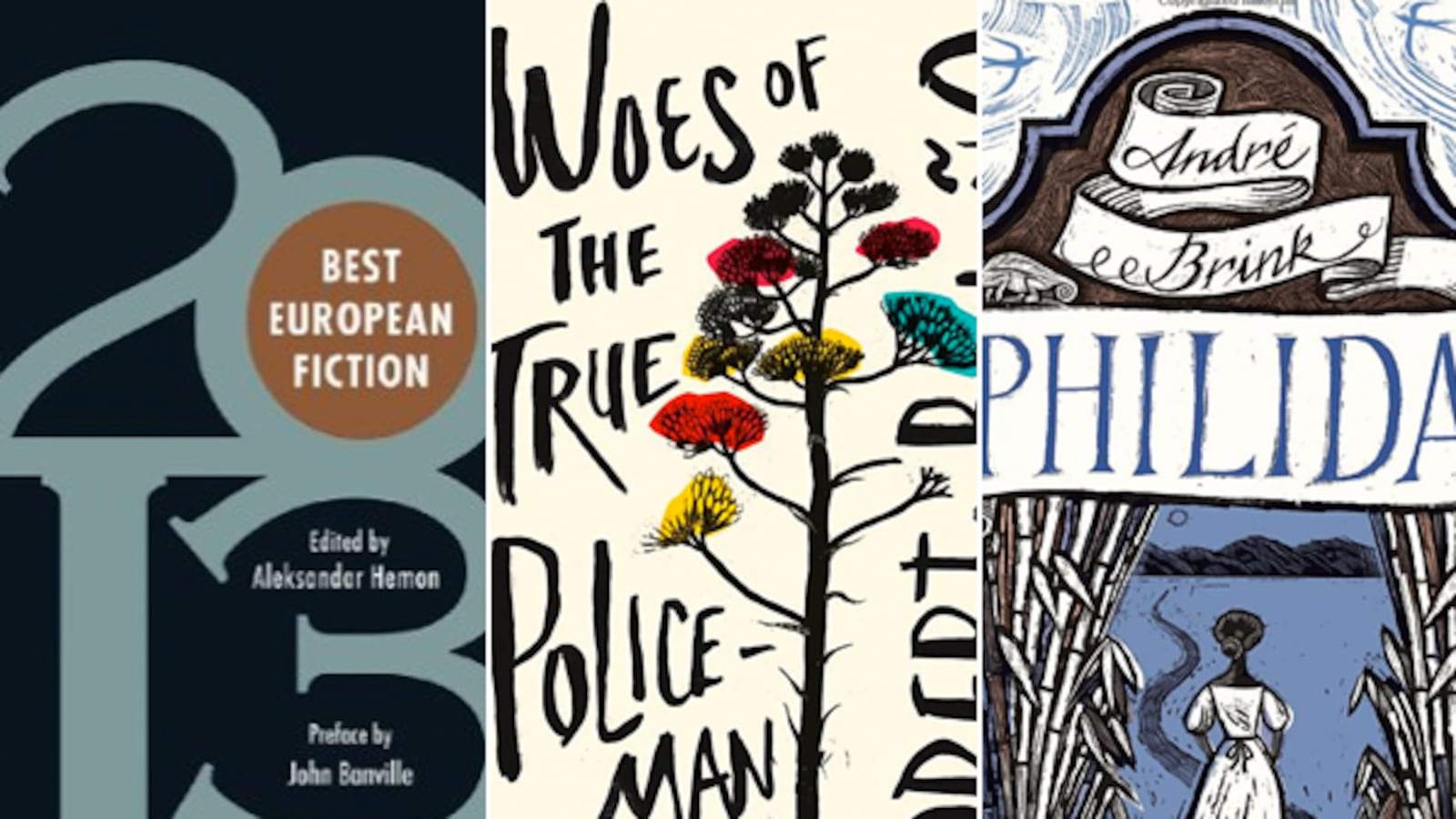
Philida by André Brink
Set in the lead up to the 1834 emancipation of slaves in the Cape Colony, South African writer André Brink’s powerful Man Booker long-listed novel, Philida, tells the story of a slave girl owned and abused by the author’s own ancestors.

The novel opens with Philida making her way from the farm of Zandvliet where she lives and works, to the town of Stellenbosh to lodge a complaint against her owner, Cornelis Brink, and his son Frans. The latter, she explains, coerced her into sex with the promise that he would buy her freedom for her, but eight years on, and after having borne him four children (two of whom survive, the youngest strapped to her back as she stands in front of the slave protector to voice her grievance), he’s made no attempt to make good on his word.
Words, and the act of recording the truth, lie at the very heart of Brink’s novel, from the necessity of Philida’s complaint being written down “very precisely,” to a spill of ink that obliterates the names inscribed in the back of the Brink family bible. In giving a voice to Philida, Brink isn’t just rewriting the sins of the fathers—her consciousness is joined by that of Frans, Cornelis, and a freed slave, Petronella, in a cacophony that indicates the shift in the power balance happening in the Cape during this period. The Dutch colonists’ aim to be able to proudly declare that they “whored the whole West Coast white” is being increasingly undermined by both their own actions—Petronella is secretly Cornelis’s mother—and the regulations in slave ownership that are being introduced by the British. Philida’s body may not be her own, but her voice certainly is. Her complaint sets in motion a series of events that sends shock waves through the lives of everyone around her: “One day there must come a time when you got to say for yourself: This and that I shall do, this and that I shall not.”—Lucy Scholes
Through the Window by Julian Barnes
The essays of the Booker-winning English novelist makes erudite scholarship look easy and effortlessly entertaining.

The critic James Wood once compared two descriptions of landscape: the first an unacademic, almost unknowing passage from Willa Cather’s My Antonia, where her narrator looks through a window; the second a name-dropping, “prissy-clever” one from E. M. Forster’s The Longest Journey that consecrates the land with a reading of Shelley. Wood preferred Cather’s, and equated Julian Barnes’ fiction to Forster’s knowing, uber-literary approach. The “novelist of ideas” of Flaubert’s Parrot and The Sense of an Ending might irk Wood, but the impressively knowing, argument-driven Forsterian approach is perfect for an “essayist of ideas,” for what else are essays for? In literary criticisms such as “The Deceptiveness of Penelope Fitzgerald,” Barnes presents a prim portrait of the great novelist, written with short, sure sentences that scatter riddles and scholarship like birdseeds for readers to eagerly peck up. He repeatedly asks: “how does she do that?” In “George Orwell and the Fucking Elephant,” written in the same perfect, cozy, “prissy-clever” style, Barnes holds Orwell’s exaggerated and invented reportage to task. “Many of those who admire him might lose respect or faith if he turned out not to have shot a fucking elephant … and if he hadn’t, then was he not mirroring those political truth-twisters whom he denounced?” Barnes gives us three fantastic little essays on Ford Maddox Ford, one of which is about Ford and Provence, two on Rudyard Kipling and France, five on French writers from Houellebecq to Flaubert, one on Edith Wharton, one on Lorrie Moore, and two on bereavement, one for John Updike and one for the grief felt by Dr. Johnson, Joan Didion and Joyce Carol Oates. Let us apply what Barnes writes about Ford to himself: “I am not sure whether calling a novelist ‘undervalued’ helps or not. Perhaps it would do more good just to assume and assert [his] value. He is not so much a writer’s writer (which can suggest hermeticism) as a proper reader’s writer.” Barnes’s nonfiction emphatically deserves The Good Reader.
Woes of the True Policeman by Roberto Bolaño
The final (we promise, maybe) unpublished and unfinished novel of the Chilean writer, who worked on it from the 1980s until his death in 2003.

Of all the last unpublished works of Roberto Bolaño posthumously released, we think this really is the last one. At any rate it is probably (fingers crossed) the final unpublished Bolaño novel—please don’t blame me if some deleted Word document is pulled from his recycle bin. What Woes of the True Policeman has going for it is that it falls in the tradition of Bolaño’s best novels, 2666 and The Savage Detectives, those works of snake-coiled sleeps of death, set in the northern Mexico border town of Santa Teresa where, like 2666, tales of women mysteriously killed haunt it. The book follows Chilean professor Amalfitano, exiled from Chile and Barcelona because of suffocating political climates, who flees to Santa Teresa, where he hears about these tales of murder and meets many other colorful characters, including Castillo the painter of Larry Rivers forgeries, and Arcimboldi the writer, whose books Amalfitano devours. The story is told through countless short chapters. Some of them are mini-biographies. Some of them are book reviews of Arcimboldi novels. Some of them begin with “Padilla’s next letter …” The only time that it is interesting to note that a novel reads like an unfinished work is when it is in fact a finished product, and very much so. On the other hand, to call Woes of the True Policeman unfinished is merely to state a fact, and when we read it as a sealed and delivered piece of fiction, the disconnected narratives, though colorful and funny, give the effect of horror, as if at the end of every short chapter one has to reckon with blank pages of silence, and look around the room to see if somebody’s there. Perhaps the biggest woe of a true policeman is fear.
Best European Fiction 2013 edited by Aleksandar Hemon, prefaced by John Banville
The fourth edition of this series features stories as different from one another as prose is from verse, as Arabic is from Japanese.

Novelists Aleksandar Hemon and John Banville are known for embracing anything that’s “difficult.” They are very serious artists, unapologetically highbrow. In the preface and the introduction, the two mobilize their forces to demand that we read these translated stories, which might seem “difficult.” What more, Hemon gladly admits that he has no clue what European fiction is. If you are finding your recent Best American Short Stories a bit too unadventurous and homogenous, as if all factory-produced by Iowa Writer’s Workshop grads, then what you need is Best European Fiction. A dictionary is never needed if you want to navigate through the terrain of contemporary American short fiction, whereas you will need to look up where the city of Budva is if you encounter the Montenegran Dragan Radulovic’s spectacularly Borgesian tale “The Face.” Or you might wish to know what makes a Mignon Espresso or a Gerbeaud patisserie, or who Rakosi is, in the Hungarian story “Portrait of a Mother in an American Frame” by Miklos Vajda, which begins: “She stands in the kitchen, in a kitchen, not our kitchen, not the old kitchen, not any of out old kitchens, but her own kitchen, an unfamiliar one, not mine, and she cooks, stirs something.” Is that not the voice of a frantic and eager child, whatever his or her age, struggling to recall or make sense of a photo of mother? These stories are as different from one another as prose is from verse, as Arabic is from Japanese.