It was a key storyline of the 2012 campaign—both political parties are growing ever more ideologically pure. The resignation of GOP Sens. Dick Lugar and Olympia Snowe and Democratic Sen. Jim Webb were widely hailed as indications of a moderate island disappearing between conservative and liberal streams.

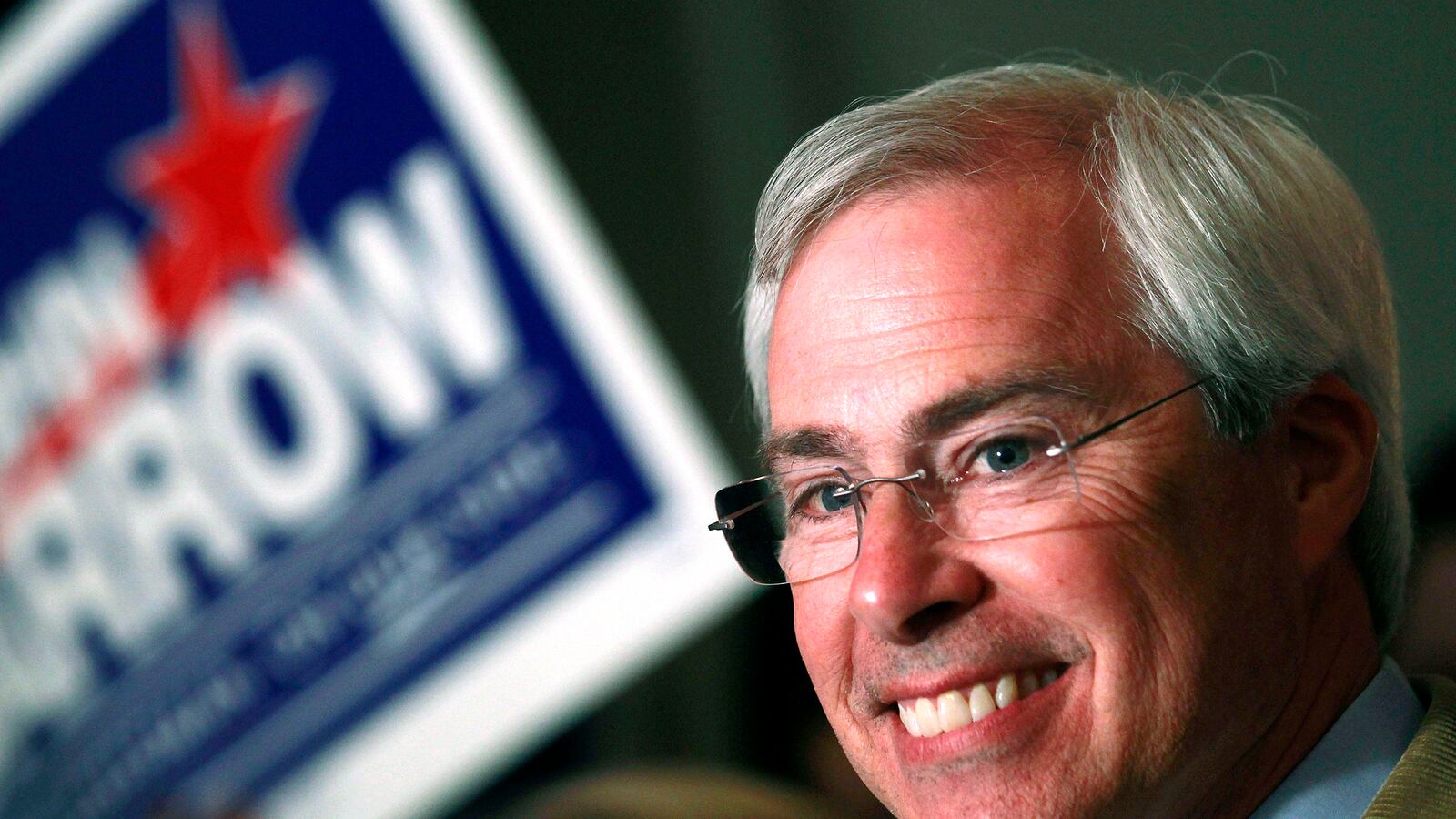
But there are a few holdouts who survived on Election Day. Notable among them is one of the last Blue Dogs standing—Rep. John Barrow of Georgia, the lone white Democrat from the Deep South in the U.S. House of Representatives.
In the years following World War II, the South was a safe haven for Democrats—famously branded, in Nixon’s time, the “solid South.” But today, Barrow is part of a vanishing breed, something that he doesn’t like reminding voters about. On the campaign trail, he shies away from even mentioning his party affiliation, so red is the map around him.
“I have never been a rubber stamp for any party, any party leadership, or any president,” Barrow said at a campaign stop. “I’m an independent … if Obama is doing what's right for Georgia, then I’m on his side. If he’s not, then I’m not.”
Barrow’s battle to hang on in hostile terrain was tougher this time around. Following the 2010 census, Georgia gained an extra seat in the U.S. House. The GOP-controlled state legislature carved the left-leaning city of Savannah from Barrow’s district and replaced it with the conservative city Augusta. The district was thus “retooled to ensure his defeat,” as an AP dispatch described it.
Barrow poured money into the race, outspending his opponent 2 to 1 and bombarding the Georgia airwaves with advertisements cultivating his image as a freethinking Southerner. In one ad, he criticized federal funding for genetic research on grapes because “we already have seedless.” In another, following his endorsement from the National Rifle Association, Barrow placed a small handgun on a table and picked up a large rifle, which he said is always kept close by. “These are my guns now,” Barrow proclaims in the ad, cocking the gun. “And ain’t nobody gonna take them away.”
The ads were a hit, grabbing headlines across the country and turning a 1-point deficit at the end of August to a 7-point win on election night.
It wasn’t the first time redistricters targeted Barrow’s seat (and his estimation, probably won’t be the last). After winning the seat from Republican Max Burns in 2004, a rare mid-decade round of redistricting pulled Barrow’s hometown of Athens into the conservative 10th District.
Seeing victory there as impossible, he moved to his ancestral home so he could run to retain his current seat. Burns returned wielding high-profile endorsements from then-President George W. Bush and others, but Barrow ran hard to the center, eventually winning by less than 900 votes.
Since then, Barrow has been periodically loved and hated by both sides. He supported the stimulus bill and Nancy Pelosi’s bid for speaker of the house, two moves that were attacked by Grover Norquist’s group Americans for Tax Reform during the 2012 campaign. He’s been criticized from the left for his A rating from the NRA and for his “No” vote on Obama’s health-care bill.
But whatever his formula is, the people of Georgia seem to think he has it right, for the moment anyway. In his victory speech Barrow said the voters’ verdict was a win for “the politics of bipartisanship,” and expressed hopes that the middle will be revived in the forthcoming Congress.
"I’m trying to show folks on my side of the aisle how to vote,” Barrow said. “I'm a party un-favorite.”