Spoiler Alert: This article reveals major plot twists in Life of Pi.

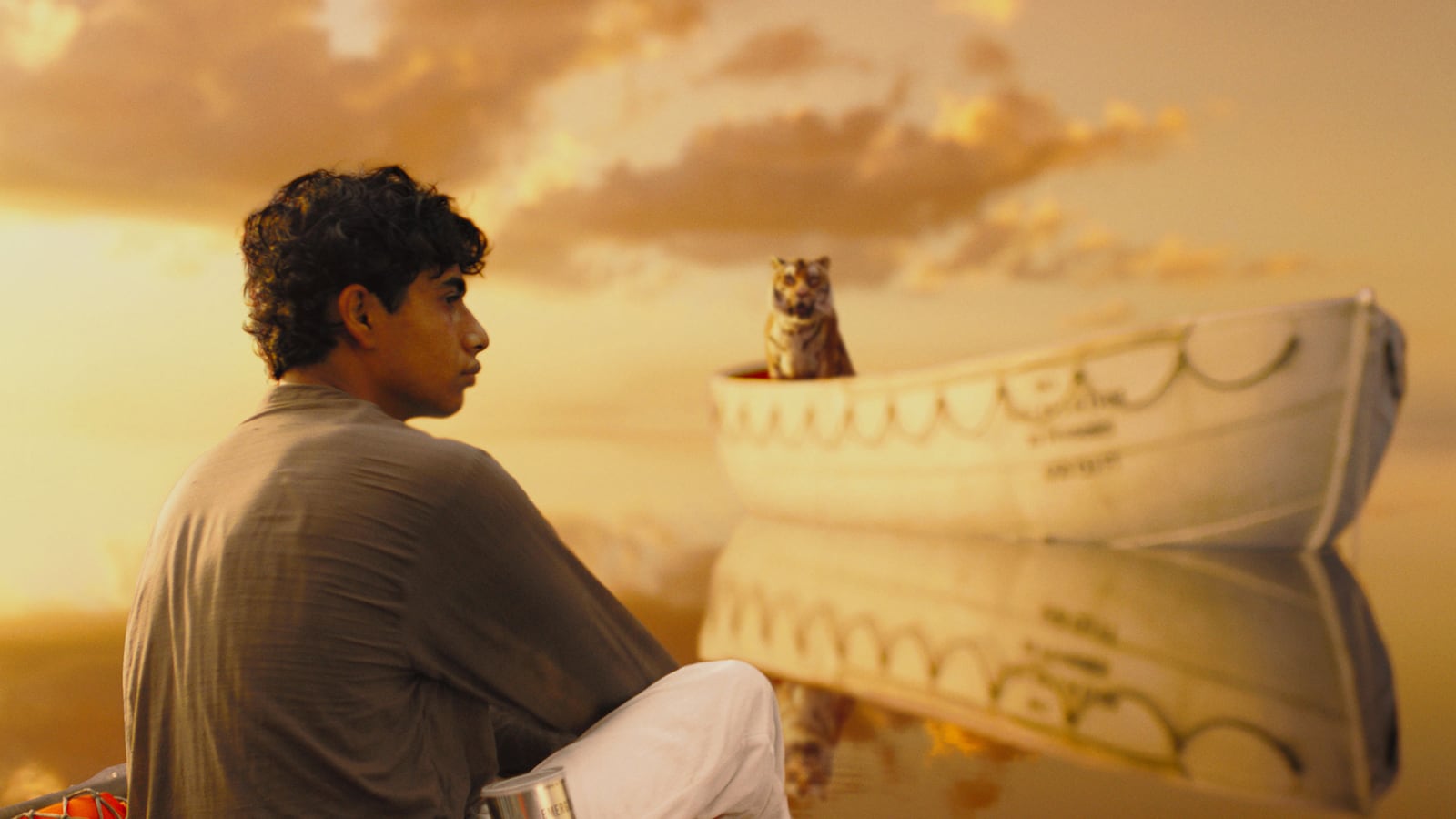
Based on the award-winning novel of the same name by Yann Martel, Life of Pi follows the amazing story of a young man named Piscine “Pi” Molitor Patel who finds himself lost at sea after his family’s cargo ship sinks in a storm. But Pi is not alone on this journey and must survive in a crowded life boat with four animals from his family’s zoo—A hyena, an orangutan named Orange Juice, an injured zebra, and worst of all, an adult Bengal tiger named Richard Parker.
In breathtaking 3D and featuring stunning visuals, director Ang Lee (Crouching Tiger, Hidden Dragon and Brokeback Mountain) brings the story to life on the big screen. Although Lee does his best to stay true to the story, there are clear differences between the film and the novel.
Pi’s Love Interest
In both the novel and the film, Pi is devastated when he learns that his family is leaving their hometown of Pondicherry, India, and heading to Winnipeg, Canada, but the film takes the liberty of adding a character and giving Pi a love interest (played by Shravanthi Sainath) who does not appear in the book.
In the film, Pi’s parents are concerned to find that he is practicing Hinduism, Christianity, and Islam all at once. Pi’s mother orders him to work for a dance class to take his mind off of things, and one of the dancers catches his eye. He follows her and her friends one day after class and is caught off guard when she confronts him. Pi manages to smooth things over and takes her on a tour of his family’s zoo. The two eventually form a relationship, making Pi’s move to Canada much more difficult.
PG Rating
After reading the novel, it’s hard to believe that the film adaptation is rated PG. With four animals, including two carnivores, stuck on a small lifeboat with no food, it’s safe to assume that nature will eventually take its course. After a few a days on open water, the hyena attacks the injured zebra, and the novel graphically describes how the hyena eats the zebra alive and eventually kills Orange Juice as well. Pi is also forced to hunt despite being raised vegetarian and is even desperate enough to try and eat Richard Parker’s feces as well. The book isn’t for those with weak stomachs, but the film spares viewers all the blood and guts.
Richard Parker
Pi’s relationship with Richard Parker varies greatly between book and film. In the movie, Richard Parker is extremely aggressive and while Pi manages to survive with him for 227 days, he never manages to tame the tiger. In fact, there is one scene in which Pi attempts to train Richard Parker by getting him to associate the sound of his whistle to the sensation of being seasick. But when Richard Parker still shows signs of aggression, Pi gives up on the training.
The book, on the other hand, shows that Pi is very knowledgeable about animals from his time at his father’s zoo. He is very cautious around Richard Parker, but he quickly asserts himself as the alpha male and marks his territory on the boat. Pi is also more deliberate in his training with Richard Parker and has him literally jumping through hoops by the end of the book. On multiple occasions, Pi also notices Richard Parker making a sound known as prusten—a noise big cats makes to show they are not aggressive.
Pi Loses His Mind
Towards the end of the book, Pi loses his vision when he runs out of food and fresh water and he begins to have a conversation with a voice he believes belongs to Richard Parker. The two discuss their favorite foods, and it becomes clear that Pi is losing his mind. He then has an unlikely encounter with another man who is stranded at sea. Desperate for food, the man attacks Pi but he is killed by Richard Parker. The sequence didn’t make the film and probably wouldn’t have translated to the big screen. But it is a pivotal chapter in the book as it is the least probable part of Pi’s story and is the first time the reader sees Pi as an unreliable narrator.
The End (Spoiler)
Life of Pi ends with Pi being interviewed by two insurance men who are trying to figure out how his family’s boat sank. The men have a hard time believing his story and ask him to tell them the truth. Pi tells a second story that directly reflects his first, but instead of animals, he is stranded on the life boat with his mother, a cook, and a sailor. The similarities between the two stories make it clear that his mother represents Orange Juice, the cook represents the hyena, the sailor represents the zebra, and Pi represents Richard Parker.
While both book and film share the same ending, their tones are much different and can lead the audience to different conclusions. In the novel, Pi appears annoyed with the two men and almost seems to tell them the story just so they will leave him alone. But the similarities force the reader to decide which story is true. When Pi tells the story in the film, he becomes visibly upset, especially when describing his mother’s death. Where the ending of the book is much more ambiguous, the tone of the film seems to suggest that Pi made up the story with Richard Parker in order to cope with the horrible things that happened on his lifeboat.