The celebrated musical Les Misérables, adapted from the 1862 novel by Victor Hugo, has penetrated the cultural zeitgeist in ways few other theatrical productions have.

Millennials still cringe at the thought of Joey Potter (Katie Holmes) belting out the tune “On My Own” on the cult TV series Dawson’s Creek, while homely Scotswoman Susan Boyle became an international phenomenon after performing a towering rendition of “I Dreamed A Dream” on the TV competition show Britain’s Got Talent. The song “One Day More,” meanwhile, was used by both Bill Clinton during his 1992 presidential campaign and by Obama supporters during POTUS’s 2008 White House run.
Now, interest in the musical has reached a cultural confluence of sorts, with Les Misérables, the movie-musical directed by Oscar winner Tom Hooper (The King’s Speech).
Last Friday, an eager audience at Lincoln Center’s Alice Tully Hall in New York was treated to the film’s world-premiere screening, hosted by distributor Universal and Peggy Siegal.
“I was up until 2 a.m. yesterday finishing the film,” said Hooper, introducing the movie. “You are the first ones to see it.”
While trailers for the film have been riveting, some people have remained skeptical due to the dearth of quality movie-musicals in recent years. Remember Joel Schumacher’s Phantom of the Opera, Chris Columbus’s Rent, or Rob Marshall’s star-studded Nine? Neither do I. But, several rounds of applause and a standing ovation later, Les Misérables proved all the naysayers wrong. It hits all the right notes and is, in this writer’s estimation, the newly minted frontrunner for the Best Picture Oscar.
For the uninitiated, the film opens with Jean Valjean (Hugh Jackman), a brawny peasant in 19th-century France who has served 19 years in a prison-work camp for stealing a loaf of bread (and a handful of escape attempts). He’s done so under the supervision of the rigid Inspector Javert (Russell Crowe), who possesses a borderline phrenological view toward criminality. When his parole comes up, Valjean—or “prisoner 24601,” as he’s known—becomes a pariah. The Bishop of Digne (Colm Wilkinson, who originally played Valjean on the West End and Broadway) provides him food and shelter but in return, Valjean steals the bishop’s silver. When the police catch Valjean, the bishop lies to the authorities, telling them he gave Valjean the silver, and to release him. He then tells Valjean he bought his soul for God, and to use the gifted silver to make a better life for himself.
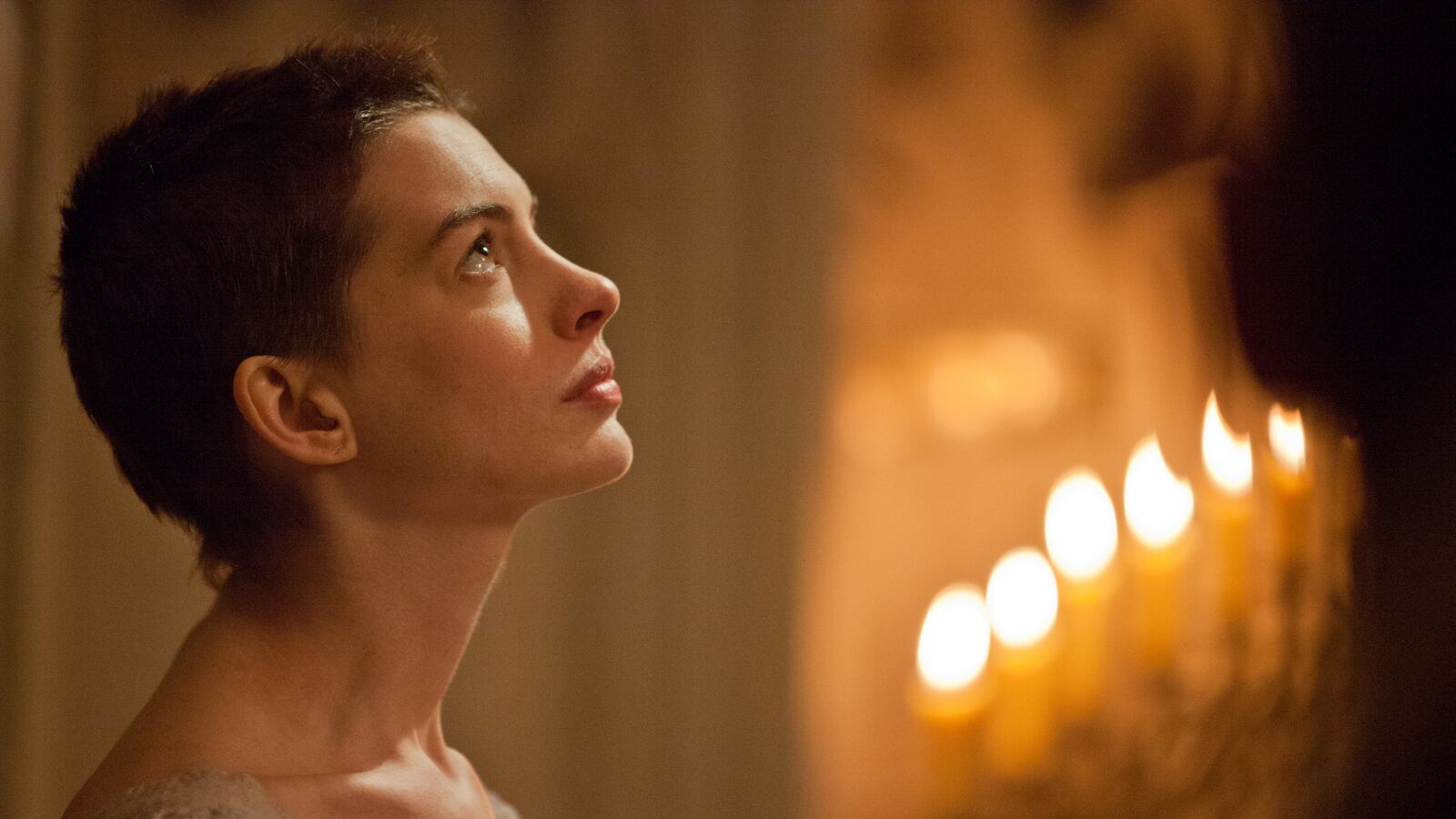
Eight years later, Valjean has assumed a new identity as Monsieur Madeleine, a wealthy and benevolent factory owner. One of his workers is Fantine (Anne Hathaway), a beautiful woman who sends every last franc she makes to the swindling Thénardiers (played by Helena Bonham Carter and Sacha Baron Cohen, in an expert bit of casting), to pay for the care of her young daughter, Cosette. When Fantine is fired from the factory due to her co-workers’ petty jealousies, she is forced to sell her hair, her teeth, and ultimately prostitute herself to provide for her daughter.
“I’d put [shaving my head] up there with one of the most difficult things I’ve had to do,” said Hathaway in the post-screening Q&A. “I looked into the mirror, called my husband, and said, ‘I honestly look like my gay brother. I’m just Man Hathaway.’”
And it’s here where Hathaway all but seals the deal on the Best Supporting Actress Oscar. After giving herself to her first client, she rises and sings “I Dreamed A Dream.” Shot in staggering close-up—and in one shot—Hathaway’s take on this ode to anguish brought many audience members to tears.
“I can’t sing like Susan Boyle,” acknowledged Hathaway. “The bar for this song has been set so high by so many incredible vocalists; so the only way I could do it was to do it differently; to not think of it as a song but as a howl from the center of your soul.”
In a masterstroke, director Hooper decided to have his entire cast sing all the songs live, and set it to live musical accompaniment (yes, this is a true musical—nearly every word is sung, save a handful of rejoinders). The performers had nine weeks of rehearsal to get their vocals in shape, and it shows onscreen, as each and every song is brimming with pathos.
“I was re-watching classic musicals and I must admit I struggled watching the movie-musicals where people are lip-syncing,” said Hooper. “There’s a distancing quality to it; a falsity to it. I feel like acting is all about the pure language in the present tense.” He adds, “Performances are often a patchwork of many takes, but in all the central songs you saw it was only one take.”
Valjean finds Fantine on the street and promises to care for her daughter, Cosette.
The action then jumps to the eve of the 1832 Paris Uprising. Cosette (Amanda Seyfried) is now a young woman and has caught the eye of Marius (Eddie Redmayne), a bourgeois revolutionary—much to the chagrin of the Thénardiers’ spawn, Éponine (Samantha Barks), who loves him. Valjean, meanwhile, is still being hunted by Javert, and is thus reluctant to let his adopted daughter find love with Marius.
Nearly every number in Hooper’s film is brilliantly performed, with other highlights including Jackman’s rendition of “What Have I Done” following his silver theft, the camera skying upward to reveal a beautiful “eye of God” shot (a nifty trick repeated to equally thrilling effect several times throughout the film); the quodlibet “One Day More,” with Hooper cutting to different members of the cast; and the heartbreaking ballad “On My Own,” magnificently sung by Barks (who played the role on the West End). And of course, the revolutionary anthem “Do You Hear the People Sing” soars to the heavens.
“There is prodigious strength in sorrow and despair,” Dickens wrote in A Tale of Two Cities, and Jackman, an actor who seems to be at his best in period dramas (see: The Prestige), does a fine job capturing Valjean’s brutish exterior and inner turmoil. All the other actors live up to the task as singers—including Crowe, whose performance as Javert approaches Jesus Christ Superstar-levels of gusto.
The only nitpicks are that two of the central characters die under mysterious circumstances—succumbing to the weight of their suffering instead of any discernible malady (still effective), the opening CGI shot of a boat being pulled by a collection of enslaved prisoners is shoddy-looking, and the number “Bring Him Home,” sung by Jackman in a decrepit tavern, drags a bit. But these are minor quibbles.
The mid-19th century, a time of social and political upheaval in Europe and America, is very current at the moment. There’s Lincoln, Spielberg’s historical epic chronicling the passage of the 13th Amendment abolishing slavery (ironically, Les Mis was a favorite among Confederate soldiers, who referred to themselves as “Lee’s Miserables”); another film adaptation of Dickens’s Great Expectations by Mike Newell; The Dark Knight Rises, which was inspired by the Dickens classic, A Tale of Two Cities; and its predecessor, The Dark Knight, whose scarred character the Joker paid homage to the lesser-known Hugo novel L’Homme qui rit (The Man Who Laughs).
As for Les Misérables, Hooper’s film is one of the most joyous, epic experiences you’ll have in a cinema this year. It’s vaulted past other contenders like Lincoln, Argo, and Silver Linings Playbook in the Best Picture race, and proves that the director’s Oscar-winning previous effort, The King’s Speech, was no fluke.