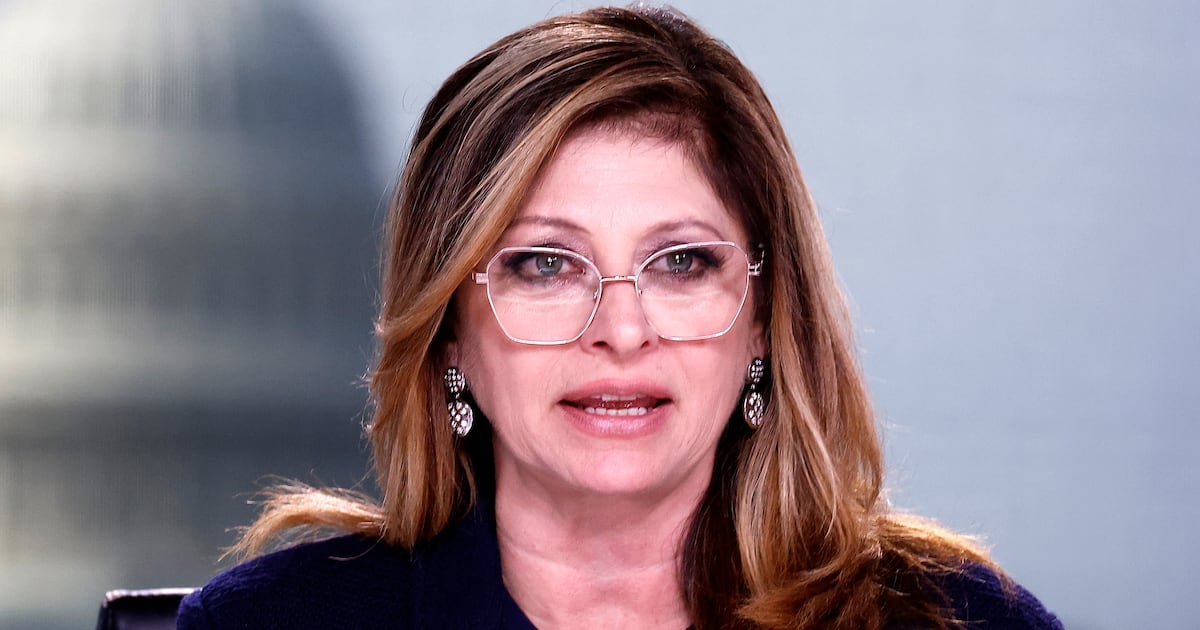

The target of all this vitriol is Suzanne Venker, a 44-year-old author and social critic who over the weekend penned a piece on the Fox News website titled “The War on Men,” in which she took issue with commentators on the left who have called the coming era “the end of men,” and described a dearth of marriageable men—the kind with good jobs who want to settle down—not due to a declining manufacturing economy that has rendered their skills less useful—but to the rise of feminism.

“The so-called rise of women has not threatened men,” she wrote. “It has pissed them off. It has also undermined their ability to become self-sufficient in the hopes of someday supporting a family. Men want to love women, not compete with them. They want to provide for and protect their families—it’s in their DNA. But modern women won’t let them.”
Reached by phone last night, Venker said that the whole thing was a misunderstanding. When she wrote about women and men, she meant to write about wives and husbands.
“I didn’t mean that women can’t compete with men in the workforce. I meant that men don’t want to compete with their wives in marriage. Husband and wife would have been better than men and women,” she said.
She is all for women having high-powered careers, she said, but “you need to keep those separate. Otherwise it will make your marriage more of a competition than a complementary relationship.”
The article in question is based on a book Venker has written that is expected to come out in the spring, called How to Choose a Husband. The book, she said, is a “cultural detox” for women who have been confused about what “empowerment” really means.
“Women should understand that they absolutely can be strong and independent and be married, but that being feminine and vulnerable and taking on that more traditional role as being dependent on a man and letting him have some say in the matter is not wasting that empowerment. They are confusing what empowerment means. They think it’s about money and prestige, but there is a tremendous amount of empowerment in surrendering in the home and letting the man in your life be what he wants to be, which is to protect you and care for you and provide for you.”
A small Web article, she pointed out, could not do full justice to the arguments in several-hundred-page book.
But still, the article doesn’t mention what Venker says she meant it to be about at all.
When asked to explain this discrepancy—between what the article says and what Venker says she meant to say—the writer grew quiet for several moments.
“I understand. All I can say in my defense is that it can be so hard when you write as much as I’ve written—three books, articles, blogs—you think you have said something but you haven’t. It’s like I am thinking something and I am so clear about it and I think what I have said is that. I don’t know. I don’t know. I didn’t think that much about it. It is an important distinction between men and husbands for sure.”
A small article, she said, “can’t encompass an entire point. An article is meant to engage a reader in a quick way. I am not advocating a strict division of gender roles. I am not suggesting that women can’t compete with men in the workforce or that men can’t handle strong women. People are extrapolating these things because the article is, I admit, rather open-ended.”
Rather, Venker said, it is that, “women, once they have children would prefer to work part-time or not at all when their children are young. Their career trajectory will be different than that of men. Feminists don’t like that. They want everybody to want the same thing, career trajectories to be the same. Women may say I really want to exercise or hang out with my friends and have coffee or go shopping and have a cushier life, and your guy will be happy to do that, and go to the office all year long for 40 years to allow you to do that. Men don’t have that option. And there is nothing wrong with having different road maps.”
Venker, who is the niece of conservative firebrand Phyllis Schlafly, said that she came to the writing life after starting out as a teacher in the New Jersey public schools. In her mid-20s, she hoped to write a book about that experience, but got divorced, moved back to her hometown in St. Louis, got remarried, and started having kids before taking up writing again.
Her own biography, she said, gives her credibility in the argument that her article ignited.
“I work outside the home. My husband does his thing. No one would consider me a docile or obedient housewife,” she said, adding, “I am married to a guy who works so that I can have a cushy writing life. That is the beauty of marriage.”
She has written two previous books—The Flipside of Feminism and Seven Myths of Working Mothers—and it was the experience of touring and promoting those two books that she said put her in contact with women who told stories similar to the one she tries to give voice to in her latest tome.
And in a word, those stories reveal that women have been sold a script about sex and gender roles.“I think women have robbed Peter to pay Paul. Women went out and did what men did and they lost this other piece of their life. They can’t have it all.”
And as the culture has been calling on men to adapt and embrace the new role of women in society, it is now time for women to adapt back, as it were.
“Men have been changing for the past 40 years. They have responded to this revolution. They have changed and changed and changed and changed and they still can’t win. They can never do enough. And women get frustrated and say it is always men’s fault. My goal is to get women to look in the mirror and say, what is your part in this gender debate? Is it women’s fault? Maybe fault isn’t the right word, but if men and women are equal, then how come it is that men are supposed to change but women are not.”