
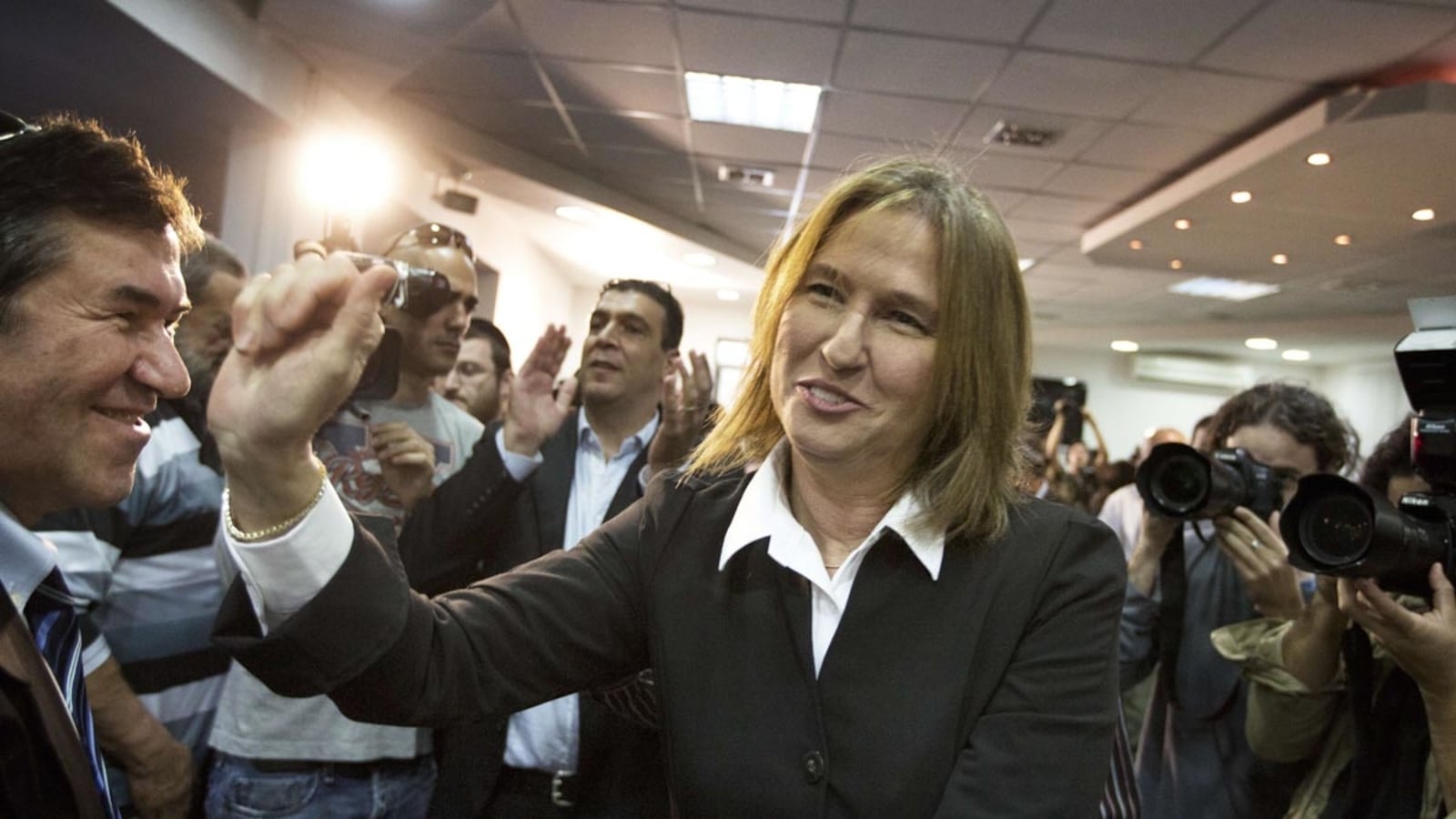
Israel’s former foreign minister announced her return to politics Tuesday, in time to contest a January national election that pits a powerful right-wing bloc led by Benjamin Netanyahu against a raft of center-left factions with similar agendas but clashing personalities.
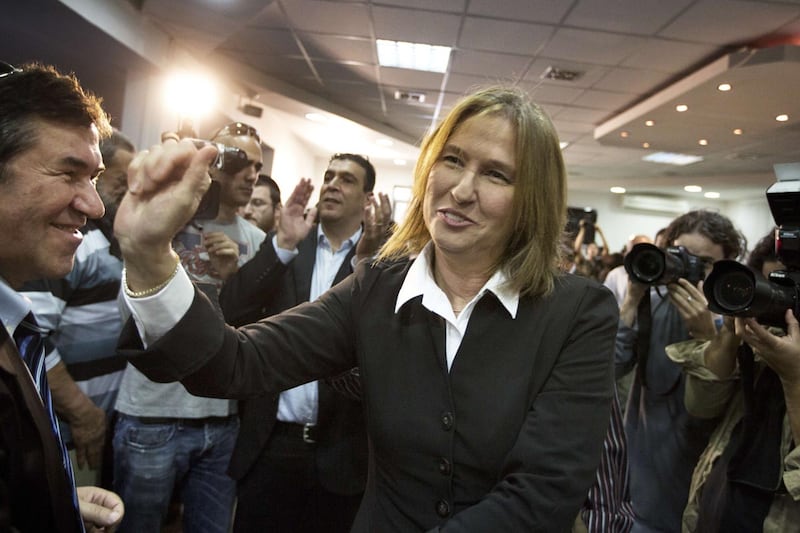
Livni said she was forming a new party called The Movement, which would seek to unseat Netanyahu and restore peace making with the Palestinians to the level it was when she led negotiations between 2006 and 2009.
Her program could potentially fill a void in Israel’s political cosmos, where left-center parties have focused more on social equality and where Netanyahu’s Likud Party moved further to the right this week, with a primary election that pushed hardliners to the top of the list.
But polls conducted after her announcement suggested The Movement would not alter the balance of power between left and right, leaving Netanyahu and his allies in Parliament with a large enough lead to easily retain power.
One of the surveys, published in the newspaper Haaretz this morning, predicted Livni’s party would win just seven seats in the 120-seat Parliament. Netanyahu’s coalition of right-wing and religious parties would control 69 seats, according to the poll, a commanding majority by the standards of Israeli politics.
Another poll, commissioned by Israeli Channel 10 News, gave Livni nine seats but determined she was getting almost no crossover support from right-wing voters, a further indication that her candidacy was unlikely to change the country’s political geometry.
Livni led the centrist Kadima Party to 28 seats in elections just four years ago, making it the largest faction in Parliament. But she failed to forge a governing majority and spent her term in the opposition.She left politics earlier this year after losing a primary election in Kadima to former Army chief Shaul Mofaz. Under Mofaz, Kadima is expected to perform so poorly in the coming election that it might be wiped out altogether.
Over the past several weeks, Livni weighed the possibility of joining one of two other center-left parties—either Labor or Yesh Atid (“There is a Future”). But the negotiations broke down because she refused to accept the No. 2 spot on either list, according to media reports, prompting moans in the political establishment about the fractured state of the center-left bloc.
“There are ego issues that played a role here; there’s no about that,” said Doron Avital, a lawmaker from the Livni’s old Kadima Party. But he also said political opinions in the center-left varied more widely than on the right, making it harder for the opposition parties to form an alliance that would seriously challenge Netanyahu.Israel’s previous elections over the past two decades were fought mainly over the issue of land and peace—specifically, how much of the West Bank Israel should cede to the Palestinians, if at all, in exchange for a conflict-ending agreement.
But opinion polls show that while most Israelis want peace with the Palestinians, they don’t believe an agreement is within reach. As a result, political parties are emphasizing other issues in this election, like the deteriorating economic situation of the middle class and the tensions between ultra-religious and secular Israelis.
The Labor Party, which negotiated the Oslo peace accords with the Palestinians two decades ago and championed peace making for much of the time since then, has largely avoided the issue during the current campaign.
Avraham Diskin, a political scientist at the Interdisciplinary Center in Herzliya, says the shift away from the preoccupation with the Palestinian conflict is not necessarily bad for the center-left parties. “It allows Labor to potentially draw votes from the center right, which it almost never does,” he told The Daily Beast.
He said the center-left parties may end up benefiting from their failure to form an alliance that would match the one on the right between Netanyahu’s Likud Party and Foreign Minister Avigdor Liberman’s Israel Beiteinu.
“I’m not sure the fragmentation necessarily works against the bloc in general. I really doubt it,” he said. “When parties merge, they often end up getting fewer votes than they would if they ran separately.”
Still, he said the chances of the center-left bloc defeating Netanyahu in the elections were “very slim.”
“Unless we have something very dramatic, it really looks as if it’s going Netanyahu’s way. It’s not guaranteed. I cannot say it’s a 100-percent bet but a 70 percent bet. More even,” he said.