
Nadia Sidiqi knew her life was in danger, but she tried not to dwell on it. She told friends she had been getting threats from Taliban commanders and hard-line clerics in Afghanistan’s eastern Laghman province, where she served as acting director of the provincial Department of Women’s Affairs. “I saw her last week,” says Mrs. Niazi, the head teacher at a girls’ school in Mehtar Lam, the provincial capital. “She briefly mentioned the risk to her life, but she talked more about how to improve women’s education and women’s circumstances in the province.” Now someone has carried out those threats, shooting Sidiqi dead on her way to work.
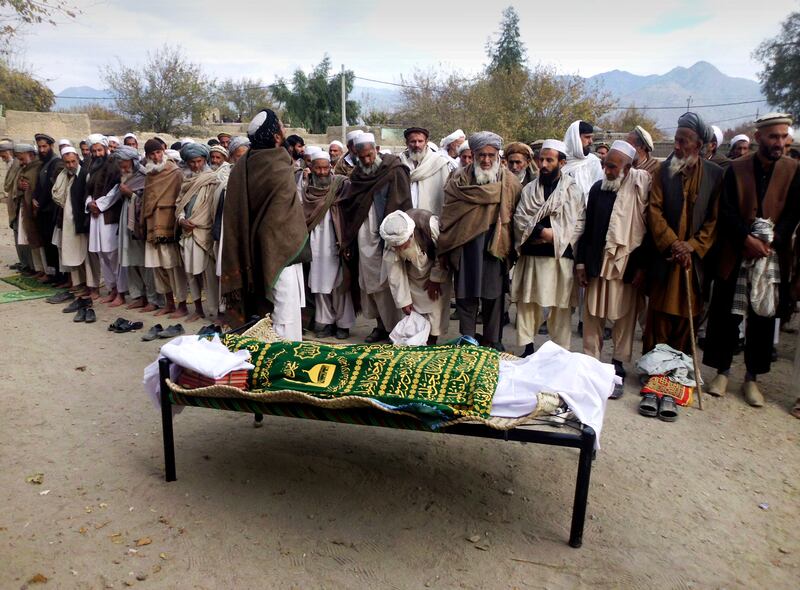
There had been no doubt that the threats were genuine. Laghman, situated on one of the main Taliban infiltration routes to and from Pakistan, is a hotbed of insurgent activity. Sidiqi’s predecessor in the job, Hanifa Safi, was killed this past July by a magnetic bomb attached to her car, and her husband and daughter were injured in the explosion. Nevertheless, Sidiqi agreed to take the post. “She accepted the challenge for the sake of Afghanistan’s women,” says Niazi.
Human-rights activists around the world praised Sediqi’s courage and denounced the killing. “The cold-blooded assassination of Nadia Sidiqi underscores the deadly consequences that lie in store for courageous women standing up for basic rights in Afghanistan,” said Suzanne Nossel, executive director of Amnesty International USA, in a statement. “They take their lives in their hands by insisting on equal opportunity and rights for everyone, including the right to go to school.”
Many Afghan women fear that the fragile rights they have gained in the past decade will vanish when the last U.S. and NATO combat troops pull out of Afghanistan in 2014. Just a day after the killing, the United Nations issued a new report deploring the ongoing level of violence against Afghan women. “If those forces leave, the Taliban will reverse us all back to nowhere,” Niazi warns. The prediction is echoed by a 23-year-old medical student, a Laghman native now studying in Jalalabad. She says the country’s future is dark because the future for Afghan women is dark, and it will stay that way until Afghan women demand that their children be educated.
The medical student recites just a few of the victims in the war against Afghan women. “The Taliban killed Safia Ahmed-Jan in Kandahar. A few days back they killed a girl for assisting the polio-vaccination program in Kapisa. And now they’ve killed Nadia.”
“It’s strange,” says Afghan journalist and women’s-rights activist Spogmai Basir. “After 12 years of war, we thought the Taliban were finally coming back to the circle of humanity. But it seems they’re the same as they’ve always been.” Nevertheless, she says, the problem isn’t only the Taliban. The roots of male supremacy in Afghanistan go far deeper than just the insurgents’ attitude toward women. In fact, it’s the same all over the country: victims of gang rape can legally be sent to jail for supposedly committing adultery, and women who run away from abusive husbands are committing a crime according to Afghan custom and culture.
Nizia recalls her last meeting with Sidiqi. “She told me the Taliban had been sending her threats, but she said she paid no attention to their words.” Sidiqi said they had called her on the telephone too. “I am your sister,” Sidiqi replied. She prayed five times a day, just as the Taliban do, she told the caller. “You can’t be our sister,” the caller told her. “Our sister does not go outside unveiled. A woman’s place is inside her home or in the cemetery.”
“Nadia Sidiqi was an old woman, and the Taliban insulted her,” the medical student says. “Hijab is not my problem,” she adds. “I wear hijab every day. I go to work at the hospital in hijab. My problem is the illiterate agents of Pakistan, the Taliban.” It’s been four years since she last dared even to visit her home village in Laghman province. “I’m sure the Taliban would kill me for being enrolled at the university,” she says. “There are many Taliban from my village living in Pakistan and coming back to Afghanistan to kill Afghans and women. I want to tell them: it’s better to take your mother or your sister to an Afghan doctor than to a Pakistani doctor. The world has many Muslim countries where women attend schools and universities. What makes us different?”
It’s no use trying to talk sense to such people. The medical student says the Taliban met with her brother and told him she was visiting American military bases to have sex. She says her brother trailed her for a whole week until he was satisfied that she was only traveling back and forth between her home and the university. “Because the Taliban themselves are low-minded, they think every woman and girl is just like them,” she says. “In fact, from a medical point of view, they are mentally sick.”
Sidiqi’s death has terrified the students and teachers at Niazi’s school, and attendance is noticeably down. Niazi herself is having second thoughts about staying in Laghman province. Her daughter is in the final year of high school. “To give her higher education, I would like to move to Kabul, where her chances would be a bit better.”
Still, the killers have no reason to congratulate themselves. “If the Taliban claim that killing a woman is an act of resistance, I would say shame on them,” the medical student says. “Killing an innocent women is pitiful, not proud.” And Basir agrees. “Killing women like Nadia Sidiqi only proves the Taliban’s moral weakness,” she says.
That’s small comfort as 2014 grows inexorably closer. The medical student speaks for many of her sisters: “I ask Mr. Obama and Hillary Clinton, as a woman: please do not abandon Afghan women to the terrorists.”