
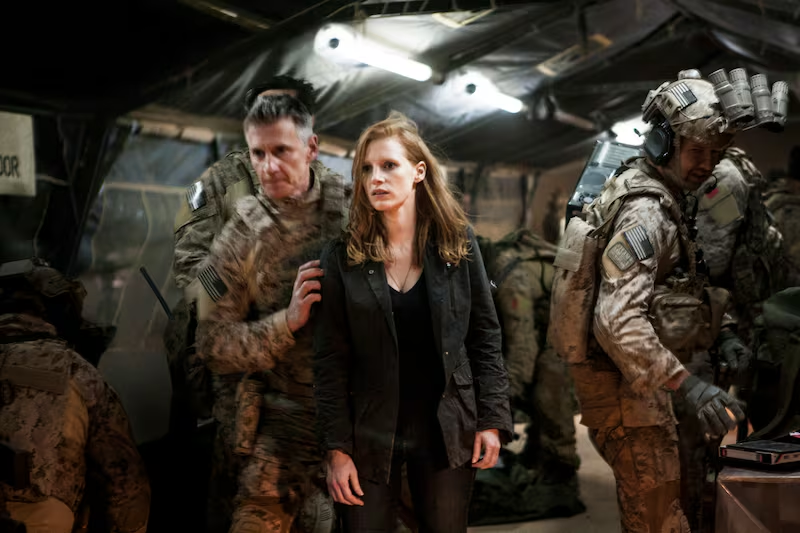
Zero Dark Thirty, director Kathryn Bigelow and journalist-cum-screenwriter Mark Boal’s highly anticipated follow-up to 2009’s Oscar winner The Hurt Locker, has received kilotons of critical praise. The film, which documents the Central Intelligence Agency’s decade-long hunt for Osama bin Laden, was named Best Picture by the National Board of Review and the New York Film Critics Circle, and was named one of the 10 best films of the year by the American Film Institute.
It was only a matter of time before the backlash came, and oh boy, is it a doozy.
Bigelow and Boal’s impressive film is being painted by contrarians as pro-torture propaganda, with New York magazine critic David Edelstein branding it “morally reprehensible” and making “a case for the efficacy of torture.” In a mini-profile of Bigelow, The New Yorker buried this incendiary nugget:
The waterboarding scene, which is likely to stir up controversy, appears to have strayed from real life. According to several official sources, including Dianne Feinstein, the head of the Senate Intelligence Committee, the identity of bin Laden’s courier, whose trail led the C.I.A. to the hideout in Pakistan, was not discovered through waterboarding.
New York Times columnist Frank Bruni churned out the most pointed criticism of the film, writing: “No waterboarding, no Bin Laden: that’s what Zero Dark Thirty appears to suggest. And the intelligence agents involved in torture seem not so much relieved as challenged by Obama’s edict that it stop.” Bruni writes that the movie does not “reflect many experts’ belief that torture is unnecessary, yielding as much bad information as good,” and then adds this coup de grace: “I’m betting that Dick Cheney will love the new movie Zero Dark Thirty.”
“We made a movie about what happened, so our focus was trying to bring the audience to the center of the intel hunt,” Boal told The Daily Beast a few weeks ago, before the backlash began. “We did a lot of homework. All the characters in the film are based on real-life people, and the movie is based on first-hand accounts.”
I’ve seen Zero Dark Thirty twice, and either these rabble-rousers weren’t paying close enough attention to what happened, or they simply misinterpreted what they saw.
Take one scene set in 2003, for example. “Dan” (Jason Clarke), an interrogation specialist, is in one of the CIA’s off-grid “black sites” torturing a man who allegedly transferred $5,000 to his cousin, a 9/11 hijacker.
“When you lie to me, I hurt you!” Dan screams at his bloodied captive.
Over the course of two “interrogations,” the detainee is stripped naked, has his face covered in a towel and doused with water repeatedly until he almost drowns, is beaten, subjected to a barrage of heavy-metal music, forced to crawl around in a dog collar, and then placed in a tiny box the size of a cupboard. He’s also subjected to sleep deprivation. All of this happens in front of the film’s protagonist, Maya (Jessica Chastain). However, very little information is gleaned from these barbarous methods.
The detainee does give up the name “Abu Ahmed al-Kuwaiti,” an alias of bin Laden’s “most trusted courier,” but only does so when Dan and Maya embrace a more relaxed technique. In lieu of torturing him, they take him outside into the sun, sit him down, offer him a plate of Arabic food and a cigarette, and ask him nicely.
“I’m sure the falafel was bad, but they gave him a cigarette, and that’s when he started talking,” said Boal. “I don’t think it’s that simple, but we’re not trying to come at it with an agenda. I don’t think anybody really debates that [the torture] happened, so we had to include it in the story.”
The torture scenes, meanwhile, not only horrify the viewer, but also Dan, who abruptly quits his post as an interrogation specialist and moves to Washington, D.C., to sit behind a CIA desk.
Later, in 2008, a roomful of CIA operatives, including Maya, are watching President Obama’s first postelection interview with Steve Kroft of 60 Minutes. They stare blankly at the screen as he says, “I’ve said repeatedly that America doesn’t torture.”
The CIA, which until this point has been torturing at will in the film, needs to change its methods of interrogation/information-retrieval. Mind you, its methods of torture have gotten its operatives nowhere so far.
Real progress is made when, after the torture dies down, Dan bribes a tacky Kuwaiti with a yellow Lamborghini in exchange for the address of the courier’s mother. The CIA then taps her phone and, after the courier calls, follows his cellphone signal until they locate him in a crowded square in Pakistan. The courier then leads the CIA agents to a compound in Abbottabad, Pakistan, where Maya believes bin Laden is shacked up.
Despite locating the compound in August 2010 and Maya being “100 percent convinced” that bin Laden is inside, the agency takes forever to act.
Maya demands that a bomb be dropped on the compound—despite knowledge that children are inside. Washington, however, wants more surveillance footage of the area, believing the mystery man holed up inside could be a Saudi drug dealer.
“The president is a thoughtful, analytical guy,” the president’s adviser says.
And it’s here—not the torture scenes—where people could criticize the Obama administration for failing to act sooner. Despite loads of circumstantial evidence that the mystery man inside the compound is none other than bin Laden, it takes the Obama administration nine months to take any sort of action. Maya, meanwhile, is ripping her hair out and, as each day passes, angrily scribbles the number of days its been since they discovered the compound on the glass window of her CIA superior.
On May 1, 2011, Maya is thrilled to learn that the Obama administration has given the go-ahead to send a group of Navy SEALs into the compound to kill bin Laden. And yes—SPOILER ALERT!—they succeed.
According to Boal, he and Bigelow may turn next to a project they were working on before Zero Dark Thirty—a film about the Mexican drug trade. Bring on the backlash.