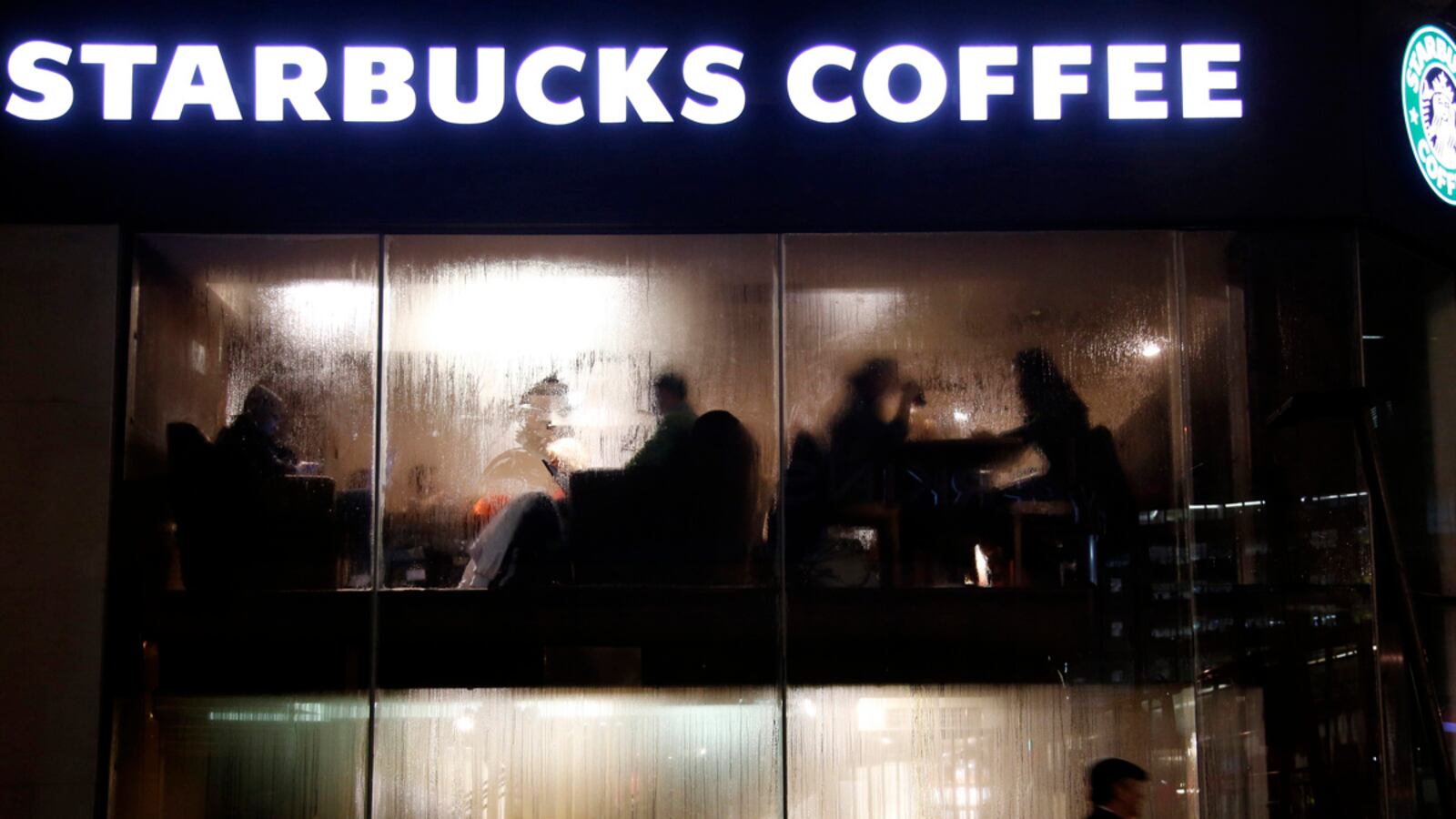
So now Starbucks is trying to solve the fiscal cliff. With just a few days left before taxes rise and spending cuts start to bite, the ubiquitous coffee chain is adding its voice to the calls for a compromise. CEO Howard Schultz noted in a blog post Wednesday morning that for the next few days, baristas in the D.C. area will scrawl the phrase “come together” on cups. “It’s a small gesture, but the power of small gestures is what Starbucks is about!”
This idea is sort of, um, doppio.

Corporate America is desperate to get fiscal cliff resolved, because it contains a lot of bad news for the economy, and for individual companies: defense contractors, health-care providers, pharmaceutical companies, the financial-services complex, and infrastructure firms. Meanwhile, as I’ve argued, it’s likely that companies that rely on lower-earning Americans—e.g., Walmart—will be the first to suffer when the payroll tax jumps higher and unemployment benefits fade away.
So it’s not surprising that since the conclusion of a divisive election, many companies and their leaders have become involved in pushing for a peaceful resolution of the fiscal-cliff hostage situation. CNBC has been running a “Rise above,” campaign. The organization Fix the Debt has enlisted dozens of CEOs of blue-chip companies to push for a deal. The CEOs of companies like Goldman Sachs, JPMorgan Chase, Aetna, and Honeywell have publicly urged Congress and the White House to come together.
And yet the calls go unheeded. The nation can’t rise above, or come together, or fix the debt, for some very good reasons. On issue after issue—global warming, tax cuts, even personal economic feeling—Democrats and Republicans see the world differently. In fact, it often seems as though they represent two different countries. The Republicans, who still command a majority in the House thanks to gerrymandered districts, are shrinking to a rural and Southern core. (There isn’t a single GOP representative east of the Hudson River, save Peter King of Long Island, which is really part of its own universe.) The Democrats dominate the urbanized coasts and the industrial Midwest.
The more the Republicans lose, the more stubborn and obstinate they become. They don’t want to do a deal with President Obama. They don’t want to compromise on taxing. They want to rip up the safety net, except for the portion that covers those who are already receiving benefits. They have said so, over and over again, to the press, to their own leaders, to anybody who will listen. The Democrats, having won two presidential elections in a row, are in no mood to rip up the greatest achievements of generations of Democratic presidents in exchange for smaller tax cuts than would be achieved by going over the fiscal cliff. And it seems unlikely that either side will have a big change of heart in the few remaining working days.
Large companies that put their brands behind a fiscal-cliff solution don’t have a particular solution in mind. Generally, they seem to want a compromise that would raise taxes some in exchange for a larger reduction in entitlements. But they do think that they can use their influence and moral authority to push the two parties to make a deal. In doing so, they’re failing to grasp the political dynamics. When two parties are a few hundred million dollars apart, they tend to meet in the middle. However, as I’ve noted, the fiscal-cliff situation is not a business transaction. When it comes to matters of theology—as the issue of taxation is for Republicans—there is no middle ground in which the two parties can come together.There’s a broader fallacy at work here. What makes CEOs think that putting their imprimatur on a political movement will increase public pressure on the two parties? Decades of lobbying have made observers suspicious of corporations in the public sphere. Why would they push for a solution unless they are pushing a parochial interest? Besides, while Americans may love their brands, they don’t exactly love big business. A decade of weak stock-market returns, stagnant wages, insane executive compensation, massive tax avoidance, and bailouts have sapped a great deal of the moral authority that large corporations once had in the public sphere. Companies who are known for paying absurdly low corporate income tax are poor messengers for tax reform, and CEOs who enjoy ridiculous pensions and retirement perks are poor messengers for entitlement reform.Besides, there’s a degree to which companies’ efforts to align their brands with a nonpartisan message can be counterproductive. It’s a simple fact that some companies have partisan identities—thanks to the personal preferences of CEOs, or thanks to the way companies benefit from policies, or thanks to market positioning. Walmart is Republicans, Costco is Democratic. Oil companies like ExxonMobil are Republican. Tesla Motors, the electric carmaker, is Democratic. MSNBC is (largely) Democratic. CNBC is (largely) Republican.Which brings us back to Starbucks. Like all great American companies, it needs to be perceived as nonpartisan, as a neutral player in the political and culture wars. But come on. The company is based in Seattle. It publicly supported Washington’s gay-marriage referendum. The stereotypical liberal drinks a latte or a cappuccino. This is a company that sells CDs of Bob Dylan and other lefty musicians at its checkout counters. It encourages its well-heeled customers to pay extra for “fair trade” coffee. Its CEO publicly supported Obamacare. I’m sure plenty of Republicans patronize Starbucks. But listen. There are five Starbucks outlets in the Jackson, Miss., area. There are single blocks in Manhattan that have that many Starbucks joints.Now, this shouldn’t be read as a blanket rejection of Starbucks efforts to promote inside-the-Beltway civility. But if the company really wants to help us get through the fiscal cliff, maybe it could cut prices on its coffee drinks, or sell a triple-shot espresso for the price of a doppio. After all, we reporters are going to be pulling some all-nighters as we wait for a resolution of the fiscal cliff.