
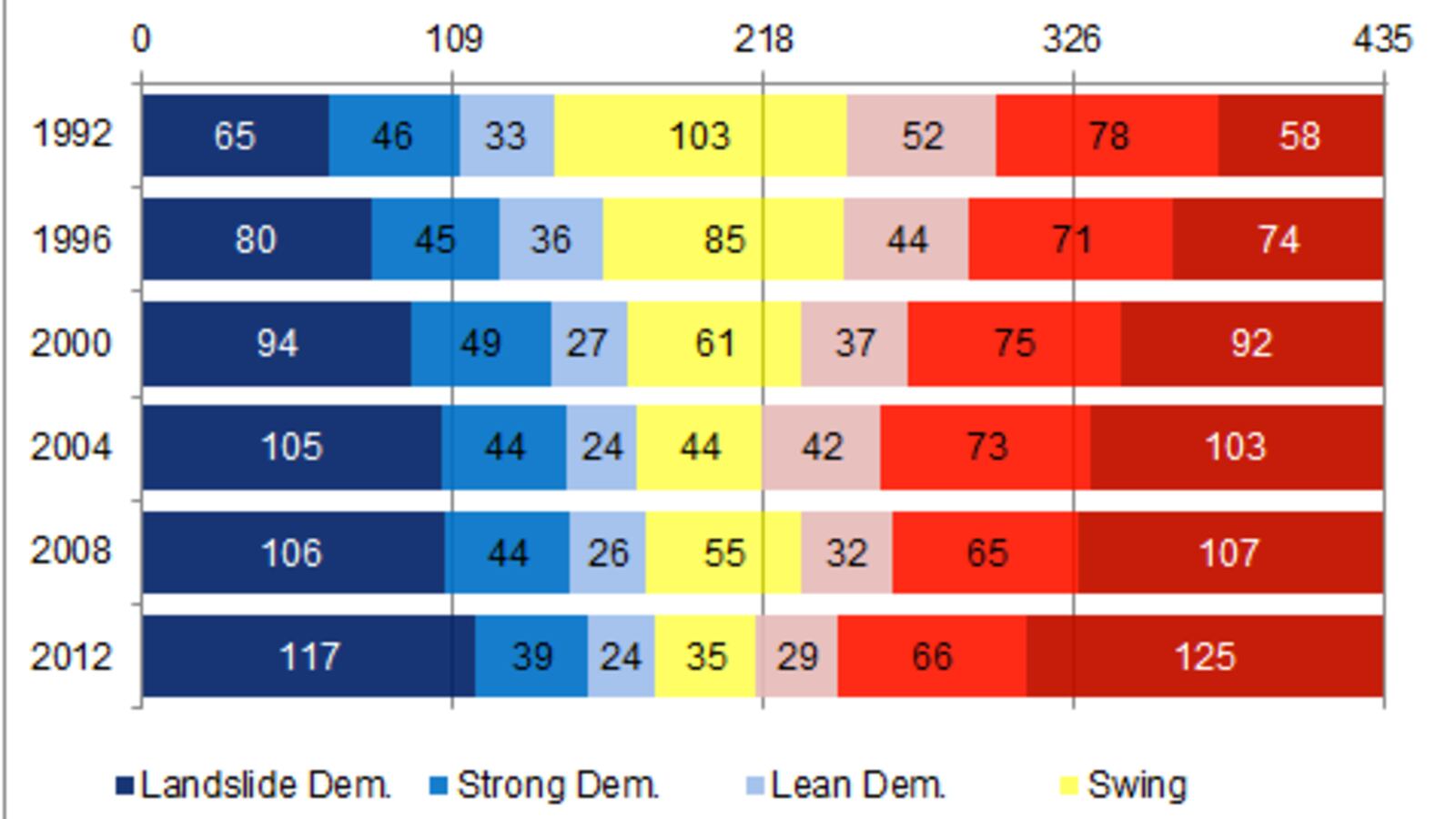
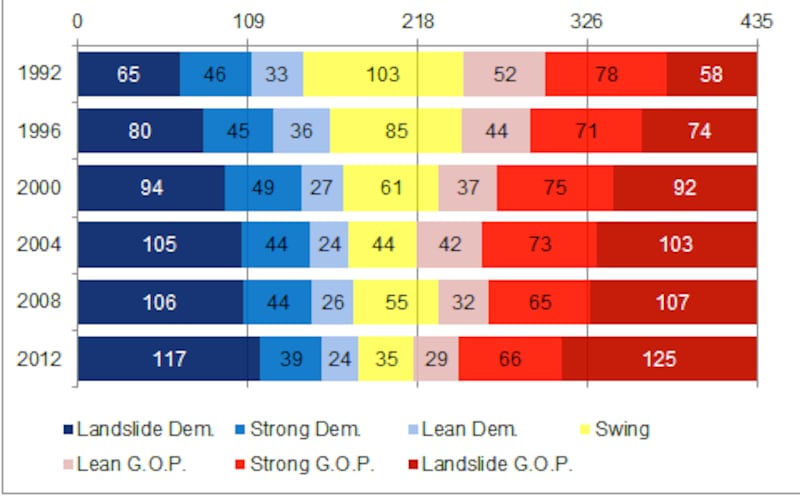
The New York Times' Nate Silver turns his data crunching to the topic of polarization, and the results are startling. The part most political types understand is that the Republican wins in 2010 (at the state level) were key for gerrymandering House districts for the next ten years. What most observers have not seen, however, is the decline of split-ticket voting:
[I]n 1992, there were 247 districts where the presidential vote was at least 10 percentage points more Republican or Democratic than in the country as a whole. Of these 42, or about 17 percent, split their tickets between their presidential and Congressional votes. Such splits are much rarer today. Of the 347 districts that were at least 10 points Democratic- or Republican-leaning in their presidential vote this year, only 6 (less than 2 percent) crossed party lines in their vote for the House.
There have been other periods in American history when polarization was high — particularly, from about 1880 through 1920. But it is not clear that there have been other periods when individual members of the House had so little to deter them from highly partisan behavior.
In the partisan era between 1880 and 1920, there were extremely rapid shifts in the composition of the House. For example, Democrats went from controlling 72 percent of House seats in 1890 to 26 percent in 1894. That is equivalent to Democrats losing about 200 seats in the House relative to today’s baseline of 435 Congressional districts.