
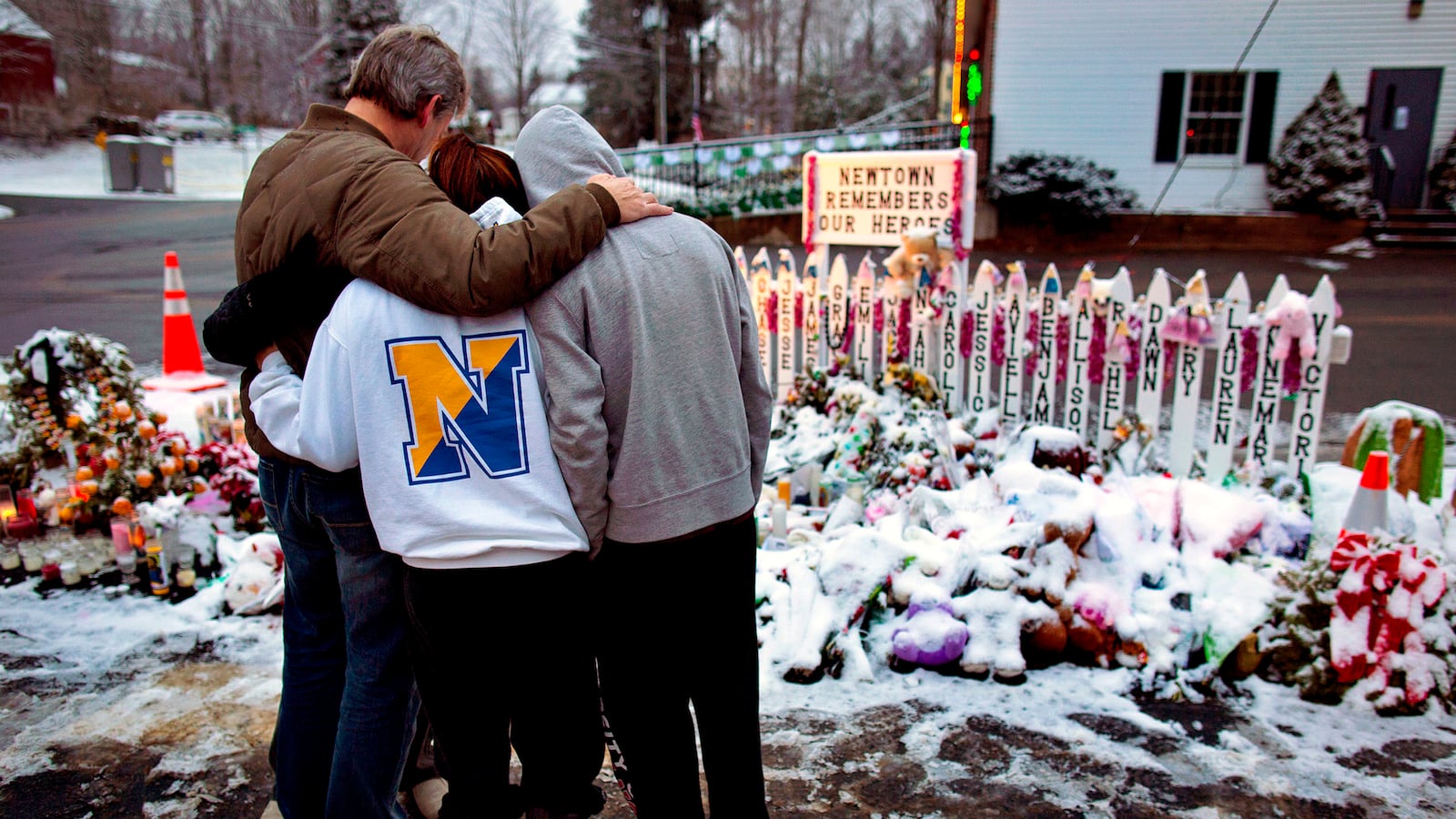
Our attempt to comprehend the horror of the Newtown, Conn., elementary-school massacre took a new turn this week when the office of the Connecticut Medical Examiner announced it would work with experts to determine whether the assailant, Adam Lanza, had any discernible genetic defect that might have led to his inconceivable action. Their hope is that perhaps from the tragedy we can gain some new insight, a knowledge that might help to identify the next mass murderer in advance and stop him before it’s too late. Or something.

Though met with a certain amount of surprise and concern, the planned DNA-ification of Lanza is the 21st-century version of an old pastime—scientists trying to understand insanity on a literal and physical level. In the 19th century, St. Elizabeth’s Hospital in Washington, D.C., the first federally run psychiatric hospital and a (now-closed) place famous for housing Ezra Pound and John Hinckley among others, also went about collecting the brains of the insane (PDF). About 1,500 brains taken at autopsy have been preserved for examination both contemporaneously but also with an eye to the future, when perhaps smarter scientists with stronger microscopes and more discriminating stains might be able to unlock the key to insanity. Now called the Blackburn-Neumann Collection, the samples are part of the National Museum of Health and Medicine.
Just as once we had assumed that invention of the microscope and microbial basis of disease and elucidation of the atom and all the rest would place scientific pursuit onto a bedrock of truth and indivisible, unassailable reality, so too are we now seduced by the promise of DNA and the entire traveling circus of the double helix. Furthermore, genetic decoding has been presented with comic-book simplicity; here, the genes are nothing more than a series of off-on switches studding the twisting molecular strands, each unambiguously responsible for just one expression: red hair or seafood allergy or mass-murder inclination. It’s all just one big scavenger hunt, working and sifting through junk, inch by inch, to find the nugget that encodes for some physical or behavioral trait till—bingo, here’s the gene that makes you love Celine Dion.
Of course, this is all baloney—the genetic code gets more, not less, complex as we nibble our way along its outer edge of secrets and sneaky tricks. We have taken only the first baby steps of a long adventure, an inquiry likely to take not a semester or even a generation but a century or two. To hope that anyone anywhere for the next long stretch of time can and will make sense of anything in Lanza’s genetic makeup is akin to waiting for the Tooth Fairy or for Washington to function in the public interest. Perhaps one day we’ll learn something, just like the countless St. Elizabeth brains may someday be unlocked and show us the way to insanity and by reverse logic, to its converse—sparklingly normal mental health. But not now, not soon.
This faulty premise of a quick explanation is only part of the problem that the pursuit of a genetic understanding of the insane might produce. Let’s say next week a geneticist somewhere does find a big weird genetic defect that Lanza and Lanza alone has—what then? Does this mean that Lanza is not guilty but rather just operating under the influence of his oppressive genetic makeup? His genes made him do it? Perhaps we are all just playing out our genetic destiny, like programmed robots, free of free will, unencumbered by choice. Maybe this is The Matrix (the first one that was faintly intelligible) after all.
And what would such a discovery mean to the world of screening? We screen many fetuses for Down syndrome—would we want to add the screen for the mass-murder gene? Genetics as a field has struggled to keep up with the accompanying ethical quandaries its scientific pursuit has created: for example, whether to test for the Huntington’s disease gene or the BRCA gene that may predispose to cancer of the breast. Plus, what if insurance companies began to use the information to select good-risk genetic stock only, passing over those with too many scrambled genetic elements?
Geneticists have wrestled slowly and responsibly, if very painfully, with these complex and unprecedented issues. BRCA, Huntington’s, and many others though are worthy of pursuit because of the great promise of genetic screening for these clearly defined diseases. The field, however, would suffer greatly to have dropped into its midst a high-profile fishing expedition as is planned with Lanza, where the public wants an answer, damn it, and doesn’t care so much for the questions that follow. Yes scientists can and should preserve his DNA and that of anyone else in some master repository somewhere that awaits a day when the tools are available to investigate the material intelligently, productively, and dispassionately. But to embark on this particular wild-goose chase right now serves only to place onto a pseudoscientific scaffolding the deepest question of human existence, the nature of good and evil. With such shoddy materials, the inquiry is certain to fail, providing no novel understanding of the genetic code and no solace to the families of Newtown.