
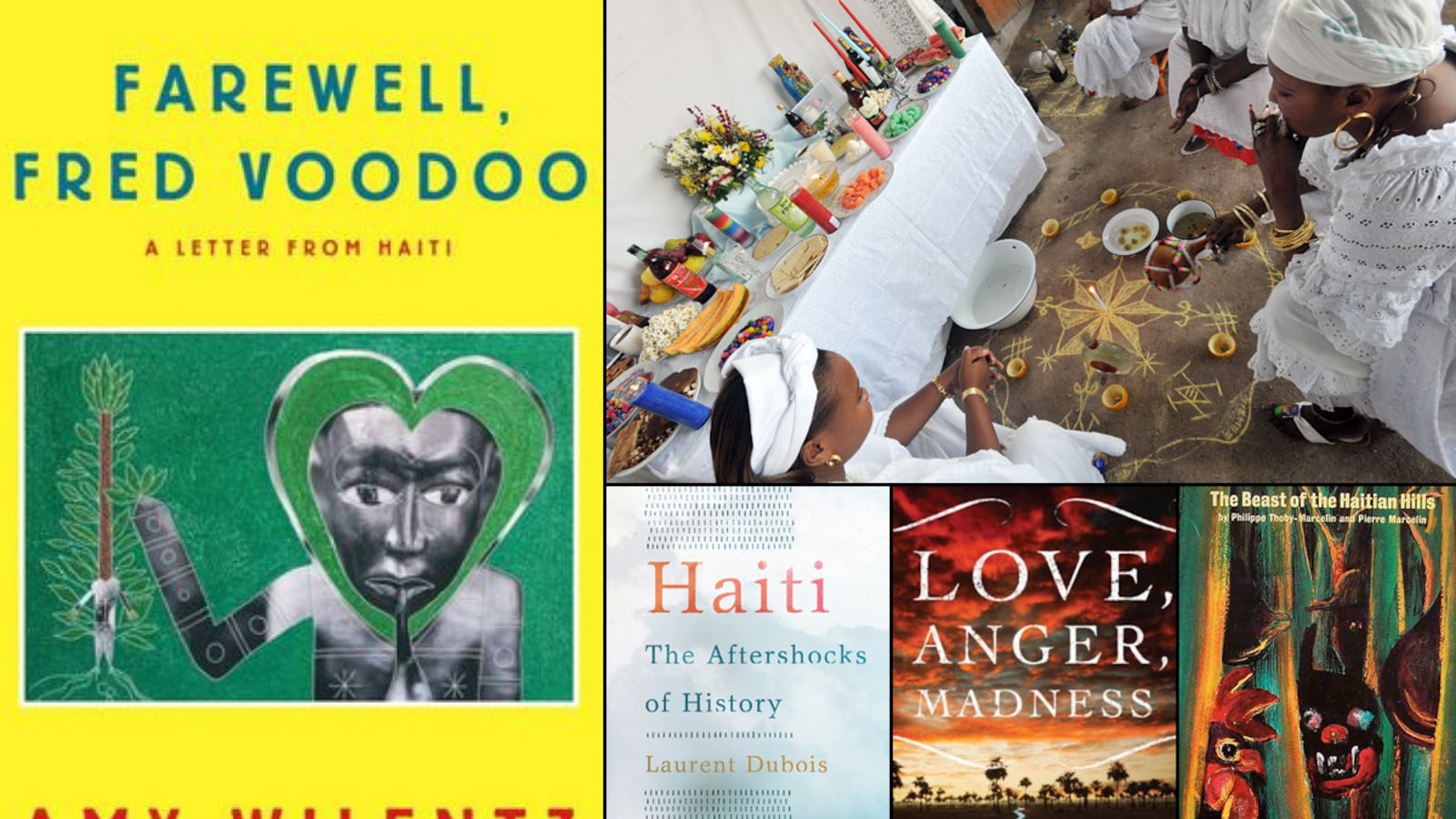
Haiti: The Aftershocks of HistoryBy Laurent Dubois

I’ve written about Haiti for a long time now, and thought about it for a long time, and whenever I get blue, or stuck, or think I’m over it, Laurent Dubois, newer to the scene than I and far more erudite, publishes a new book on Haitian history. He’s a thoroughly engaging and witty writer, and his books always reveal new aspects and new ways of thinking about and interpreting this country’s amazing history, a history so spectacular and dramatic that, rather than merely having happened, it often seems to have been scripted by a mad global genius, and then acted out by Haiti’s most captivating actors and comedians. In Aftershocks, a sequel to his equally panoramic Avengers of the New World (which begins with the colony and takes us to independence from France), Dubois continues his exploration and explanation of Haiti, through the U.S. marine occupation of the country (1915 -1934) up to the regime of the weird and brutal François “Papa Doc” Duvalier in the late 1950s and early 1960s. Haitian history has never been dull; Dubois takes us through this rich material, enlivens it further with his original and meticulous research, and helps us understand why things happened as they did, and what it all means for Haiti today in the wake of the terrible earthquake of January 12, 2010.
The Beast of the Haitian HillsBy Philippe Thoby-Marcelin and Pierre Marcelin

One of the great novels to come out of Haiti in the 1940s, The Beast tells the story of Morin Dutilleul, a light-skinned Haitian shopkeeper who decides to move back to “the land” and become a farmer after his wife dies in childbirth. Though he longs for the planter’s pastoral life, the people among whom he goes to live do not return his affection, nor do they live up to his sentimental idea of them. Instead, the peasants around him lead a harsh and demanding life. They also live in fear of a great beast that is believed to roam the area, terrorizing families and stealing livestock. Their terrible fear controls many actions and behaviors, and eventually, Morin himself, drunk and wracked with guilt over his wife’s death, finally sees the beast himself. This great and poetic novel offers countless examples of the divisions that split Haitian culture, and provides an object lesson about the failures of sentiment and condescension in politicized situations. Perhaps I’m making the novel sound didactic, but it’s not: it’s an early and poetic example of magical realism, weird, beautiful, and sui generis.

Love, Anger, Madness: A Haitian Trilogy By Marie Vieux-Chauvet
An astounding collection of three novellas by the controversial Chauvet, who grew up under the harrowing American occupation only to see its end result in two decades of Haitian political turmoil, finally spitting Papa Doc into the presidential palace. Each of the novellas could have been written about Papa Doc’s regime, and indeed, Chauvet was forced herself to flee from Duvalier’s Haiti, turning up in Queens, where she died in 1973. Her novellas tell dark Duvalier tales: of lust, rape, and theft; of the slow progress of criminality; of families shattered in the totalitarian system; of the seepage of cruelty, envy, and greed into private lives from the political arena; of the deforming of artists’ souls, of the destruction of the crippled and the weak. Haiti was a dark place for a long time, and you’d think these stories would depress a reader, but instead they dazzle and impress. They’re modern and sexy and even when they turn tragic, which is often, they manage to make you believe in the triumph of the decent human spirit, and the victory of the artist through her art.

Haiti Noir Edited by Edwidge Danticat
Who can ever judge how important Danticat has been to Americans’ understanding and re-evaluating Haiti’s position and role in the hemisphere? Not just as a novelist and essayist in her own right, but as editor and guiding force behind this collection of short stories and the re-publication and English translation of the Chauvet triptych, the Haitian-born Danticat has brought her country’s literature back into the world of English-speakers. Filled with delights and surprises, Haiti Noir, taken as a whole, provides a profound portrait of the country, from its crises to its triumphs, from the tiny bouks of the countryside to the shanties of the sprawling bidonvilles. Danticat herself has a lovely story in the collection, and permits two distinguished foreign writers on Haiti, Madison Smartt Bell and Mark Kurlansky, to slide in there among all the brilliant Haitians.

The ComediansBy Graham Greene
The granddaddy of all outsider books on Haiti, by the granddaddy of outsiders. Hard to mention all of its virtues. Here are some: The love affair between the spiritually disaffected narrator, and Martha, an ambassador’s wife. The plot against the dictatorship (based on the many abortive coups against Papa Doc). The wicked and comic story of the visiting American presidential candidate (a perennial loser) and his wife, both vegetarians with unlikely plans to start a center for vegetarianism in Haiti. The dead minister in the empty swimming pool. The disruption of his funeral by the Tontons Macoute. The twisted fate of the complicated Mr. Jones, an American agent around whom the narrative swirls. This is the book all outsiders who write about Haiti would have written if we could have. It is weirdly accurate and prescient, down to the smallest details—including little asides about things like corruption in the purchase of neighborhood water pumps. An amazing work of political and fictional imagination; wonderful and moving. It’s fun to read even if you’ll never look at another thing about Haiti.