The Future Of Palestinian-Israeli Security Cooperation
Dan Fleshler reports on the causes of fraying Palestinian-Israeli security cooperation in the West Bank.

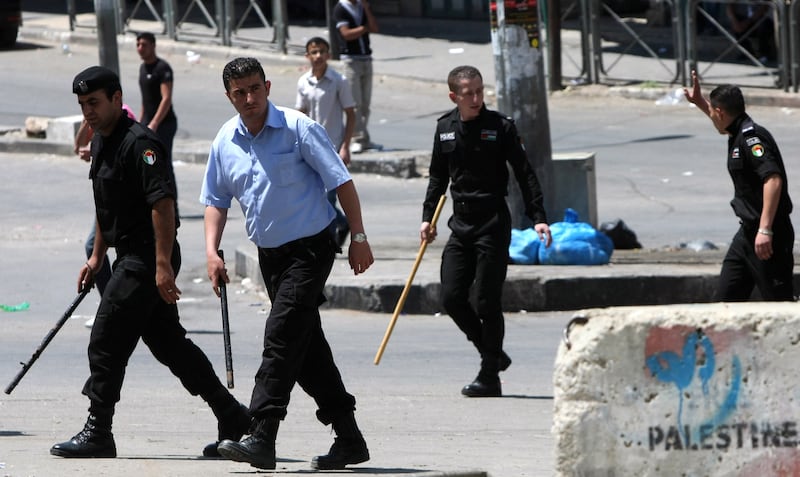
Hazem Bader / AFP / Getty Images
Get the Beast Digest newsletter delivered straight to your inbox
By clicking “SIGN UP” you agree to our Terms of Use and Privacy Policy.
No American knows more about Israeli-Palestinian security cooperation than Steven White, an aide to three U.S. Security Coordinators in the region between 2005 and 2010. He is clearly worried about the impact of recent Israeli provocations on the joint security apparatus he helped to set up, which has played a major role in a substantial decrease in terrorist attacks emanating from the West Bank.
”I was told by a top Israeli military official that, ‘Netanyahu has obviously decided to put a bullet in Abu Mazen’s head without any thought to the strategic consequences,’” White said, using PA President Mahmoud Abbas' nickname when describing a recent trip to the region.
Only deluded or blind apologists for Prime Minister Benjamin Netanyahu are arguing that it is possible to implement his plans for new housing on the outskirts of Jerusalem—including the infamous "E-1" corridor—without killing the two state solution. Objections to these plans from the Zionist left generally focus on outcomes that will occur down the road (e.g., they will lead to one binational state and the end of democratic Israel). But the lack of a Palestinian political horizon also poses a more immediate danger: the potential collapse of joint Israeli-Palestinian security operations in the West Bank.
Palestinian Authority security forces, trained in Jordan with American assistance, have been protecting Israeli lives and ignoring derisive claims that they are collaborators not because they want to collect salaries; instead, they want to build an institution necessary for statehood and to allay Israeli fears about relinquishing the West Bank. Ghaith al-Omari, a former Palestinian Authority advisor, told me that the work of the security services “was predicated on a path leading to liberation and a new state. Soon, very soon, if it is clear that is not happening, they will feel like suckers enforcing the occupation, and this security regime—like the Palestinian Authority itself—could dissolve."
Indeed, a troublesome Yediot Aharonot report indicates that amidst a recent upsurge of violent unrest in the West Bank, security cooperation has been fraying. Some believe the West Bank is on the verge of a third intifada, which, White says, would put Palestinian security officers in an “impossible situation.”
In a conference call organized by the Israel Policy Forum with his colleague, Colonel P.J. Dermer, White recounted what a “senior IDF general” involved in the cooperative security operations told him: “‘My job was to tactically set the ground where my government, the government of Israel, could negotiate with the Palestinians without a knife against its neck... With American help, with Palestinian help, we delivered that. Unfortunately, my government has not chosen to take the strategic, long-term view or to build upon that.”
In a better world, the political situation would not have an influence on how Palestinian moderates take on the violent rejectionists in their midst. But the grim reality is that in a battle between two national movements—with such a long history of bitter conflict—those moderates need incentives. Netanyahu's government seems determined to destroy those incentives with its settlement plans, as well as with its decision to withhold salaries from the Palestinian Authority as punishment for its bid for upgraded U.N. status.
In his harsh response to Israeli President Shimon Peres’s assertion that Abbas was a partner for peace, Netanyahu said: “Everyone knows that Hamas could take over the Palestinian Authority. It could happen after an agreement; it could happen before an agreement. Therefore…the diplomatic process must be managed responsibly and sagaciously and not in undue haste.”
But by continually provoking Abbas and Palestinian Authority officials who have been shielding Israelis from the consequences of the occupation, Netanyahu is essentially inviting Hamas to take over and working for even more extremist Palestinian groups within the territories to have a freer hand. That is not going over very well with Israelis who are responsible for protecting their country’s security. According to White, “There is a very, very clear distinction between the messages and reports that Israeli security officials have given to their government and what the government puts out for the public.”
See more of our coverage in your search results.

Got a tip? Send it to The Daily Beast here.
Unlock a year of full access to The Daily Beast for $35.
Monthly
$1
First month then $5.99/month
Annual
$35
First year then $59.99/year
Premium
$79
First year then $119.99/year
*Substack access provided by the next business day, using your subscription email. Choosing the Premium plan constitutes your permission to share your subscription email with Substack and your agreement to Substack’s Privacy Policy.
Looks like you already have a subscription!
- Account (completed)
- Payment (completed)
- Confirmation (completed)
You're all set!
Thanks for subscribing.
- 1Account
- 2Payment
- 3Confirmation
Sign in or create an account
Register below to read this article for free or subscribe
to unlock unlimited access to The Daily Beast.
Monthly
$1
First month then $5.99/month
Annual
$35
First year then $59.99/year
Premium
$79
First year then $119.99/year
*Substack access provided by the next business day, using your subscription email. Choosing the Premium plan constitutes your permission to share your subscription email with Substack and your agreement to Substack’s Privacy Policy.
Already have an account? Sign In
Looks like you already have a subscription!
- Account (completed)
- Payment (completed)
- Confirmation (completed)
You're all set!
Thanks for subscribing.
- 1Account
- 2Payment
- 3Confirmation