
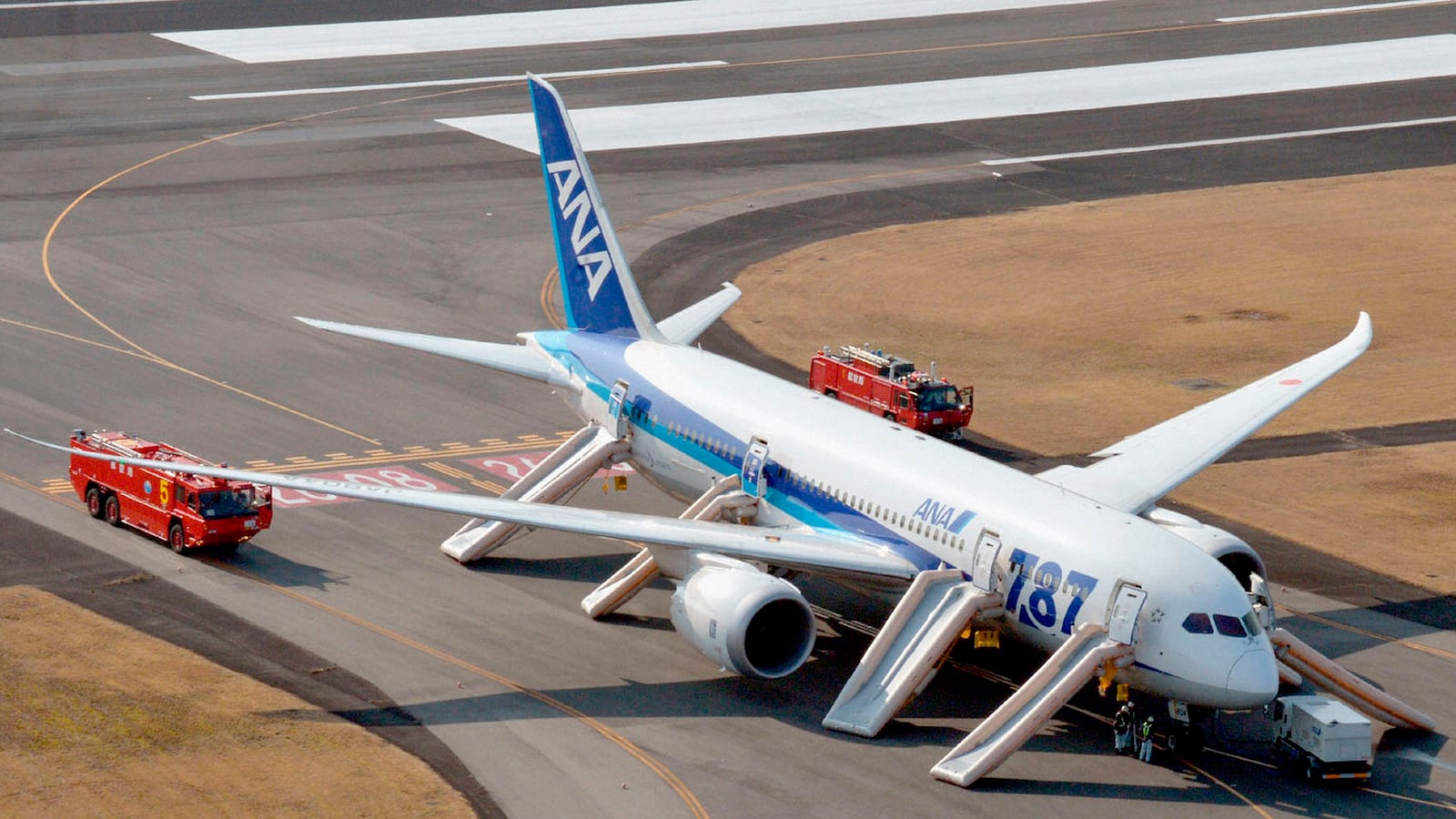
Over the course of the last week, the Boeing 787 Dreamliner has become the most troubled airliner in the sky. Now the grounding of the plane by Japan’s two main airlines shows that Boeing faces its gravest challenge in decades.
A statement from the National Transportation Safety Board on Tuesday made it clear what investigators regard as the most serious of the 787’s problems. As they drill deeper into the cause of the fire aboard a parked Boeing 787 Dreamliner in Boston last week, their focus is on a decision taken early in the development of the plane: to use lithium-ion batteries as a power source.
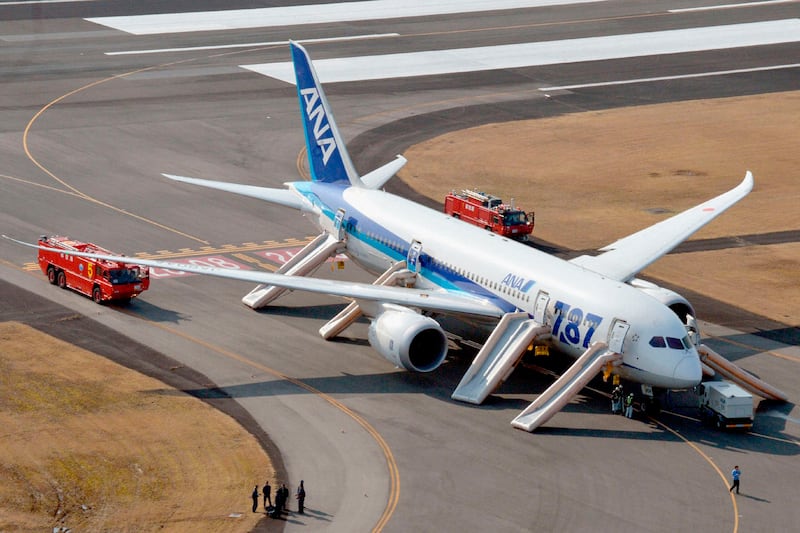
Last week’s fire was in one of these batteries, in an electronics bay under the rear of the cabin. The latest emergency, when a 787 flown by All Nippon Airways—the first airline to fly the 787—had to make an emergency landing in Japan, apparently involved a similar battery in a second electronics bay under the forward cabin.
The Dreamliner was the first airliner to employ this type of battery—a technology that has caused problems in other applications, for example overheating in laptops and in electric cars. For Boeing the appeal of lithium-ion batteries, in contrast to older battery technology, is that they deliver far more power for their weight, and weight is always critical in airplane development.
In fact, in 2007, when the Dreamliner design was being screened by the FAA as part of being certified fit to fly, the choice of lithium-ion batteries was identified as a “special condition” that needed rigorous testing, as would be the case with any untried technology that might compromise safety.
These batteries are prone to “burn out” when overloaded. The unit involved in the Boston fire, made in Japan, had two functions when the 787 was parked at a gate—to provide power to a small gas turbine called an auxiliary power unit that keeps systems running when the main engines are shut down (all jets have them), and to provide some cabin lighting.
After the Boston fire I asked a highly experienced airline pilot if he had ever known of a fire connected to an auxiliary power unit. He could not recall one.
Boeing has declined to discuss the specifics of either incident. Of the A.N.A. emergency landing, a spokesman in Chicago told The Wall Street Journal, "We're aware of the event and working with our customer.”
But as the crisis has unfolded, Boeing has seemed one step behind where the investigators are going.
After the Boston emergency, they stressed in a statement that that fire was unrelated to other electrical problems experienced by the 787. (Both United Airlines and Qatar Airlines have had recent cases, and Qatar grounded three 787s while they were inspected.) At the same time, the NTSB promptly announced that the Boston incident arose from a “serious fire.” Then, last Friday, the FAA took an extremely rare step by announcing a “comprehensive review” of the 787’s critical systems.
Even then, Boeing responded by saying that the reliability of the 787 during its first year in service was comparable to that of the larger 777 when it was introduced in the 1990s.
This was public relations obfuscation. The 777 was a relatively conventional design, and its innovations were refinements of existing technologies, not the kind of radical leap embraced by the Dreamliner, which uses composites instead of metal for most of its structure and, now very salient, much more electrical power, generated independently of its engines, for many of its systems.
What matters is the kind of problems, not their number or the basic statistics cited by Boeing. It only takes one unforeseen technical weakness to jeopardize an otherwise reliable design, and for Boeing its choice if lithium-ion batteries could be that kind of weakness.
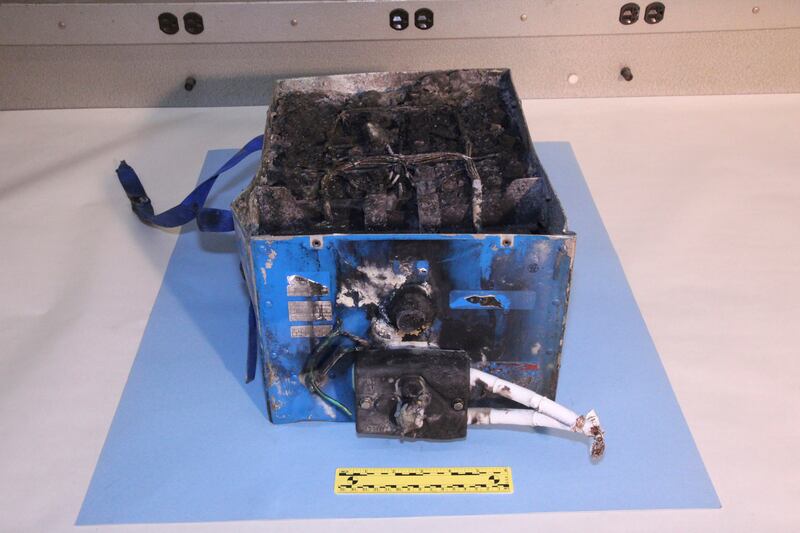
When, yesterday, the Safety Board homed in on the battery problem, they released a photograph of the unit from the Boston fire; it looked completely fried. Right now the FAA, the NTSB, and Boeing seem to be taking turns in a not-very-well-coordinated series of announcements that swing from the specifically alarming to the generally evasive. Traditionally, it’s the NTSB that is the least political of these three. As the specialists on the ground and in the lab, they get the bad news first. And they seem ready to share it.
With the two Japanese airlines deciding to ground their 787s, the question is whether the remaining 787s, of the 50 now flying, should be grounded too. In the interests of all airline passengers, that question needs urgently to be addressed.