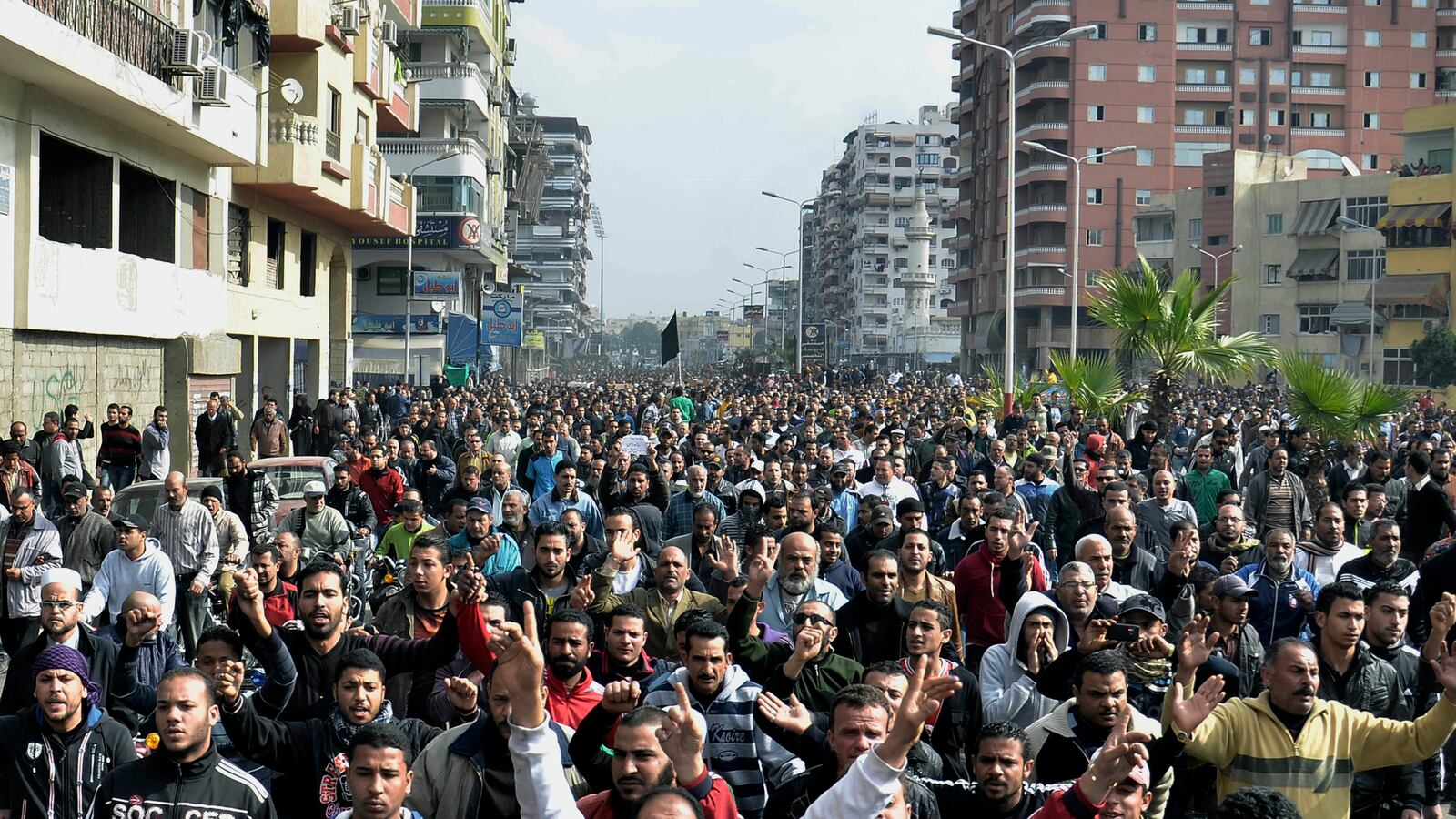
Port Said remained defiant on Monday night. When the hour came for the new 9 p.m. curfew—imposed by President Mohamed Morsi’s controversial emergency decree—protesters in the restive Mediterranean city promptly poured into the streets. They sang songs, chanted against Morsi’s government and played soccer—at times, even kicking balls at the soldiers tasked with enforcing the curfew, who gamely kicked the balls back. Cars drove around town with makeshift license plates labeled “The Republic of Port Said.”

The scenes were similar in cities across the three governorates where the emergency decree took effect, as Morsi’s attempt to restore order following nearly a week of unrest that has left more than 50 dead seemed to be faltering. In Port Said—where clashes erupted last week after a court doled out death sentences to young soccer fans known as “ultras” for their role in a deadly riot last year—the demonstrations were quickly moving beyond soccer. “This started with the ultras, but the problem is bigger,” said Mohamed el-Katatny, an engineer and Port Said native. “It’s a matter of injustice.”
For Aly Ashraf, an 18-year-old student in Port Said who said he was unaffiliated with an ultras group or political party, the protests now were about one thing—Morsi. “Morsi’s administration divided our country,” he said.
Morsi has tapped the military to help bring the city and its neighbors back to order—on Monday, the Egyptian government passed a measure granting the Army the power of arrest. Meanwhile, the country’s top military commander, Gen. Abdel Fattah al-Sisi, issued a dire warning about the ongoing unrest, via a statement on the military’s official Facebook page. “The continuation of the struggle of the different political forces,” he said, “could lead to the collapse of the state.”
Port Said—along with its canal-region neighbors of Ismailia and Suez, which are also covered by Morsi’s decree—has been a picture of chaos in recent days, with demonstrators trading gunfire with police and volleys of tear gas dispersing funeral processions for residents killed in the clashes. Amid the upheaval, the country’s opposition—which had taken to the streets en masse just a day before the Port Said verdict last week, in commemoration of the two-year anniversary of the 2011 revolution—has sought to press the advantage against Morsi, renewing its fight against the controversial Constitution he pushed through last year. A number of opposition leaders met with the president late Monday—however a coalition of 35 secular groups—led by Mohamed ElBaradei—boycotted the talks, saying it was merely political theater.
Many in the opposition think Morsi’s use of the emergency decree—a hated tool of repression during the three-decade rule of his predecessor, Hosni Mubarak—will only see him further weakened politically. “No. 1, we have had very bad experience with emergency law,” said the Cairo activist who blogs under the handle Big Pharaoh. “And No. 2, it’s completely useless. If you look at the news reports coming from the cities where the emergency law was declared—I mean people are still taking to the streets. They are not paying attention to emergency laws.”
Port Said may see this as its moment to shine in Egypt’s ongoing political transition. Many smaller cities have felt somewhat neglected by the rapid changes engulfing Egypt these past two years, with much of the focus concentrated on the larger cities like Cairo and Alexandria—while at the same time, an alarming deterioration in security has gripped the country outside the capital. Like Suez, Port Said has played a significant role in Egypt’s revolutionary past—in 1956 when then-President Gamal Abdel Nasser nationalized the Suez Canal Company, triggering an invasion by Britain, France, and Israel, Port Said was the battleground, and it became synonymous with the resistance movement that emerged from the crisis.
Even Egypt’s revolutionary activists seem unsure where the new round of protests might lead. “This violence is kind of new,” said Big Pharaoh, the Cairo blogger. “It’s definitely not like [the 2011 revolution], where you had large groups of people acting together. Now, you have different people acting in different cities across the country, and we don’t know where this is taking us.”