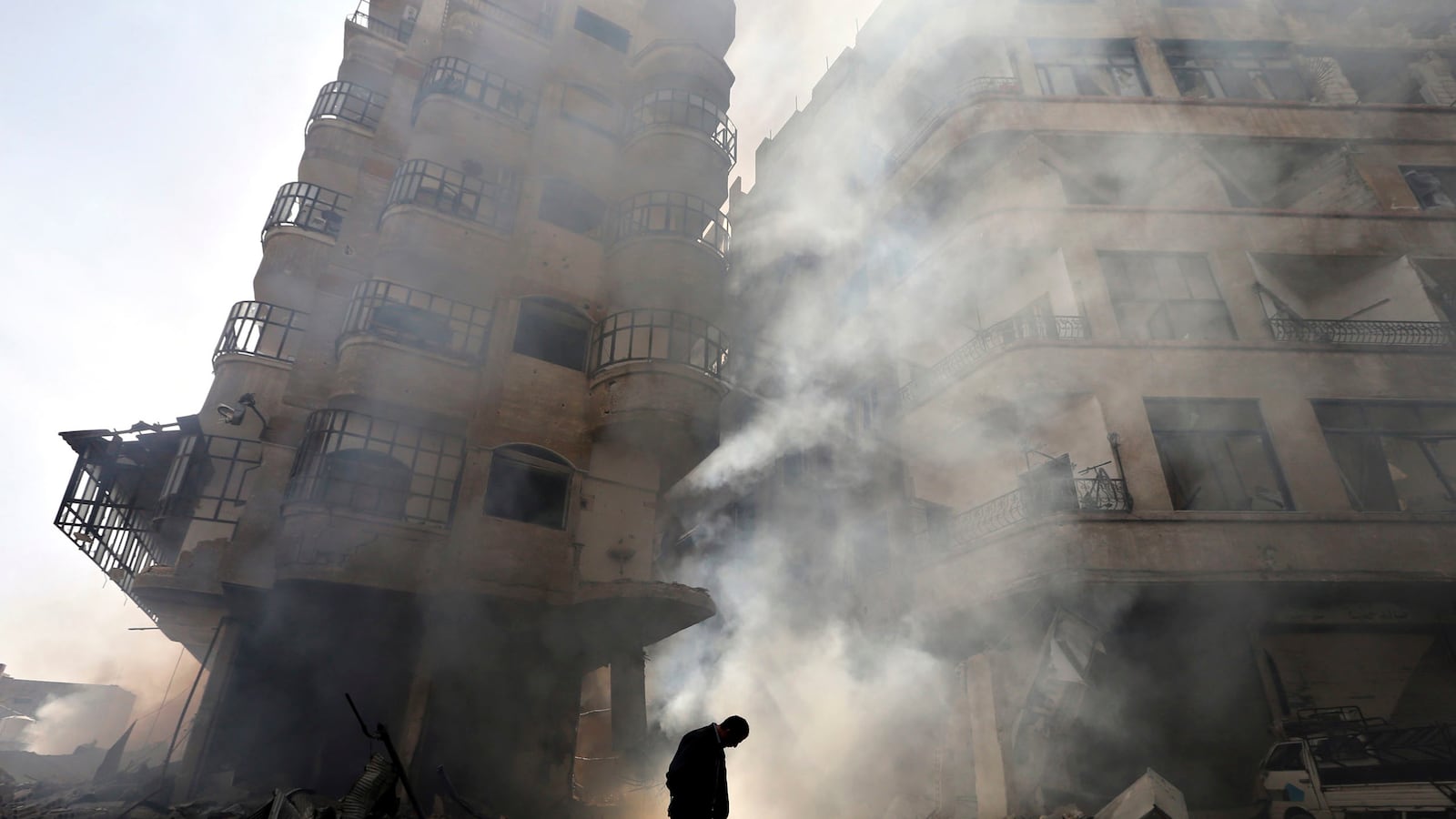
Violence and emergency law in Egypt. French troops battling Islamist insurgents in Mali. Emboldened radicals attacking an Algerian gas plant in a days-long standoff leaving dozens dead. Each conflict has caused much hand-wringing in the West over the unintended consequences of the Arab Spring.

But nowhere, perhaps, is the dismay over these conflicts greater than in Syria where rebel forces fear they will be used by the United States and the international community as an excuse not to give the insurgents what they’ve long been begging for, namely support from the West in the form of arms and a no-fly zone like the one imposed by NATO to help oust Libyan dictator, Muammar Gaddafi.
“They do not want to see the rapid collapse of the regime, because that basically creates a big black hole, and it’s chaos,” says Amr al-Azm, a Syrian dissident and professor at Shawnee State University, who once worked as an adviser to the Syrian government. “They would prefer to see a wearing down of the regime instead—enough to bring it to the negotiating table.”
But America’s fears of heavily armed jihadists overrunning the country is already coming to pass, Azm says—a result, in his opinion, of the lack of international support for more moderate and organized rebel factions. “No one supported them,” he says. “Then you had these Islamist groups come in, and they had weapons, and they had guns, and they had money—and people started to drift toward them. And they’re on the loose now anyway.”
America has indicated growing concern over one particular jihadist group, Jabhat al-Nusra, which has become increasingly prominent in the rebel fight. Late last year, the U.S. government designated Jabhat al-Nusra a terrorist group, citing links with al-Qaeda—a move that inspired a backlash among the opposition, with protesters declaring their anger at America and their support for the Islamist group.
Many Islamist rebels insist that they plan to return to their normal lives after the war, and deny that they have plans to expand their campaign beyond Syria. Indeed, one rebel fighter described how he crossed the Syrian border with Iraq to fight the Americans there during the war, and then, when the war ended, went back to Syria and earned a degree in law.
Sipping tea in the Turkish border city of Reyhanli last weekend, the fighter, who goes by the nom de guerre Abu Islam, said that he joined Jabhat al-Nusra after the revolution, leaving them only recently in order to lead his own Islamist group in his home province of Hama. He said that he still identified with Jabhat al-Nusra—but that he had no intention of waging further jihad once Assad falls. Instead, he said, he plans to put his law degree to use. “Once this is over, everyone will drop their weapons,” he said.
More secular rebels, though, express concern about the increasing strength of the Islamists. Abu Mohamed al-Kurdi, the commander of the Liwa Roukn al-Din battalion in Damascus, said that jihadists are already empowered in Syria—and echoed the idea that a lack of support from the West is helping to fuel the problem. “It’s opening a big gate for these radical groups, because they have their own funding,” he said. “They have to stop the weapons from flowing to the wrong people.”
He added that his battalion has taken small steps to try to head off a slide into chaos if Assad falls. He’d recently issued ID cards to his soldiers, with details of the weapons they’d been issued—information that has been stored on the battalion’s rolls. In the future, those who don’t join up with a new national army will have to return their arms, he said.
One of the Liwa Roukn al-Din fighters, who’d recently received his new ID card, said that he planned to return to running his small grocery store in Damascus when the war ends. But he also worried about the potential of chaos to come. “Right now—I’m not going to lie—there are people who are buying weapons in Damascus,” he said, “just to create chaos when this is all over.”