
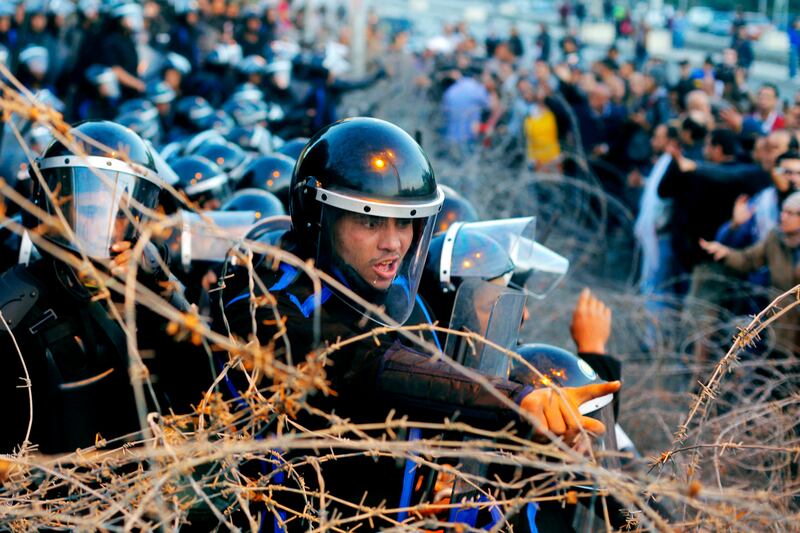
On Friday, the Muslim day of prayer, Egyptians are planning another round of protests, of the kind made famous during their Arab Spring uprising. After services at mosques across the country, activists will flood the streets, chanting anti-government slogans and facing off with riot police. But unlike the demonstrations in 2011, which led to the ousting of ruler Hosni Mubarak, today’s protests will not be about the unity of one people standing against a dictator. Instead, Egypt's current unrest is a sign of how much the nation is splintering.
Gone are the days of liberal and secular activists singing songs alongside members of the Muslim Brotherhood in Tahrir Square. Now, the two groups are split bitterly over the tenure of President Mohamed Morsi, the Brotherhood leader elected in June. The country’s opposition hopes to force Morsi to compromise on some of his recent measures, such as the new constitution that Islamists pushed through in November—an act that set off a previous round of unrest. Some activists even say they hope Morsi is overthrown outright in another revolution.
Yet the protesters themselves are far from unified beyond their conviction that Morsi is the enemy. On one end, liberal activists who were at the vanguard of the 2011 revolution are calling for a march on the presidential palace, similar to the one in December that brought masses to the palace gates and led to a night of fatal clashes between activists and Brotherhood supporters. Meanwhile, senior opposition politicians, led by Nobel laureate Mohamed ElBaradei, met with top members of the Brotherhood on Thursday, releasing a joint statement renouncing violence and promising to work to build trust.
The opposition’s leadership, however, seems to have little connection with or control over the fragmented protests raging for the last week in the capital and across the country. In central Cairo, young demonstrators have engaged in pitched battles with police that seem as much about reviving old grudges with the cops as about opposing Morsi. A new group of masked youth, who call themselves the “Black Bloc,” have emerged and vowed to use violence to “defend the revolution.” The Black Bloc say they are an organized cohort, but street vendors on the edge of the demonstrations sell the black masks to anyone who wants one.
The protests are fractured along regional lines, too. In the north, unrest has gripped three Suez Canal cities, where “ultras”—bands of well-organized soccer fans—have led the agitation against a recent court ruling that sentenced fans of the local Port Said team to death for their role in a lethal riot with fans of a Cairo club last year. Cairenes cheered the verdict, and the demonstrators in Port Said have directed their anger at the capital as well as at Morsi. If the court verdict had favored Port Said, Cairenes say, the capital's own ultras would have turned Cairo upside down.
With the one-year anniversary of the soccer riot taking place on Friday, turnout after prayers is expected to be massive in the Suez Canal cities, and many Egyptians worry that the protests will turn violent again, despite ElBaradei’s calls to the contrary. “This is anarchy, you know?” says Mahmoud Salem, a popular Egyptian blogger who writes under the handle Sandmonkey. “Or, it’s not even anarchy. It’s chaos.”
In the Islamists’ camp, things aren't much more cohesive. The Brotherhood’s onetime allies in the hardline Salafist al-Nour party took up the opposition’s calls earlier this week for Morsi to bow to pressure and form a unity government. (At the same time, the Nour party itself has suffered several internal splits after sweeping to an unexpectedly strong second-place showing in parliamentary elections last year.)
The one unifying thread among the street protesters in Cairo and the soccer fans in the Suez seems to be a pervasive dissatisfaction with Morsi’s government. Still, analysts say that the problem runs far deeper than Morsi—and that Egypt is now plagued by a fundamental lack of security, regardless of who reigns.
But Michael Wahid Hanna, an Egypt expert at the Century Foundation in New York, says Morsi has done little to restore confidence in the Egyptian state. Few Egyptians seem to respect it—an attitude that has lately been further undermining Morsi's government. Hanna points out that the protesters in the Suez have been so bold as to openly defy a government curfew and that they show no intention of respecting the ruling of the court. “What is shared in all of this—and the atmosphere that gives this oxygen—is the erosion of the authority and legitimacy of the state,” Hanna says. “And that’s hard to restore.”
The lack of a unified opposition may make the chaos harder for Morsi to rein in. The current unrest, Hanna notes, “is not being led by anybody. It is for the most part unorganized and from the bottom up, and that’s much harder to contain.”
As Cairo raged this week, one group of youths in black masks came surging down Talaat Harb street, a busy thoroughfare lined with shops and vendors. It has seen a steady stream of protesters over the past two years, as it leads to Tahrir Square. Usually, all the demonstrators making their way down the street are on the same side. As the masked kids streamed through the crowd, though, heading toward the protest with Molotov cocktails, they suddenly stopped and spun around. “Get back here,” one of the masked kids screamed, but it wasn't clear at whom. One of his companions flung his Molotov cocktail into the middle of the street, where it mercifully crashed before its contents could catch fire.