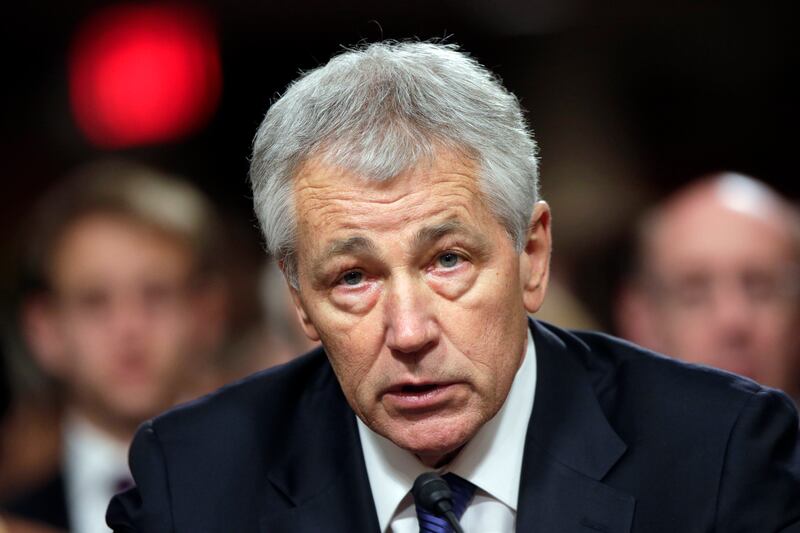
Why did Chuck Hagel perform so poorly before the Senate Armed Services Committee Thursday? Perhaps because his Obama administration handlers urged him to be something he’s not. The real Hagel is a curious combination of raw emotion and international relations theory abstraction. On the one hand, he’s known for getting angry, especially when people who know little about the realities of war imply that he’s not tough enough on America’s foes. Knowing that, Hagel’s former Republican colleagues were clearly hoping to goad him into some kind of eruption. Tennessee’s Bob Corker had already warned that Hagel’s “overall temperament” would be an issue at the hearings.
All nominees are warned not to allow their hearings to turn combative, but a source close to Hagel suggests that the staffers prepping Hagel were particularly adamant on this score: “They expected [Jim] Inhofe, [John] McCain, and especially [Ted] Cruz to come after him, and they said, ‘Be a tank—don’t rise and attack back.’” An aide involved in the Hagel preparations says that’s overblown, but acknowledges that it was made clear that as a nominee, Hagel could not allow himself to be drawn into the kind of feisty exchange that Hillary Clinton had with Wisconsin Republican Ron Johnson during last month’s hearings on Benghazi. This was considered particularly important in winning over those relatively moderate Senate Republicans like Tennessee’s Lamar Alexander and Alaska’s Lisa Murkowski, who, administration aides believe, like Hagel personally and can be convinced to vote for him, or at least to oppose a Republican filibuster.
The problem is that Hagel is quite compelling when he’s mad. I suspect that’s part of why Obama chose him in the first place, because Obama is himself mad that he was pressured by the military brass and by congressional Republicans into sending more troops to the lost cause that is the Afghan War. And Obama wants someone to push back, hard, if Benjamin Netanyahu and his friends in the GOP try to pressure him the same way on Iran.
At the hearing, however, under instruction not to show too much emotion, Hagel sounded like Obama in the first debate: lethargic, unfocused, disassociated from his own words. To make matters worse, says the source close to Hagel, the White House also worried about Hagel being too professorial. Given his penchant for quoting George Kennan, or at least Thomas Friedman, and saying things like “borderless challenges will require borderless solutions,” Hagel’s handlers reportedly advised him not to wax theoretical about the broad direction of American foreign policy. In particular, they worried that Hagel would justify his past views—in particular his concern about the overreliance on American military power and his belief that Israel bears some of the blame in the Israeli-Palestinian dispute—in a way that allowed Republicans to draw a distinction with Obama’s public statements. “Republicans wanted to crystallize and make distinct his views and show the distance between his views and Obama’s,” says the source. “Hagel didn’t want to do that.”
This too may have made sense on paper. But in practice, Hagel’s effort to avoid both a fight and a lengthy discussion of his personal views kept him from effectively explaining his past statements. Staffers involved in the nomination process suggest that Hagel spent much of his preparation time on the less politically contentious issues—weapons acquisitions, post-traumatic stress disorder, Afghanistan, cyber warfare—that defense secretaries actually focus on. But when the Republicans went after Hagel, again and again, on his past statements about Iran and Israel, Hagel appeared so worried that defending those statements might create distance between his views and the administration’s that he often did little more than mutter that he had been wrong.
If the aim of the hearings was simply to make sure Hagel gets confirmed, all this may not matter very much. After the hearings, three important Senate Democrats—New York’s Kirsten Gillibrand, Connecticut’s Richard Blumenthal, and Colorado’s Mark Udall—said they would support Hagel. And if the Democrats hold firm, as it appears they will, it’s unlikely the Republicans will be able to mount an effective filibuster. But if the aim of the hearings was also to begin building a case for Obama’s second-term foreign policy—a foreign policy that brings military spending into balance with economic resources and aggressively pursues diplomacy with Iran, and maybe Israel and the Palestinians too—Hagel failed. And if he continues to fail as a foreign-policy spokesman once confirmed, that second-term agenda will be harder to achieve.