
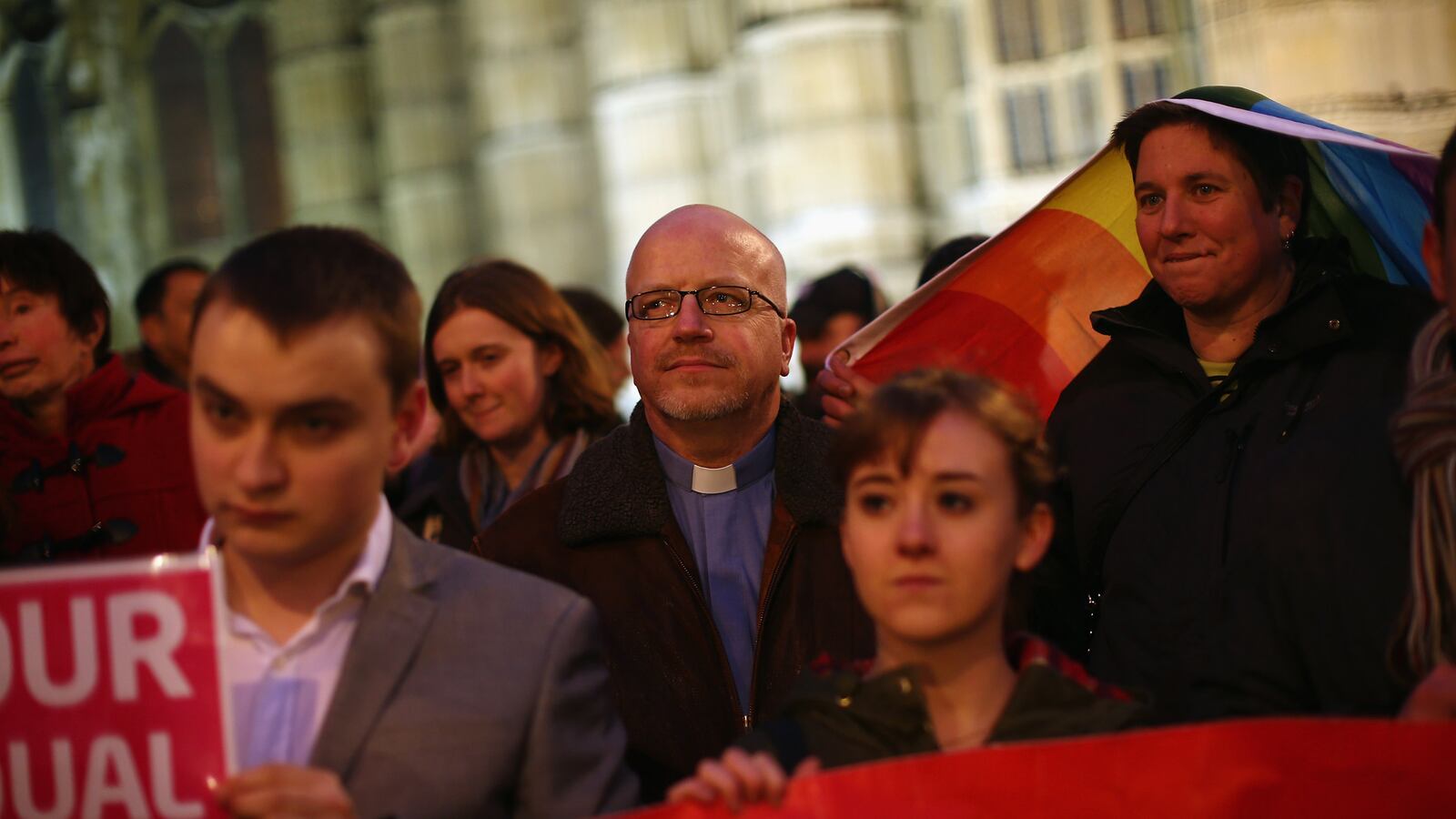
When the British House of Commons voted in favor of gay marriage on Tuesday, many on both sides of the Atlantic wondered: how did the U.K., which often lags behind the U.S. on civil liberties, manage to steal another march on gay rights?
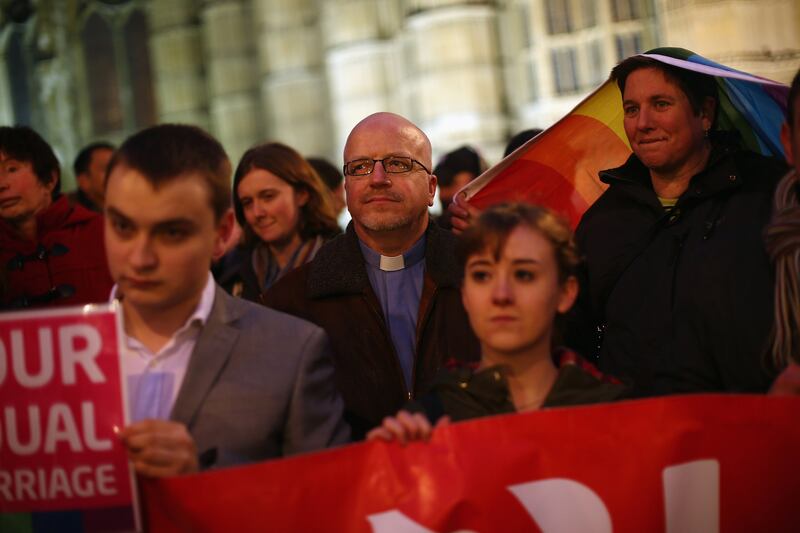
Although it was the Labour government that created landmark legislation recognizing same-sex marriage in civil and legal terms nine years ago, Tuesday’s vote was noteworthy because it was the Conservative leadership that introduced the new bill. In the end, 217 Labour and 44 Liberal Democrats joined 126 Conservatives members of Parliament in the “ayes.” By a slender majority, most Tories voted with the “Noes”—but there was no big interparty rebellion. And, most importantly, senior conservatives in the cabinet backed Prime Minister David Cameron, with Foreign Secretary William Hague and George Osborne, chancellor of the Exchequer, expressing open support before the debate even began.
“Marriage has evolved over time,” they wrote in a joint letter to The Daily Telegraph. “We believe that opening it up to same-sex couples will strengthen, not weaken, the institution. As David Cameron has said, we should support gay marriage not in spite of being Conservatives, but because we are Conservatives.”
And, in one of the most powerful speeches of the debate, Conservative M.P. Mike Freer explained how being elected to Parliament in 2010 was his “second proudest” moment: the proudest was his civil partnership in 2007 to his partner of 21 years. “I say to my colleagues,” Greer said in an impassioned plea to his fellow Tory backbenchers: “I sit alongside them in Committee, in the bars and in the Tea Room, and I queue alongside them in the Division Lobby, but when it comes to marriage, they are asking me to stand apart and to join a separate queue.”
Admittedly, the bill doesn’t amend existing legislation in major ways, and it still requires a vote in the House of Lords before becoming law. But it was a hugely symbolic—and culturally significant—vote, as it allows religious institutions to recognize gay marriage. No church will be compelled to do so, and religious organizations can opt out, but including same-sex partnerships in the religious concept of marriage is a profound cultural change.
The adoption of gay rights as a Conservative cause is not an entirely new phenomenon. Before she had moved to the right on social matters, the great icon of British conservatism, Margaret Thatcher, voted for the decriminalization of homosexuality in 1967.
To Damian Barr, a journalist and author of the forthcoming book about Thatcher’s impact on a gay young man growing up in the ’80s and ’90s, Maggie & Me, the success of the same-sex-marriage bill “is actually a profoundly conservative moment.” “Thatcher believed in including more and more people in traditional institutions,” he told the Daily Beast. “Support for equal rights actually underpins the institution of marriage.”
Given the close relation between Thatcher and Reagan and conservative policies on both sides of the Atlantic, the landmark vote on same-sex marriage leaves open the question whether such a shift is possible on the right of U.S. politics.
One salient difference between the U.S. and U.K. is the level of religious observance. The 2011 U.K. census showed 25 percent of the population describing themselves as “atheists” and only 57 percent calling themselves “Christian” compared with 6 percent nonbelievers and 73 percent Christian in a recent Pew Poll of the U.S. Since recognition of “marriage” is fraught with religious implications, this could explain the discrepancy in legislative support.
During the daylong debate, the religious implication seemed to motivate many of the 175 who voted against the bill. One of the most contentious no-votes came from the Liberal Democrat M.P. Sarah Teather. In a personal statement Teather explained her no-vote was finely balanced based on her beliefs as “lifelong liberal and committed Catholic.”
But religion didn’t explain all the votes. All six of the Muslim Labour M.P.s voted in favor of marriage equality. David Lammy, a prominent Black Labour M.P. for Tottenham and devout evangelical Christian, argued that the Christian message of compassion meant he could only vote in favor. “The Jesus I know was born a refugee, illegitimate, with a death warrant on his name, in a barn,” Lammy told a packed chamber. “He would stand up for minorities, and that is why it is right for those who are of religious conviction to vote for this bill.”
For Barr the rift between Britain and the U.S. is less about of religious belief than political polarization. “In America gay rights are seen as a minority issue for a single interest group,” he said. “Equal-rights activists could learn from the British example by trying to reach out to their conservative opponents.”
Elsewhere in Europe, support for same-sex marriage varies enormously. Catholic Spain and Portugal voted for equality in 2005 and 2010 respectively. However, despite a long history of secularism and anti-clericalism, France is experiencing a fractious and divisive debate about gay marriage. Only two M.P.s from the majority right-wing opposition party, UMP, support the marriage equality bill now before the National Assembly.